- QUICK ANSWER
The right AI certification depends on your role, current skill level and career goals. Choose a programme that delivers practical, hands-on learning, recognised credentials and skills you can apply in the workplace. Before enrolling, compare the course content, prerequisites, duration and fees to ensure it meets your learning needs.
AI is becoming part of everyday work across marketing, management, design, data and software development. As more professionals look to build AI skills, choosing the right certification has become increasingly challenging.
Some AI certification programmes focus on practical workplace applications and can be completed in just a few days. Others require programming, mathematics and technical knowledge, with learning paths that span several months.
This guide compares 16 local and international programmes across four learner profiles. Rather than recommending a single option for everyone, it helps you choose an AI certification that matches your role, skill level, budget and career goals.
Also read: Best AI courses in Singapore
Best AI Certifications for Non-Technical Roles
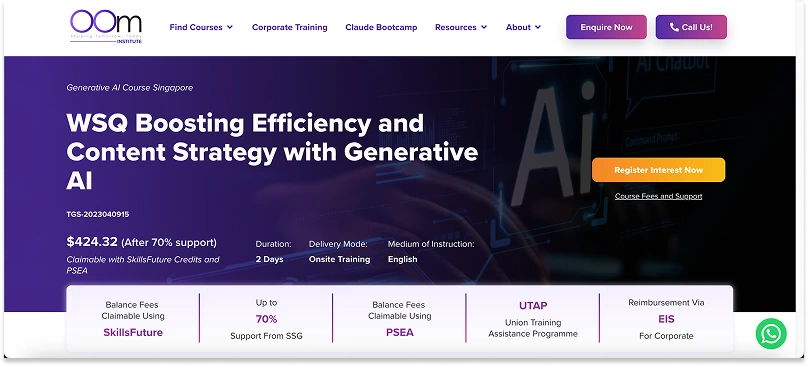
01 Boosting Efficiency & Content Strategy with Generative AI
| Details | Information |
| What this course covers | Prompt writing, market research, content planning, campaign ideation, AI hallucination checks, agentic AI and responsible AI use. |
| Best suited for | Marketers, business owners, managers, content professionals and jobseekers who want to use generative AI at work. |
| Technical level | Beginner to intermediate. No coding is required. |
| Prerequisite | Basic computer skills and the ability to communicate in English. |
| Fee | S$1,088 before support. The nett fee is S$641.92 after 50% support or S$424.32 after 70% support, including GST, for eligible learners. |
| Duration | 2 days |
| Provider | OOm Institute |
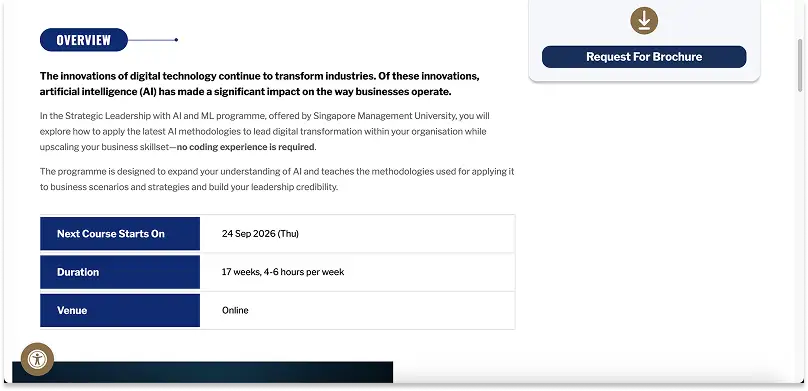
02 Strategic Leadership with AI and ML
| Details | Information |
| What this course covers | AI and machine learning use cases, opportunity assessment, implementation planning, deployment, governance, ethics and data privacy. |
| Best suited for | Senior managers, functional leaders and transformation teams responsible for planning or overseeing AI adoption. |
| Technical level | Intermediate business level. The course focuses on strategy rather than programming. |
| Prerequisite | No formal technical prerequisite is stated, although professional or leadership experience is useful. |
| Fee | US$2,200, excluding applicable taxes. |
| Duration | 14 weeks online, with an estimated commitment of 4 to 6 hours per week. |
| Provider | Singapore Management University Executive Development |
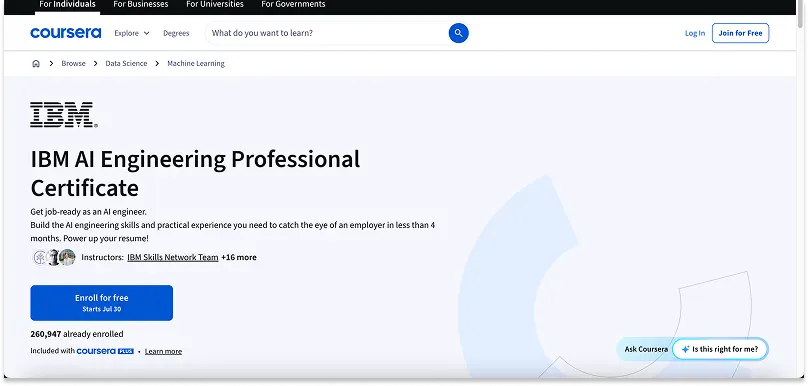
03 IBM AI Engineering Professional Certificate
| Details | Information |
| What this course covers | Machine learning, deep learning, Apache Spark, TensorFlow, PyTorch, large language models, retrieval-augmented generation, Hugging Face and LangChain. |
| Best suited for | Learners who want to move towards AI engineering, machine learning engineering or technical data roles. |
| Technical level | Intermediate. It is considerably more technical than a workplace-focused generative AI course. |
| Prerequisite | Basic Python skills and some familiarity with data analysis or machine learning are recommended. |
| Fee | Included with Coursera Plus. Subscription fees vary by location and billing plan. |
| Duration | About 4 months when studying for approximately 10 hours per week. |
| Provider | IBM through Coursera |
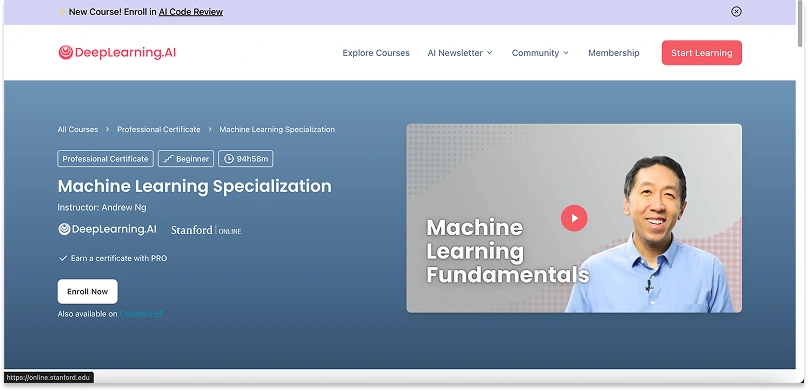
04 Machine Learning Specialisation
| Details | Information |
| What this course covers | Supervised and unsupervised learning, neural networks, decision trees, recommender systems, TensorFlow and practical machine learning with Python. |
| Best suited for | Analysts and professionals who want a technical foundation before pursuing more advanced machine learning training. |
| Technical level | Beginner technical level. The programme is accessible to new learners but includes programming exercises. |
| Prerequisite | No previous machine learning experience is required, although basic coding knowledge will make the content easier to follow. |
| Fee | US$25 per month with annual billing or US$30 on a month-to-month plan. |
| Duration | About 95 hours across 3 courses. |
| Provider | DeepLearning.AI through Coursera |
If you want to apply AI in your current role, a practical workplace-focused Generative AI course is usually enough to get started. More technical certifications are a better fit for those pursuing careers in software development, machine learning or AI engineering.
Best AI Certifications for Career Switchers
Not every career switch requires the same level of technical knowledge. Some programmes are designed to help professionals apply AI in business settings, while others prepare learners for technical roles involving software development, machine learning and AI engineering.
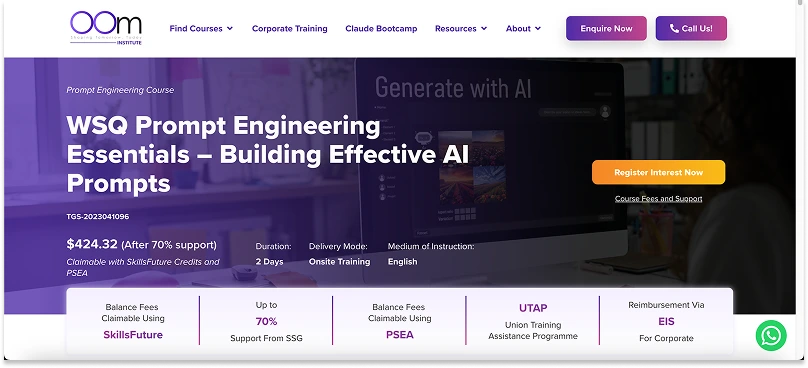
01 Prompt Engineering Essentials: Building Effective AI Prompts
| Details | Information |
| What this course covers | Prompt frameworks, priming, prompt optimisation, market research, SWOT analysis, brand voice development, content strategy and responsible AI use. |
| Best suited for | People entering AI-enabled marketing, administration, human resources, communications or content roles. |
| Technical level | Beginner. The course focuses on using AI tools rather than programming them. |
| Prerequisite | Basic computer skills and the ability to communicate in English. No coding experience is required. |
| Fee | S$1,088 before support. The nett fee is S$641.92 after 50% support or S$424.32 after 70% support, including GST, for eligible learners. |
| Duration | 2 days. |
| Provider | OOm Institute |
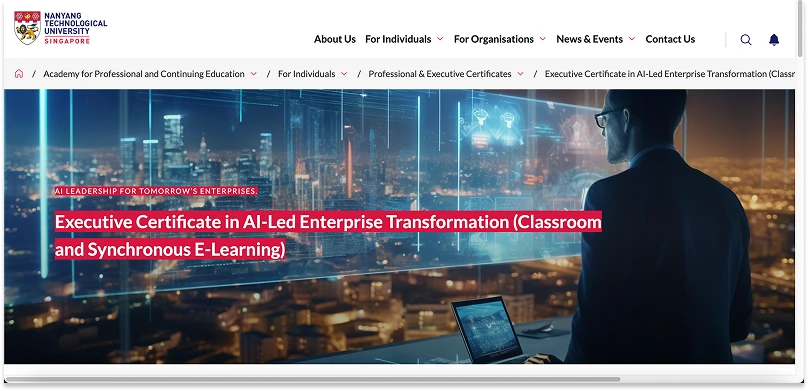
02 Executive Certificate in AI-Led Enterprise Transformation
| Details | Information |
| What this course covers | >AI strategy, generative AI, agentic AI, no-code automation, workflow redesign, governance and methods for creating business value with AI. |
| Best suited for | Managers, consultants, entrepreneurs and professionals moving into digital transformation or AI strategy roles. |
| Technical level | Intermediate business level. Programming is not the central focus. |
| Prerequisite | No formal academic prerequisite is stated, although professional experience is expected. |
| Fee | S$6,000 before GST. Eligible subsidised fees start from S$2,340. |
| Duration | 6 days or 42 training hours. |
| Provider | Nanyang Technological University PaCE |
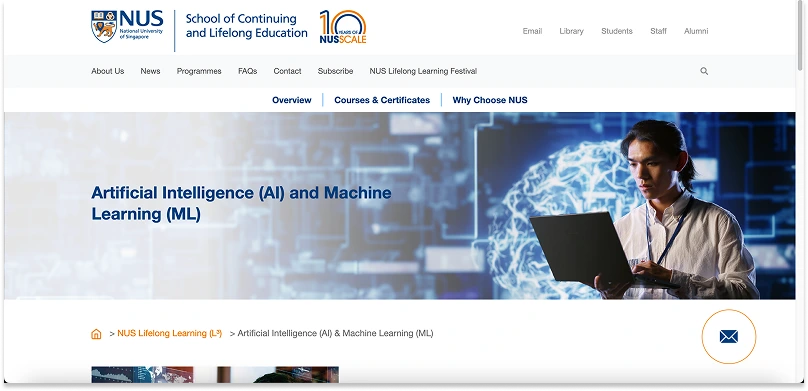
03 Professional Certificate in Artificial Intelligence & Machine Learning Foundation for Executives
| Details | Information |
| What this course covers | AI and machine learning foundations, business transformation, operational applications, responsible adoption, ethics and governance. |
| Best suited for | Executives, advisers, analysts and professionals moving into business transformation or AI-related decision-making roles. |
| Technical level | Beginner to intermediate business level. |
| Prerequisite | Applicants should hold at least a polytechnic diploma. |
| Fee | From S$2,437.50 after eligible funding. The listed fee for international participants is S$6,812.50. |
| Duration | 7 days. |
| Provider | NUS School of Computing Executive Education |
* NUS has indicated that parts of its professional certificate portfolio are being refreshed or phased out, although course dates were still displayed after June 2026. Confirm availability before applying.
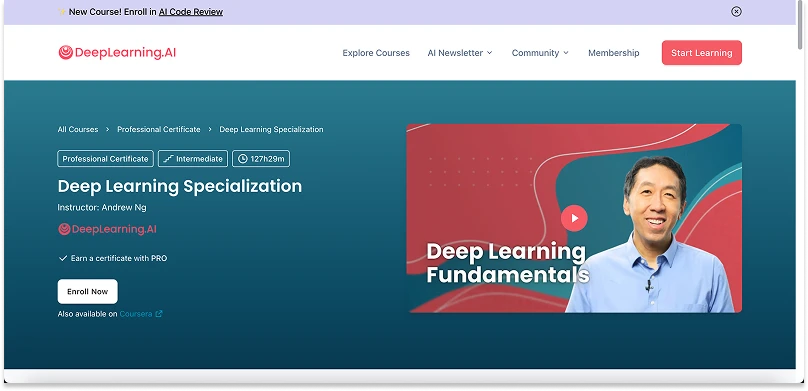
04 Deep Learning Specialisation
| Details | Information |
| What this course covers | Neural networks, model optimisation, convolutional neural networks, sequence models, transformers, computer vision, natural language processing and TensorFlow. |
| Best suited for | Aspiring machine learning engineers, software developers and career switchers targeting technical AI roles. |
| Technical level | Intermediate technical level. |
| Prerequisite | Intermediate Python knowledge is expected. Basic linear algebra and machine learning concepts are also recommended. |
| Fee | US$25 per month with annual billing or US$30 on a month-to-month plan. |
| Duration | About 127 hours across 5 courses. |
| Provider | DeepLearning.AI through Coursera. |
If you are still exploring how AI fits into your career, a practical prompt engineering course can provide a manageable introduction before progressing to more advanced or technical programmes.
Best AI Certifications for Digital Marketers and Content Creators
For digital marketers and content creators, the most valuable AI skills are those that can be applied immediately. Look for programmes that cover research, ideation, design, content production, video creation and campaign performance.
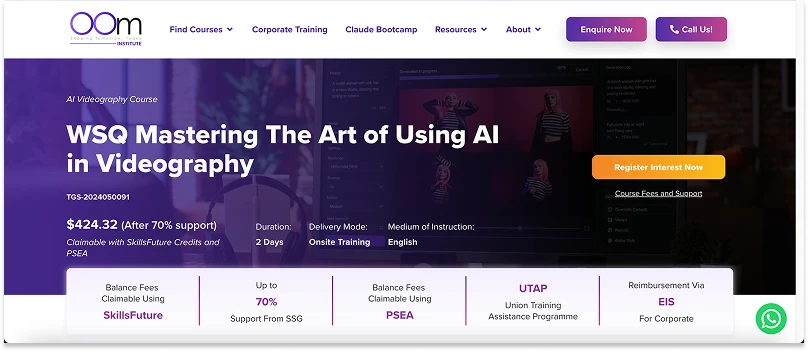
01 Mastering the Art of Using AI in Videography
| Details | Information |
| What this course covers | Storyboarding, concept art, AI image and video generation, AI music, digital avatars, editing and post-production workflows. |
| Best suited for | Marketers, entrepreneurs, social media creators and visual storytellers who want to produce video content with AI. |
| Technical level | Beginner to intermediate. No programming is required. |
| Prerequisite | Basic computer skills and English. Previous videography experience is not required. |
| Fee | S$1,088 before support. The nett fee is S$641.92 after 50% support or S$424.32 after 70% support, including GST, for eligible learners. |
| Duration | 2 days |
| Provider | OOm Institute |
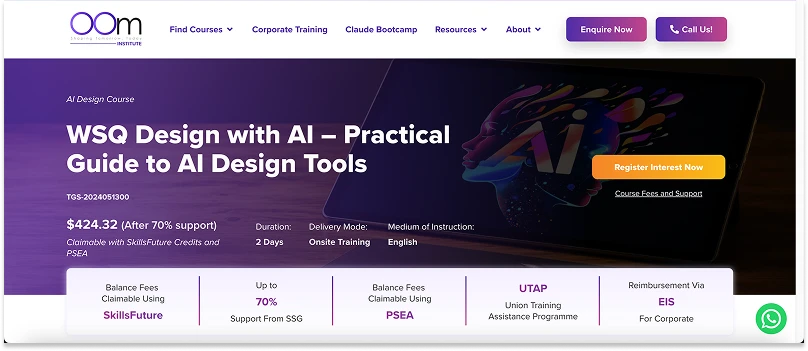
02 Design with AI: Practical Guide to AI Design Tools
| Details | Information |
| What this course covers | Visual communication, digital asset capture, image prompting, AI image generation, image manipulation, layouts and graphic creation. |
| Best suited for | Designers, marketers, freelancers, business owners and content creators who want to use AI in visual production. |
| Technical level | Beginner. The course focuses on practical design tools rather than coding. |
| Prerequisite | Basic computer skills and English. Previous AI or professional design experience is not required. |
| Fee | S$1,088 before support. The nett fee is S$641.92 after 50% support or S$424.32 after 70% support, including GST, for eligible learners. |
| Duration | 2 days |
| Provider | OOm Institute |
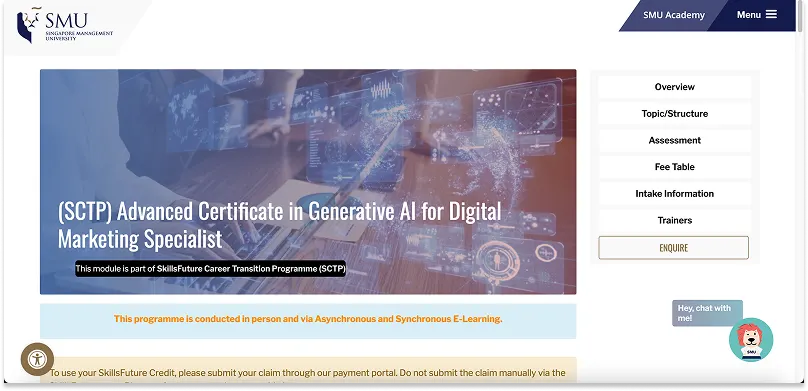
03 Advanced Certificate in Generative AI for Digital Marketing Specialist
| Details | Information |
| What this course covers | Digital marketing fundamentals, SEO, content creation, email marketing, analytics, personalisation, social media, landing pages, generative AI and a capstone project. |
| Best suited for | Career switchers seeking junior digital marketing roles and professionals who need broader digital marketing training. |
| Technical level | Beginner to intermediate. It combines marketing fundamentals with applied AI tools. |
| Prerequisite | Applicants must be Singapore citizens, permanent residents or LTVP+ holders aged 21 or above. Other programme eligibility requirements apply. |
| Fee | S$20,928 before support. The fee may be as low as S$1,478.40 for learners who qualify for the applicable funding. |
| Duration | 320 hours over approximately 3 months. |
| Provider | SMU Academy. |
* NUS has indicated that parts of its professional certificate portfolio are being refreshed or phased out, although course dates were still displayed after June 2026. Confirm availability before applying.
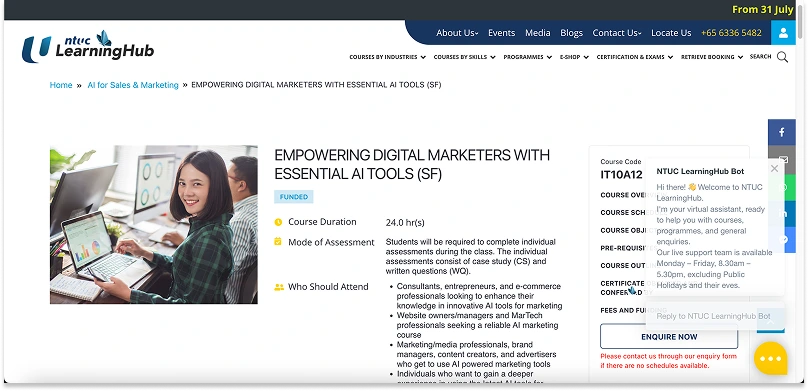
04 Empowering Digital Marketers with Essential AI Tools
| Details | Information |
| What this course covers | AI-assisted market research, content creation, visual production, landing pages, advertisements, analytics and the selection of suitable AI tools. |
| Best suited for | Digital marketers, SME owners, consultants and entrepreneurs who want to add AI to existing marketing workflows. |
| Technical level | Beginner. |
| Prerequisite | No formal prerequisite is stated, although basic digital marketing knowledge will help. |
| Fee | Learners should check NTUC LearningHub for the current course fee. SkillsFuture support may apply to eligible participants. |
| Duration | 3 days or 24 training hours. |
| Provider | NTUC LearningHub |
If your work involves video production, a practical videography course can help you integrate AI into every stage of the creative process. If you focus on visual branding, social media graphics or marketing assets, learning about AI in graphic design may be a better fit.
Best AI Certifications for Advanced Developers and Engineers
Developers and engineers should look for certifications that build technical skills beyond prompt writing. The most relevant programmes cover machine learning, model development, deployment, evaluation, cloud platforms and the practical use of AI in production environments.
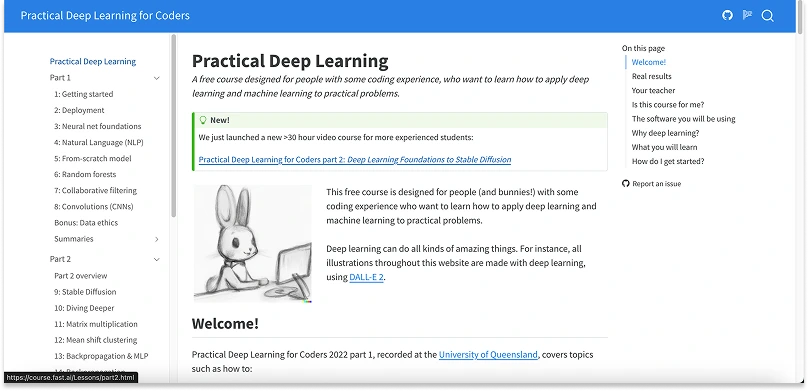
01 Practical Deep Learning for Coders
| Details | Information |
| What this course covers | Computer vision, natural language processing, tabular models, collaborative filtering, model deployment, PyTorch, fast.ai and Hugging Face. |
| Best suited for | Programmers who want hands-on experience building and training deep learning models. |
| Technical level | Intermediate to advanced. |
| Prerequisite | About one year of coding experience, preferably with Python, and secondary-school mathematics. |
| Fee | Free. No formal paid certification is stated. |
| Duration | Part 1 contains 9 lessons of about 90 minutes each. Part 2 contains more than 30 hours of material. |
| Provider | fast.ai |
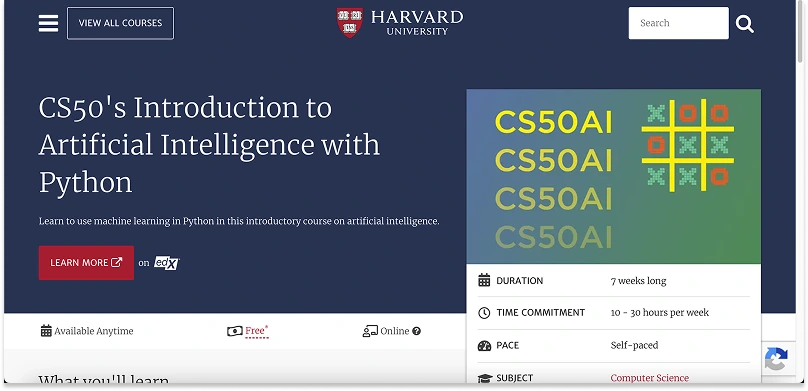
02 CS50’s Introduction to Artificial Intelligence with Python
| Details | Information |
| What this course covers | Search algorithms, optimisation, classification, machine learning, reinforcement learning, neural networks and AI programming with Python. |
| Best suited for | Developers and computer science learners seeking a rigorous, project-based introduction to artificial intelligence. |
| Technical level | Intermediate. |
| Prerequisite | Previous Python or general programming experience is recommended. |
| Fee | Free to audit. A verified certificate costs US$299. |
| Duration | 7 weeks, with an estimated commitment of 10 to 30 hours per week. |
| Provider | Harvard University through edX |
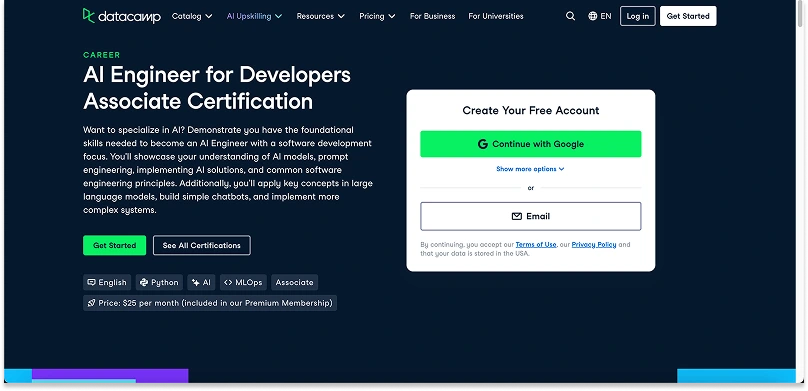
03 AI Engineer for Developers Associate
| Details | Information |
| What this course covers | Large language model applications, prompt development, chatbots, model use, Python development, software engineering practices and AI governance. |
| Best suited for | Software developers moving into applied AI engineering and LLM application development. |
| Technical level | Associate to intermediate. |
| Prerequisite | Python knowledge and basic software development skills. |
| Fee | Included with DataCamp Premium, listed at US$25 per month. |
| Duration | A 30-day certification window, supported by a 29-hour preparation track and certification assessments. |
| Provider | DataCamp |
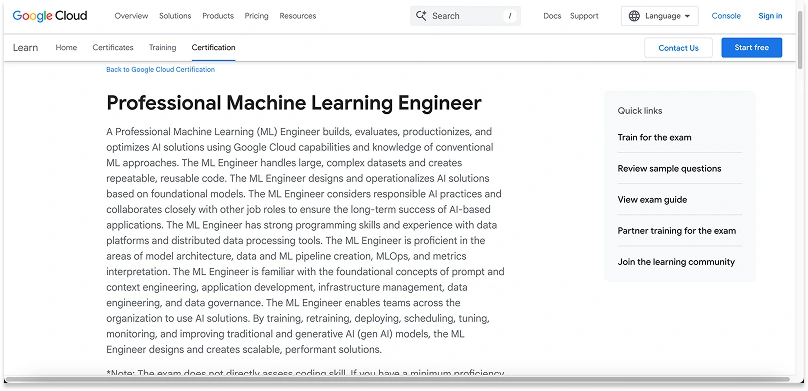
04 Google Cloud Professional Machine Learning Engineer
| Details | Information |
| What this certification covers | Machine learning architecture, generative AI, model serving, scaling, pipelines, monitoring, MLOps, governance and Google Cloud services. |
| Best suited for | Experienced machine learning engineers, cloud engineers and technical professionals working with Google Cloud. |
| Technical level | Advanced. |
| Prerequisite | No formal prerequisite is required. Google recommends 3 years of industry experience, including at least 1 year designing and managing solutions on Google Cloud. |
| Fee | US$200, excluding applicable taxes. |
| Duration | The examination lasts 2 hours. Preparation time depends on the candidate’s existing experience. |
| Provider | Google Cloud |
Most of these certifications assume some programming knowledge and are designed for technical career pathways. If you are new to AI or work in a non-technical role, consider building practical AI skills before progressing to these programmes.
How to Choose the Right AI Certification
Evaluate your career goals
Choose the Right Tier and Domain
Consider Industry Recognition and Overall Value
Look Beyond the Certificate
I. Evaluate Your Career Goals
Start by identifying how you plan to use AI in your work. The skills needed by a marketer creating content or automating campaigns are very different from those required by an AI engineer building machine learning models.
Rather than choosing the most recognised certification, focus on one that aligns with your intended role and the skills you want to develop.
II. Choose the Right Tier and Domain
AI certifications range from beginner workplace courses to advanced technical programmes.
- Beginner: Generative AI tools, prompt engineering and workplace productivity.
- Intermediate: AI applications for marketing, analytics, business transformation and software development.
- Advanced: Machine learning, model development, deployment and MLOps.
It is equally important to choose the right domain. A course on AI video production, for example, is unlikely to prepare you for cloud engineering, just as a machine learning certification may offer limited value to someone working primarily in content marketing.
III. Consider Industry Recognition and Overall Value
A recognised certification can strengthen your CV, but reputation alone should not determine your decision. Compare the overall investment, including the cost of the AI course, examination fees, software subscriptions and the time required to complete the programme.
Most importantly, consider what you will gain by the end of the course. Practical outcomes, such as a portfolio, automated workflow, marketing campaign or deployed AI application, often provide greater long-term value than the certificate itself.
IV. Look Beyond the Certificate
Many employers place greater emphasis on practical skills than on qualifications alone. Review job advertisements in your target industry and identify the tools, technologies and competencies that appear most frequently.
For technical roles, employers may prioritise Python, cloud platforms and machine learning experience. Business and marketing roles are more likely to value prompt engineering, workflow automation and AI-assisted content creation. Choosing a certification that helps you demonstrate these skills will usually provide the greatest return on your investment.
AI Certification vs AI Course: What Is the Difference?
Although the terms are often used interchangeably, an AI certification and an AI course are not always the same thing.
| AI Certification | AI Course |
| Usually includes an assessment, examination or graded project | Focuses on developing specific knowledge or practical skills |
| Awards a recognised credential upon successful completion | May provide a certificate of completion or attendance |
| Typically follows a structured competency framework | Often offers greater flexibility in content and duration |
| Commonly used to support career progression or professional recognition | Suitable for building practical skills or exploring a new topic |
| May require prior knowledge or work experience | Often designed to accommodate beginners |
The distinction is not always straightforward.
Many AI courses include formal assessments and award recognised credentials on completion. In Singapore, approved WSQ courses may also lead to a SkillsFuture Singapore Statement of Attainment for learners who successfully meet the required competency standards.
Ultimately, the better option depends on your objective.
If you need recognised credentials for career progression or a career change, an AI certification may be more appropriate. If your goal is to develop practical skills that you can apply immediately at work, an AI course may provide a faster and more flexible learning path.
Do You Actually Need an AI Certification?
The answer depends on your career goals, current experience and how you plan to use AI. While a certification can strengthen your CV, it is not always the most important factor when employers assess your capabilities.
Yes, if an AI certification is worth considering if you are changing careers, applying for roles that require a recognised credential, or looking for a structured way to develop new skills. It can also be valuable if you prefer guided learning with assessments, instructor support and clearly defined milestones, or if your employer requires formal training as part of workforce development.
AI Certification may not be necessary if you only need to learn a specific AI tool or solve a particular workplace challenge. Professionals with relevant experience or a strong portfolio of AI projects may also find that practical results carry more weight than an additional qualification.
Likewise, there is little value in earning a credential if the skills taught are unrelated to your career goals or are unlikely to be applied in your work.
AI Certification vs AI Skills
AI certification demonstrates that you have completed a programme or met a recognised assessment standard. It does not, however, prove that you can apply AI effectively in real-world situations.
Employers increasingly look for practical evidence of capability.
A marketer should be able to use AI to research, create and refine content, while a developer should understand how to build, evaluate and deploy AI solutions. The strongest candidates combine recognised learning with hands-on experience, practical projects and measurable results.
How OOm Institute Approaches AI Certification and Training
The right AI certification is not necessarily the most technical or expensive one. It is the programme that equips you with skills you can apply confidently in your role and supports your long-term career goals.
OOm Institute offers courses in generative AI, prompt engineering, AI videography and AI-supported design, with a strong emphasis on practical workplace applications. Rather than focusing solely on theory, learners develop hands-on skills through guided exercises, real-world scenarios and competency-based assessments. Eligible learners who complete an approved WSQ programme may also receive a WSQ Statement of Attainment.
When comparing the best AI course in Singapore, consider more than the provider or certificate. Look at the skills you will gain, how they relate to your work and whether you can apply them immediately after completing the course.
Explore OOm Institute’s AI courses to find a learning path that matches your career goals and the way you plan to use AI in your work.
Frequently Asked Questions
1. Is there a WSQ AI certification in Singapore?
Yes. Several AI courses in Singapore follow the WSQ framework, including programmes in generative AI, prompt engineering, AI videography and AI-supported design. Learners who successfully complete the required assessments may receive a WSQ Statement of Attainment.
2. Is an AI certification enough to become an AI engineer?
Not on its own. AI engineering typically requires programming, machine learning, data handling and hands-on experience building or deploying AI applications. A certification provides a strong foundation, but practical projects and technical skills remain essential.
3. What are the top AI certification programmes recognised by employers?
That depends on the role. Cloud certifications are often valued for platform-specific engineering positions, while university programmes and certifications from recognised providers such as IBM and DeepLearning. AI can demonstrate structured learning. Employers generally place greater emphasis on relevant skills and practical experience than on the certificate alone.
4. Are there SkillsFuture-supported AI courses in Singapore?
Yes. Many approved AI courses are eligible for SkillsFuture funding. The level of support depends on factors such as your citizenship, age and the specific course, so it is worth checking the latest eligibility criteria before enrolling.
5. Should I choose a global AI certification or a local AI course?
Choose a global certification if you need platform-specific or internationally recognised credentials. A local AI course may be a better option if you want classroom-based learning, Singapore-focused examples or access to SkillsFuture funding. The right choice depends on your career goals.
6. What should I learn before pursuing an AI certification?
It depends on the programme. Beginner courses often require only basic computer skills, while technical certifications may expect knowledge of Python, statistics, algebra or machine learning concepts. Always review the prerequisites before enrolling.
7. How long does it take to complete an AI certification?
Some workplace-focused programmes can be completed in just a few days, while online specialisations and professional certificates may take several weeks or months. Examination-based certifications may also require additional preparation beyond the assessment itself.
8. How do I sign up for an AI course at OOm Institute?
Visit the course page, review the schedule, entry requirements and available funding support, then submit the registration form. The OOm Institute team can also assist with course selection, registration and funding enquiries for eligible learners.