
- Key Takeaways
- Anyone whose work shapes how your brand is found needs to understand AI search.
- SEO and digital marketing teams need the deepest knowledge, because they have to track and improve how the brand shows up in AI Overviews, AI Mode, and ChatGPT as well as in rankings.
- Copywriters, developers, designers, and PR teams need to understand how their own work affects whether AI tools can find, read, and cite your content.
- Each role needs a different depth. The aim is to train people to the level their decisions call for, not to make everyone an SEO specialist.
Not Everyone in Your Company Needs the Same SEO Training
Ask most companies who needs SEO training, and they’ll point to the marketing team.
But search visibility is shaped by far more people than that. A copywriter decides whether a page answers what someone searched for. A developer can make that page unindexable. Your PR team influences what the rest of the internet says about you.
AI search spreads this even wider. With AI Overviews, AI Mode, and tools like ChatGPT, your brand is either mentioned in the answer or it isn’t, and the decisions behind that sit across your whole team.
That doesn’t mean everyone needs the same training. It helps to think of your team in three groups.
- People who own SEO and need to carry out the work themselves.
- People whose work influences SEO, even though search isn’t their main responsibility.
- People who approve SEO-related decisions, budgets, priorities, or website changes.
Each group needs a different depth of knowledge. Here’s what each one should learn.
Who Should Be Able to Actually Perform SEO?
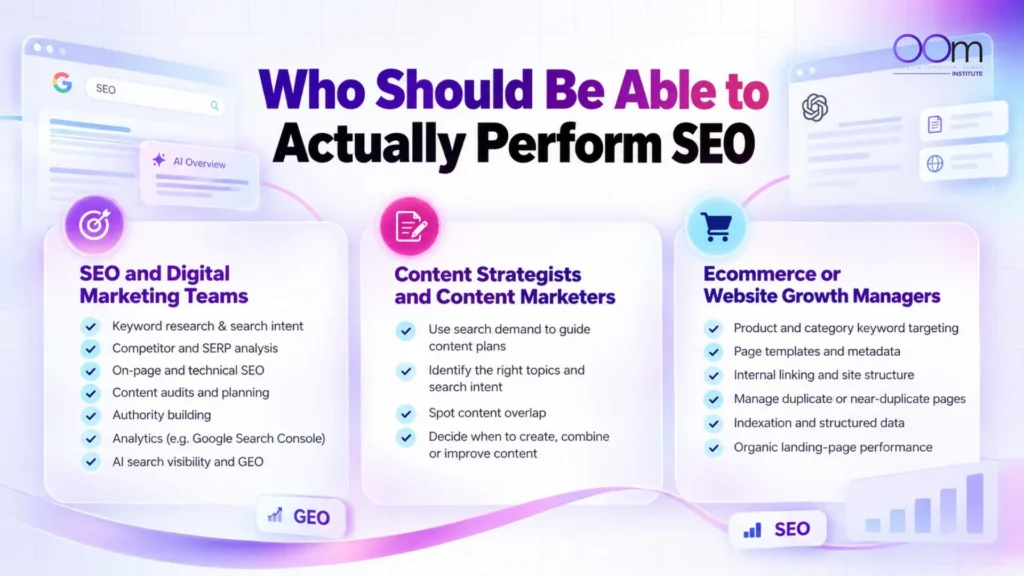
These roles make optimisation decisions themselves, work with search data, and are expected to figure out what’s wrong when something underperforms.
A. SEO and Digital Marketing Teams
If SEO or organic search is part of your core responsibility, you need the broadest range of skills. That usually includes:
- Keyword research and search intent analysis
- Competitor and search-result analysis
- On-page optimisation
- Technical SEO fundamentals
- Internal linking
- Content audits and planning
- Off-page SEO and authority building
- Google Search Console and analytics
- AI search visibility and GEO
- Using the best AI SEO tools for the right tasks
The main change is that you can no longer judge search performance only by looking at ranking positions. The same query might now trigger traditional results, an AI Overview, AI Mode, or an answer from another AI search platform. That means you also need to understand where your content is being discovered, whether your brand is being referenced, and how visibility differs across these search experiences.
For example, a page may rank reasonably well in Google but still have limited visibility in AI-generated answers. That gives you a different problem to investigate than a simple ranking drop.
B. Content Strategists and Content Marketers
If you decide what your company publishes, you influence SEO before a writer even starts drafting.
You need to understand how search demand should shape the content plan. That includes deciding which topics deserve their own pages, separating different types of search intent, spotting content overlap, and knowing when an existing page should be improved instead of creating another one.
A common example is keyword planning.
You may find five related keywords in a research tool and assume that you need five separate articles. But once you compare the search results, you may find that four of those terms are really asking the same question.
Creating four near-identical pages can leave you with several pieces of content competing for the same purpose. Good SEO judgement helps you decide when one stronger page makes more sense.
C. Ecommerce or Website Growth Managers
If you manage category pages, product pages, landing pages, site structure, or conversion growth, SEO decisions are already part of your work whether or not they sit in your job title. You may need to understand:
- Product and category keyword targeting
- Page templates and metadata
- Faceted navigation
- Internal linking and site hierarchy
- Duplicate or near-duplicate pages
- Indexation
- Product structured data
- Page experience
- Organic landing-page performance
Take filtered ecommerce pages as an example. Filters can make it easier for shoppers to narrow down products, but they can also generate large numbers of crawlable URLs with very little unique content.
From a usability point of view, the feature may work perfectly. From an SEO point of view, it may create unnecessary duplication or crawl issues.
You do not need to become a technical SEO specialist. You do need enough knowledge to recognise when a website feature, template change, or category decision should involve an SEO review.
Who Needs SEO Because Their Work Influences Search?
Plenty of SEO problems start outside the SEO team. A content edit, a website update, a navigation change, or a PR decision can all change how easily your pages are found.
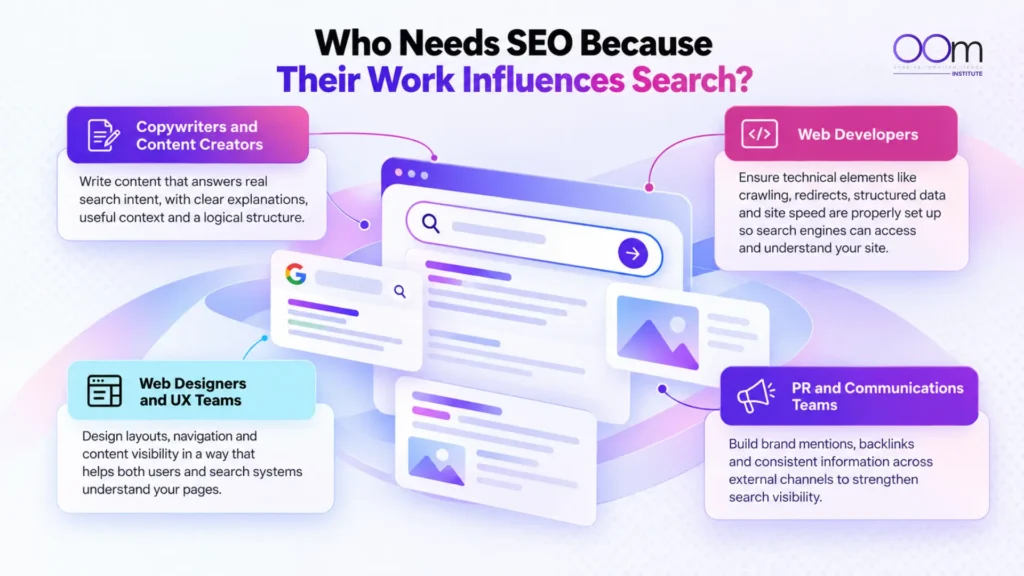
These roles don’t need to perform SEO, but they need to know where their work touches it.
A. Copywriters and Content Creators
If you write website content, SEO should shape your thinking before you start drafting. You should be able to ask:
- What is the reader actually trying to find out or do?
- What is this page supposed to achieve?
- Which questions need to be answered?
- How should the headings guide the reader through the topic?
- What context, examples, and related concepts are needed?
- Which existing pages should this content link to?
- Am I writing something useful, or simply trying to fit in keywords?
One habit we would actively discourage is writing around keywords instead of around intent.
For example, if a brief contains six variations of almost the same phrase, you do not need six separate sentences just to include every version. If they all point to the same search need, one clear explanation can usually cover the topic more naturally.
This matters even more as search becomes more AI-driven. Clear explanations, useful context, and well-structured information are more valuable than repeating phrases for the sake of optimisation.
B. Web Developers
Developers affect whether search engines can access, understand, and index a website properly.
You should have enough SEO knowledge to understand how your work can affect:
- Crawling and indexing
- Redirects
- Canonicalisation
- JavaScript rendering
- Robots directives
- XML sitemaps
- Structured data
- Mobile usability
- Site speed and Core
- Web Vitals
A website migration is a good example. From a development perspective, the new site may launch without any obvious problems.
But if old URLs disappear without redirects, important pages become non-indexable, or settings from a staging site are carried over, organic visibility can be affected even though the website appears to be working normally.
SEO knowledge helps you identify these risks before launch rather than waiting for a traffic drop to reveal them.
C. Web Designers and UX Teams
Design decisions can also affect how easily people and search systems understand a page.
If you work in design or UX, it helps to understand how navigation, page hierarchy, mobile layouts, templates, and content visibility can influence search performance.
Take a homepage redesign as an example. You might reduce the amount of copy to create a cleaner layout and give more space to visual elements. That may improve the appearance of the page, but it can also remove useful information about your services, products, or areas of expertise.
SEO awareness does not mean sacrificing good design. It means considering search implications while the page is still being planned, rather than discovering them after the redesign has gone live.
D. PR and Communications Teams
PR can influence search visibility in ways that are easy to overlook because much of the work happens away from your own website.
You should understand how communications activity can affect:
- Brand and expert mentions
- Consistency of company information
- Expert attribution
- Backlinks and citations
- Source credibility
- Original research and useful reference material
- How your organisation is described across external websites
- This becomes more relevant as people use AI-powered tools to research companies, products, industries, and experts.
An AI-generated answer may draw on information from news coverage, interviews, reports, external websites, and other sources. If your brand is described consistently and your experts are clearly associated with particular areas of knowledge, there is more useful information available for search and AI systems to interpret.
That means PR is no longer completely separate from search. The work you publish and the information others publish about you can both shape how your organisation is discovered online.
Should Every Department Attend the Same SEO Course?
Everyone should share the same foundation, but each role needs a different depth.
What that foundation covers has changed. A corporate SEO course that only teaches how to rank in Google’s traditional results is now teaching half the picture.
Employees still need the fundamentals of how search engines discover, interpret, and rank content. They also need to understand how visibility works across AI Overviews, AI Mode, and AI search tools like ChatGPT and Perplexity, and how brands get surfaced, cited, or left out of AI-generated answers.
You’ll hear a few terms for this newer work.
- AI SEO usually refers to using AI tools to carry out SEO tasks more efficiently.
- Answer engine optimisation (AEO) focuses on structuring content so it can be pulled directly into answers.
- Generative engine optimisation (GEO) is about improving how your brand and content appear in AI-generated responses.
The terms overlap a lot, and in practice most of the work builds on strong SEO rather than replacing it.
The table below shows where each role should focus.
| Role | Needs More Of | Needs Less Of |
| SEO and digital marketing | Keyword research, technical SEO, content strategy, measurement, AI SEO, GEO | Basic explanations of what SEO is |
| Content strategy | Search intent, topic planning, content gaps, AI visibility, internal linking | Deep technical implementation |
| Copywriting | Page purpose, structure, contextual coverage, natural optimisation | >Advanced analytics configuration |
| Developers | Crawlability, indexing, rendering, redirects, schema, site performance | Detailed copywriting techniques |
| UX and design | Architecture, navigation, mobile experience, content visibility | >Advanced keyword research |
| PR and communications | Authority, brand consistency, expert attribution, digital PR, AI discovery | |
| Managers and leaders | Strategy, measurement, resource allocation, risk, agency evaluation | Day-to-day implementation |
This is why the same course can serve several teams. A GEO and SEO course may cover material relevant to everyone in the table, but the takeaway differs. Your SEO specialist applies the techniques directly. Your content team uses them to write better briefs. Your developer leaves knowing which technical decisions affect AI visibility.
💭 Do Managers and Business Leaders Need SEO Training Too?
Yes. You don’t need to do SEO, but you do need to judge it. SEO knowledge helps you choose between competing requests, such as fixing crawl issues or funding more articles. It also stops you misreading reports. When AI Overviews answer a question directly, clicks can fall even though your visibility hasn’t, so a drop in traffic doesn’t always mean SEO has stopped working.
If You Can Only Send a Few Employees, Who Should Go First?
If you can’t train everyone at once, start with the people whose work affects search most directly, and move outward from there.
People directly executing SEO or search-driven marketing.
They’ll apply the training straight away in keyword research, content planning, technical fixes, and reporting.
Frequent SEO influencers.
Content leads, copywriters, developers, ecommerce managers, and whoever manages the website. SEO isn’t their main job, but their decisions shape visibility every week.
Managers who approve SEO decisions.
They don’t need the technical depth. They do need to understand priorities, trade-offs, and why some work needs investment before other initiatives.
Everyone else, only where there's a clear application.
If someone rarely touches the website, content, or search strategy, a full course probably isn’t the best use of their time. A short briefing may be enough.
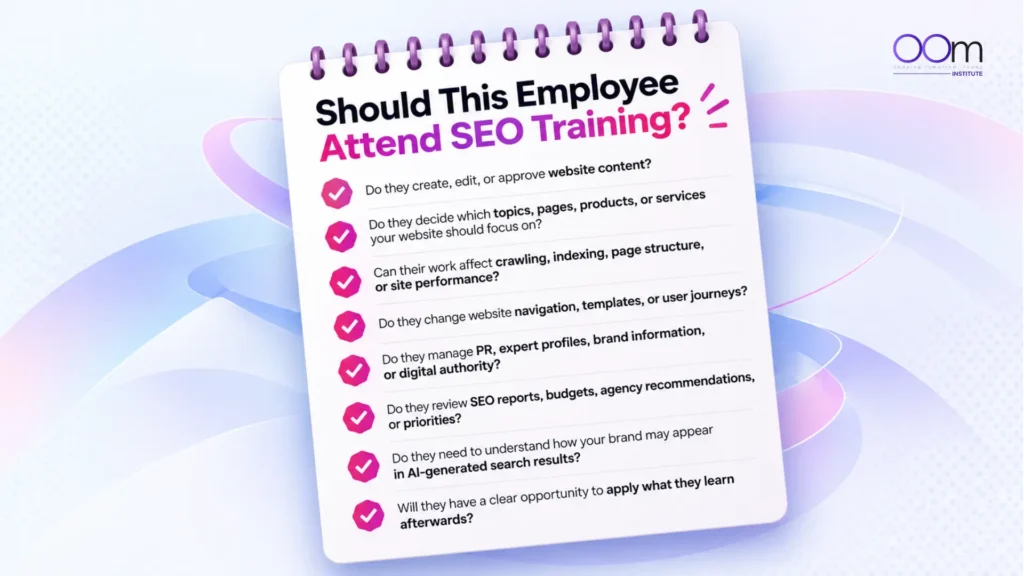
Before sending someone for SEO training, look at the decisions they actually make in their role. Ask:
How Do You Know SEO Training Was Relevant to the Employee?
We wouldn’t judge SEO training by whether rankings improved the week after the course. Rankings depend on competition, algorithm updates, website history, and how quickly changes actually get implemented. A single course can’t control those.
A better test is whether the person now makes better decisions in their own role.
A copywriter pushes back on a brief that forces unnatural keyword repetition. A developer flags that a URL change needs a redirect plan before launch. A content lead spots that two proposed articles are chasing the same search intent. A PR manager notices your company is described inconsistently across media coverage.
Those are the signs that the training matched the job.
In general, look for employees who spot SEO risks before changes go live, can explain why a recommendation matters instead of just following it, work more smoothly with other teams, and ask sharper questions when dealing with an agency.
Build the Right Level of SEO Capability Across Your Team
Search visibility now depends on decisions made across content, development, design, PR, and management, not on one SEO specialist. The practical challenge is closing the gaps between the people who create, build, approve, and measure your search presence.
At OOm Institute, our SEO and GEO training in Singapore covers keyword and content strategy, website structure, technical SEO, Google Search Console, AI-powered SEO tools, AI visibility measurement, and optimisation for Google AI Overviews, AI Mode, and ChatGPT.
Because GEO is built into the same programme, your team learns traditional search and AI-generated answers as one connected skill set, which is how they increasingly work in practice.
Frequently Asked Questions
1. Do business owners need SEO training if they outsource SEO?
You do not need to perform every SEO task yourself. A working knowledge of SEO helps you assess recommendations, set realistic expectations, and understand where your agency needs input from your team.
For business owners, SEO training is usually more about making better decisions than handling day-to-day optimisation.
2. Is SEO training useful if your company already works with an SEO agency?
Yes. Your agency may handle specialist work, but your internal team still influences SEO through website changes, content approvals, product information, and brand communications.
SEO training for employees can make collaboration easier because your team understands why certain changes or inputs are being requested.
3. Does SEO training need to be customised for our industry?
It depends on what you need the audience to understand, trust, or recognise.
Real photography is especially useful when the actual person, product, place, or experience matters. AI can be useful when you need imaginative concepts, rapid variations, or scenes that would be expensive or impractical to produce.
You can also combine both approaches by starting with real photography and building AI-assisted creativity around it.
4. Is SEO training eligible for SkillsFuture or company training subsidies in Singapore?
It can be, depending on the course, employee, and employer.
OOm Institute’s GEO and SEO for Search Visibility course currently lists up to 70% course-fee support for eligible participants and SME employees. Other support schemes may also apply, subject to eligibility. Always check the latest funding terms before registration.
5. How often should employees refresh their SEO knowledge?
There is no fixed schedule. A refresher is useful when job responsibilities change, your search strategy shifts, or major changes in search and AI affect how your team works. You do not need to repeat a full introductory course for every Google update.
6. Do employees need separate GEO training in addition to SEO training?
SEO and GEO overlap in areas such as crawlability, useful content, site structure, authority, and clear contextual information. A course that covers both may be more practical than treating them as completely separate subjects.
OOm Institute’s current programme combines SEO, GEO, AEO, AI Overviews, AI Mode, and AI visibility within one curriculum.
7. Should a company train employees in-house or hire an SEO specialist instead?
It depends on who needs to do the work. If you need ongoing audits, technical implementation, or specialist strategy, an SEO professional or agency may be more suitable. If SEO decisions are spread across content, marketing, development, and management, training can help those teams make better decisions.
8. How much does corporate SEO training cost in Singapore?
Costs vary by provider, course format, customisation, and available funding.
OOm Institute currently lists its two-day GEO and SEO for Search Visibility course at S$1,088 before applicable support and GST. Eligible SME employees may receive up to 70% course-fee support, while eligible non-SME employees may receive up to 50%.
Customised corporate training may be priced differently depending on team size, scope, and delivery format.