- Quick Answer
| If you… | What to do | By when |
| Still have credit under the current SFEC | Book training whose last day falls on or before 30 November 2026. Submit claims for foreign employees manually | 30 November 2026 |
| Want to know if you qualify for the new credit | Check that you had at least three resident employees every month in 2025, no SDL default and active ACRA status | Before 1 December 2026 |
| Have been told you’re eligible | Complete the workforce questionnaire on the OurWorkforce Portal to unlock your $10,000 | From 1 December 2026 |
| Are sending staff on a SWDA-funded course | Tell the training provider you’ll use SFEC, then submit your claim no later than 14 days after the course starts | Every course |
| Are planning training for 2027 to 2029 | Spread the credit across the skills gaps you need to close first | Credit expires 30 November 2029 |
What Changes When SFEC Becomes SFEC (Enhanced)?
From 1 December 2026, eligible companies get a fresh $10,000 SFEC (Enhanced) credit in an online wallet. The amount is the same as before, but the money now moves the other way.
Instead of paying the full fee and waiting to be reimbursed, you pay the nett fee less your SFEC offset, and SWDA pays the SFEC portion straight to the training provider.
For a SWDA-funded course, that usually means the only thing you pay upfront is the GST. The new credit also lasts three years, until 30 November 2029.
The change that matters most for employers isn’t the wallet itself. It’s the timing.
Under the current scheme, a late claim only delayed your reimbursement. Under SFEC (Enhanced), a claim submitted more than 14 days after the course starts can’t go through at all. So submit the claim as soon as you enrol your staff.
| Current SFEC | SFEC (Enhanced) | |
| Credit amount | $10,000 | A fresh $10,000, not a top-up of any old balance |
| How it’s paid | Reimbursed to you after the course, quarterly | Deducted upfront, with SWDA paying the training provider |
| Offset level | Up to 90% of out-of-pocket cost | 100% of the nett fee before GST for SWDA-funded courses, and up to 90% for WDG(JR+) |
| What it covers | Training courses, plus up to $7,000 for EDG, PSG and MRA projects | SWDA-funded courses, WDG(JR+) and NACE mentorship projects at launch |
| GST | Not covered | Not covered |
| Expiry | 30 November 2026 | 30 November 2029 |
It’s run by SWDA, the Skills and Workforce Development Agency formed when SkillsFuture Singapore and Workforce Singapore merged on 1 July 2026.
If you still have credit under the current scheme, the next question is what happens to it.
What Should You Do With Your Current SFEC Before 30 November 2026?
Use it only on training whose last day falls on or before 30 November 2026. Whatever is left after that date expires and doesn’t move into the new wallet.
The cut-off is the course end date, not the start date. A course that starts on 25 November and ends on 3 December misses the current credit, as SWDA’s (previously known as SSG) information memorandum to training providers makes clear.
How you claim depends on who attends.
- Singapore Citizens and PRs. You don’t need to submit a separate claim. SFEC is worked out from the enrolment the training provider submits in TPGateway, and it’s paid to your GIRO account with IRAS or to Corporate PayNow.
- Foreign employees, excluding LTVP+ holders. You must submit a manual claim in the SFEC system by 30 November 2026.
- EDG, PSG and MRA projects. Submit final claims to the relevant agency by 30 November 2026.
The old SFEC system then winds down. Training providers have until 30 April 2027 to endorse manual claims, you can view your claim history until 31 July 2027, and the system goes offline on 1 August 2027, according to the OurWorkforce SFEC page. If your finance team keeps claim records for audit, download them before then.
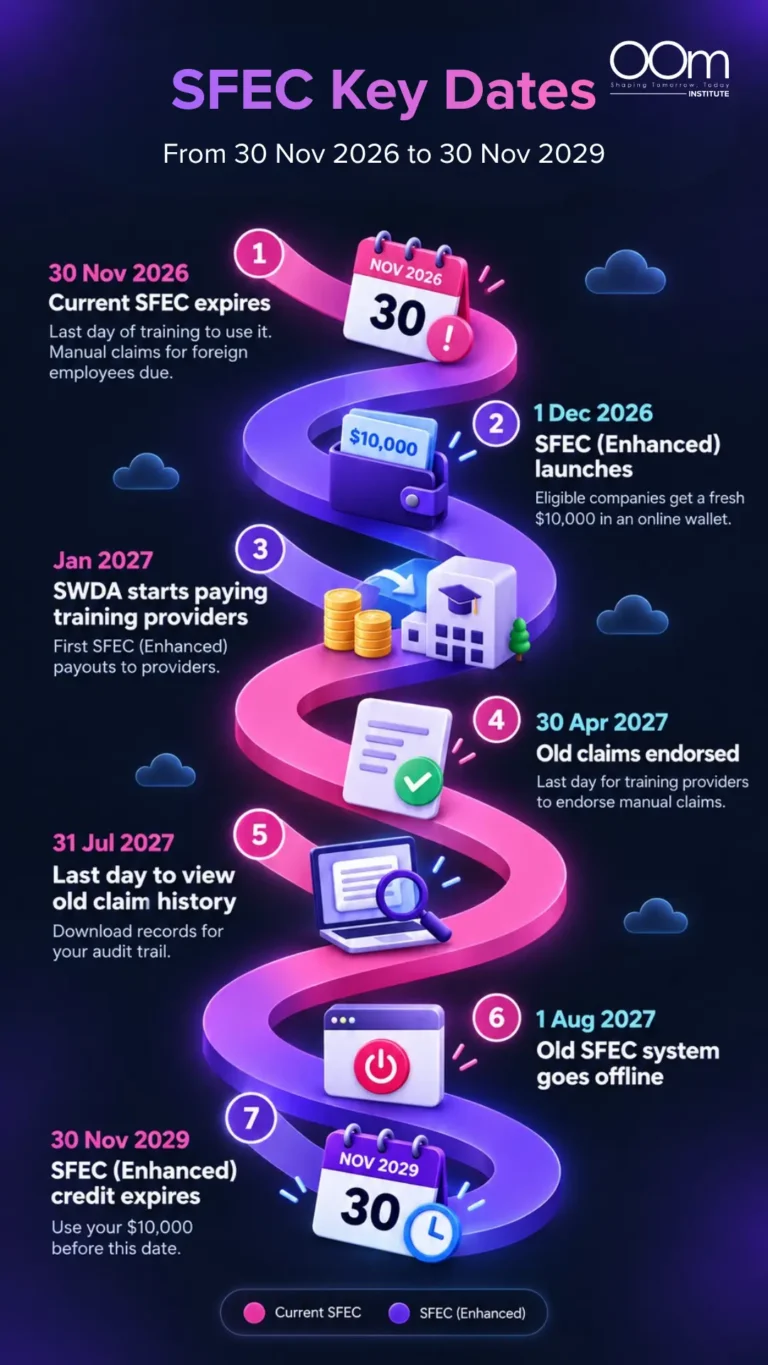
A course run that starts before 30 November and ends after it can’t use SFEC (Enhanced) either, so it falls between the two schemes and gets no SFEC support at all. If you’re booking a run in late November or early December, pick one that ends by 30 November or starts on or after 1 December.
Does Your Company Qualify for SFEC (Enhanced)?
Your company qualifies if it
- employed at least three resident employees every month from 1 January to 31 December 2025,
- wasn’t in default of its Skills Development Levy (SDL) in that period
- doesn’t have inactive ACRA status
SWDA also runs its own internal governance checks. There’s no application form to fill in.
SWDA checks which companies qualify and emails them ahead of the launch. To unlock the credit, you then complete a short workforce questionnaire on the OurWorkforce Portal.
Two points are worth knowing if you’ve looked at SFEC before.
The rules have changed. The S$750 SDL minimum that applied to Budget 2020 qualifiers isn’t part of the new criteria, and the qualifying period is now calendar 2025. A company that missed out on the current SFEC may qualify this time.
Companies that received the current credit still get the fresh $10,000, even if they used up the first one.
What Can SFEC (Enhanced) Pay For?
At launch, SFEC (Enhanced) covers three things.
- SWDA-funded, employer-sponsored training courses in the OurWorkforce course directory
- SkillsFuture Workforce Development Grant (Job Redesign+), or WDG(JR+), projects. For these, the credit covers up to 90% of your out-of-pocket cost instead of 100%
- Mentorship support projects under the National Centre of Excellence for Workplace Learning (NACE).
SWDA says more programmes will be added over time.
| You can use SFEC (Enhanced) for | You can’t use SFEC (Enhanced) for |
| SWDA-funded courses for your employees | GST on any course or project |
| WDG(JR+) job redesign projects | Courses without SWDA funding |
| NACE mentorship support projects |
A training provider can’t apply to make a single course eligible. Eligibility comes from the course’s base government funding, so before you enrol anyone, check that the course is SWDA-funded in the course directory and ask the provider for its course reference number.
It also helps to be clear about what the credit won’t do.
It doesn’t replace the course fee subsidy, it doesn’t pay Absentee Payroll, and it doesn’t make a course without SWDA funding any cheaper. If you’re new to course funding, our guide to SkillsFuture funding explains how the base subsidies work.
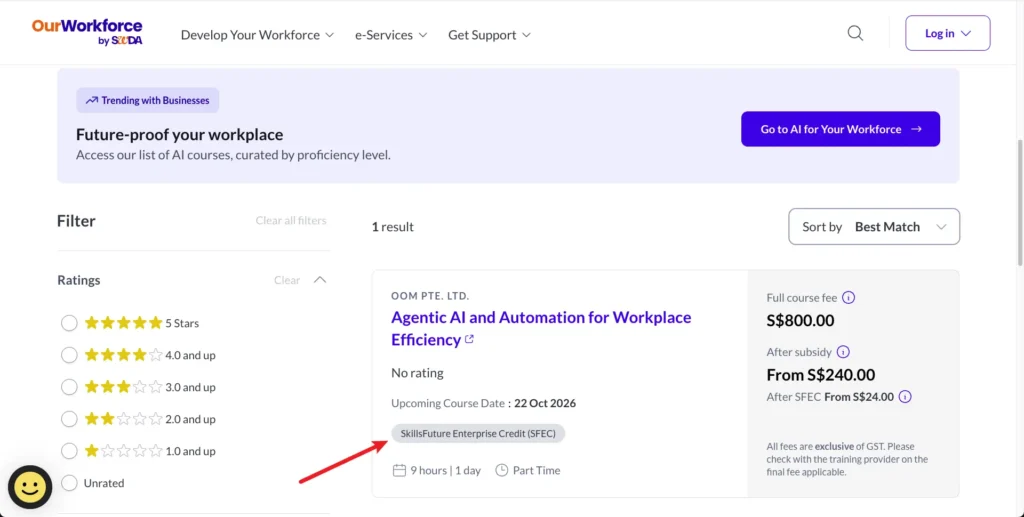
OOm Institute’s Agentic AI course listed in the OurWorkforce course directory
How Much Will Your Company Actually Pay?
For a SWDA-funded course, SFEC (Enhanced) pays the whole nett fee, so the GST is usually all your company pays. On our Agentic AI & Automation for Workplace Efficiency course, for example, an SME sending one employee pays $72.
The nett fee is what’s left of the course fee after the government subsidy. GST is charged on the full course fee, not the nett fee, and SFEC never covers it.
| Agentic AI & Automation for Workplace Efficiency course | Amount |
| Course fee | $800 |
| SkillsFuture support for SMEs (70%) | ($560) |
| Nett fee before GST | $240 |
| SFEC (Enhanced) offset (100%) | ($240) |
| GST (9% of $800) | $72 |
| Amount your company pays | $72 |
Your wallet balance then drops from $10,000 to $9,760.
A non-SME sending someone on the same course gets 50% support, so the nett fee is $400. SFEC covers that too and the company still pays $72, but $400 comes out of its wallet instead of $240.
One rule catches people out. SFEC is applied on an all-or-nothing basis, so the full eligible offset comes out of your wallet.
You can’t use part of it to save the rest for another course. If your balance is lower than the offset, SFEC pays up to what’s left and the training provider can bill you the difference.
As a rough guide, at a $240 nett fee per trainee, $10,000 covers about 41 places on this course for an SME.
How Does an SFEC (Enhanced) Claim Work?
Once attendance and employment checks are clear, SWDA pays the training provider and you only pay what’s left on the invoice.
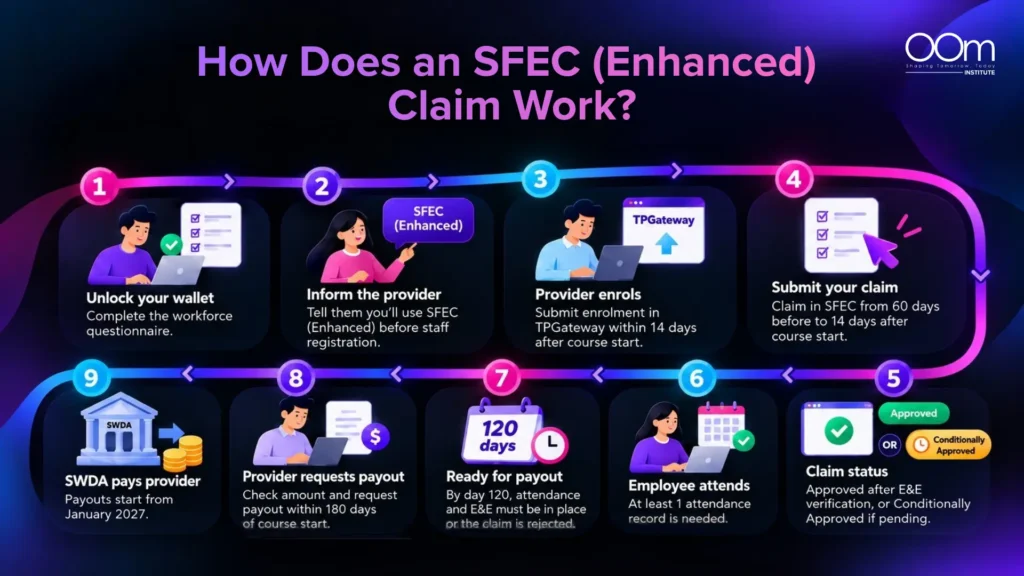
- Unlock your wallet by completing the workforce questionnaire.
- Tell the training provider you’ll use SFEC (Enhanced) before your staff are registered.
- The training provider submits the enrolment in TPGateway, no later than 14 days after the course start date.
- You submit the claim in the SFEC system between 60 days before and 14 days after the course start date. The credits are set aside for that course.
- The claim shows as Approved if employer-employee (E&E) verification passes, or Conditionally Approved if it hasn’t cleared yet.
- Your employee attends. SFEC needs at least one attendance record.
- By 120 days after the course start date, the attendance record and E&E verification must both be in place, and the claim moves to Ready for Payout. If they aren’t, the claim is rejected and the credits go back to your wallet.
- The training provider checks the claim amount and requests payout within 180 days of the course start date.
- SWDA pays the training provider. Payouts start from January 2027.
Why Do SFEC (Enhanced) Claims Fail?
Most failures come down to timing.
A claim submitted more than 14 days after the course starts, an enrolment the training provider submits late, or an employee with no attendance record or an uncleared E&E check by day 120 will all be rejected.
| What goes wrong | What happens | How to prevent it |
| You submit the claim late | The claim can’t be submitted | Submit before the course starts |
| The provider submits the enrolment late | You can’t submit your claim | Check with the provider that the enrolment is in TPGateway |
| E&E verification hasn’t cleared by day 120 | The claim is rejected and the credits return to your wallet | Watch for Conditionally Approved and follow up early |
| Your employee doesn’t attend | The claim is rejected | Make sure at least one session is attended and recorded |
| Your wallet balance is too low | SFEC pays up to the balance and you pay the rest | >Check your balance before you enrol staff |
If a claim is rejected, the training provider can then bill you for the nett fee, so it’s worth keeping a small buffer in your training budget.
Before you enrol anyone, run through this checklist.
- Your wallet is unlocked and the balance covers the offset
- The course is SWDA-funded and listed in the course directory
- You’ve told the training provider you’ll use SFEC (Enhanced)
- You’ve noted the course start date and the day-14 claim deadline
- After the course starts, you’ve checked the claim status
- After the course, your wallet has dropped by the expected amount and the invoice shows the nett fee, SFEC amount and GST
From the claims we’ve handled under the current SFEC, the most common problem is forgotten claims for foreign employees.
Companies often assume these are processed automatically, like those for Singapore Citizens and PRs.
They aren’t.
Claims for foreign employees must be submitted manually, and the deadline is 30 November 2026.
What Should You Expect From Your Training Provider?
A training provider should confirm you intend to use SFEC before registering your staff, shouldn’t ask you to pay the full fee upfront when SFEC is available, and should show the nett fee, the SFEC amount and GST on the invoice.
There are only two cases where a provider may collect more from you.
One is when your SFEC claim is cancelled or rejected. The other is when SFEC covers less than the nett fee, for example because your wallet balance is running low.
The provider can then collect the difference.
SWDA recommends that invoices show the nett fee and the SFEC amount, and that’s in your interest too. A clear breakdown speeds up verification and protects both sides if there’s a dispute later.
How Should You Plan Your $10,000 Over Three Years?
Treat the credit as a training budget that runs to 30 November 2029. Link it to the two or three skills gaps you most need to close in 2027, and check your wallet balance every quarter.
Plenty of companies never used their first credit. In November 2025, the Ministry of Trade and Industry announced that close to 40,000 enterprises, about half of those eligible, had used the current SFEC.
A simple quarterly plan is enough. The figures below are only an illustration.
| Quarter | Team | Course | Trainees | Nett fee per trainee | SFEC used | Balance |
| Q1 2027 | Marketing | [Course name] | 4 | $300 | $1,200 | $8,800 |
| Q2 2027 | Operations | [Course name] | 6 | $300 | $1,800 | $7,000 |
In my experience, SME training budgets pay off fastest on short courses tied to work the team does every week, such as using AI tools for everyday tasks, building reports in Excel or Power BI, or running digital marketing campaigns.
People use the skill the following Monday, so you can tell within a month whether it helped. Longer programmes are worth it too, but they’re easier to justify once a few quick wins have shown the team what training can do.
🤔 What Should You Do Next?
Three dates matter.
Before 30 November 2026, finish or reschedule any course you’re funding with the current credit. Around 1 December 2026, look out for SWDA’s eligibility email and complete the questionnaire. From then on, tell your training provider you’ll use SFEC (Enhanced) before your staff are registered.
If you’d like help planning your team’s training under SFEC (Enhanced), our corporate training team can check which OOm Institute’s courses are SWDA-funded and work out the cost after SFEC.
Frequently Asked Questions
1. Is SFEC (Enhanced) the same as SkillsFuture Credit?
No. SFEC (Enhanced) is a $10,000 credit for the company, used to offset course and programme fees for its employees. SkillsFuture Credit belongs to individual Singapore Citizens aged 25 and above, who use it for their own learning.
2. Is the $10,000 per company or per employee?
Per company. Each eligible company gets one $10,000 credit, which it can use across as many employees and courses as the balance allows.
3. Can non-SMEs use SFEC (Enhanced)?
Yes. Company size isn’t part of the eligibility criteria. The difference is the base subsidy, which is usually 50% for non-SMEs instead of 70% for SMEs, so more of the credit is used per course.
4. Does our employee need to finish the course before the claim goes through?
For SWDA-funded courses, the minimum is at least one attendance record for the trainee, drawn automatically from TPGateway. SkillsFuture Credit for individuals uses the same rule.
5. Who do we contact with questions about SFEC (Enhanced)?
You can reach out to SWDA through their website or online enquiry form. For questions about a specific course, your training provider can usually help too.