
Key Takeaways
|
Introduction
Many Singaporeans sign up for an AI course with the right intentions.
Then, somewhere down the line, the learning does not quite carry over into daily work. It is a frustrating place to be.
The cheapest option can feel like the safest choice at first.
Yet it often becomes the most expensive mistake when the skills do not translate into real use.
What looks affordable upfront may cost more in lost time and missed opportunities.
Understanding the cost of AI course options in Singapore is not just about comparing fees.
It is about knowing what you are paying for and what you actually gain.
More importantly, it is whether those skills stay useful beyond the classroom.
Also Read: 12 Best AI Courses in Singapore
How Much Does an AI Course Really Cost in Singapore
Before diving into specific categories, it helps to see the landscape at a glance.
| Course Type | Gross Fee | Nett Fee (After Grant/Subsidy) | Duration | Focus Area | Best For |
| Online Courses | $0 – $300 | $0 – $300 | Self-paced | Basic tools, theory | Beginners exploring AI |
| WSQ Courses | $1,000 – $3,500 | $200 – $800 | 1–5 days | Applied AI workflows | Working professionals |
| Diploma / Degree Programmes | $10,000 – $40,000+ | $5,000 – $20,000+ | Months to years | Academic + technical depth | Career switchers |
The figures above reflect typical AI course fees seen across providers in Singapore. While the spread looks wide, the real difference lies in how these programmes are structured and delivered.
A. Online Courses
Online courses often feel like the easiest entry point.
Many are free or priced under a few hundred dollars, which makes them attractive for those exploring AI for the first time.
The low cost of AI course options here lowers the risk, but it also shapes the depth of what you receive.
Most programmes focus on individual tools rather than complete workflows.
You might learn how to generate prompts, create images, or run simple models, but these are usually taught in isolation. Without context, it becomes harder to see how these tools fit into actual work processes.
The format also plays a role. Lessons are typically pre-recorded and self-paced, with limited interaction or feedback.
If something does not click, there is often no immediate support, which can slow down progress or lead to gaps in understanding.
Completion rates tend to be lower as well.
Without structure or accountability, it is easy to pause midway or move on without fully practising what was taught. Even when the course is completed, learners may struggle to recall or apply the material later.
For someone testing the waters, online courses can still be useful. They offer a quick way to build awareness and familiarity with AI tools.
For professionals who need to apply AI in real scenarios, however, the lack of guided practice and workflow integration can limit how far that learning goes.
B. WSQ-Aligned Professional Training
WSQ-aligned AI courses sit in a more practical middle ground.
They are designed with workplace use in mind, which makes them more relevant for professionals who need to apply AI, not just understand it.
Fees typically range from $1,000 to $3,500.
With government subsidies, the cost of AI certification can drop significantly for Singaporeans and PRs, sometimes to just a few hundred dollars.
This makes structured, guided training far more accessible than many expect.
💡 If you’re interested in applying for training grants for your employees, read this.
What sets these programmes apart is their structure.
Many now move beyond teaching individual tools and instead focus on complete workflows. Learners are guided through how AI fits into actual tasks such as content creation, data handling, or process automation.
There is also a stronger emphasis on support and continuity.
Some courses include extended access to premium AI tools for several months, allowing learners to keep practising after the training ends.
💡 If you’re interested, check out the best AI tools for business.
This helps bridge the gap between learning and real-world use.
Providers such as OOm Institute reflect this shift towards application. Our generative AI programmes are built around business use cases, showing how AI can support marketing, operations, and day-to-day decision-making.
For those considering how to use their SkillsFuture credit, this category often offers the most balanced mix of affordability, structure, and practical value.
C. Diploma / Degree Programmes
Formal qualifications offer a deeper level of learning, but they come with a much higher level of commitment.
They are designed for those who want to build strong technical foundations rather than pick up applied skills quickly.
These programmes can cost tens of thousands of dollars and often run for months or even years.
The focus is usually on areas such as data science, programming, and machine learning theory, which require time to grasp and practise.
For individuals planning a full career switch into AI engineering or data science, this path can be worthwhile.
It provides the depth needed for technical roles. For most working professionals, however, it may go beyond what is needed for everyday use.
When weighing the cost of AI courses at this level, the decision tends to come down to long-term career goals.
The investment makes more sense if you intend to move into a technical AI role rather than simply apply AI tools in your current work.
Think You Are Saving? The Hidden Cost of AI Courses
A lower upfront fee does not always translate into better value.
Some trade-offs only become clear after the course ends, when you try to apply what you learnt and find gaps.
What seemed like a small investment can feel limiting when the learning does not hold up in real situations.
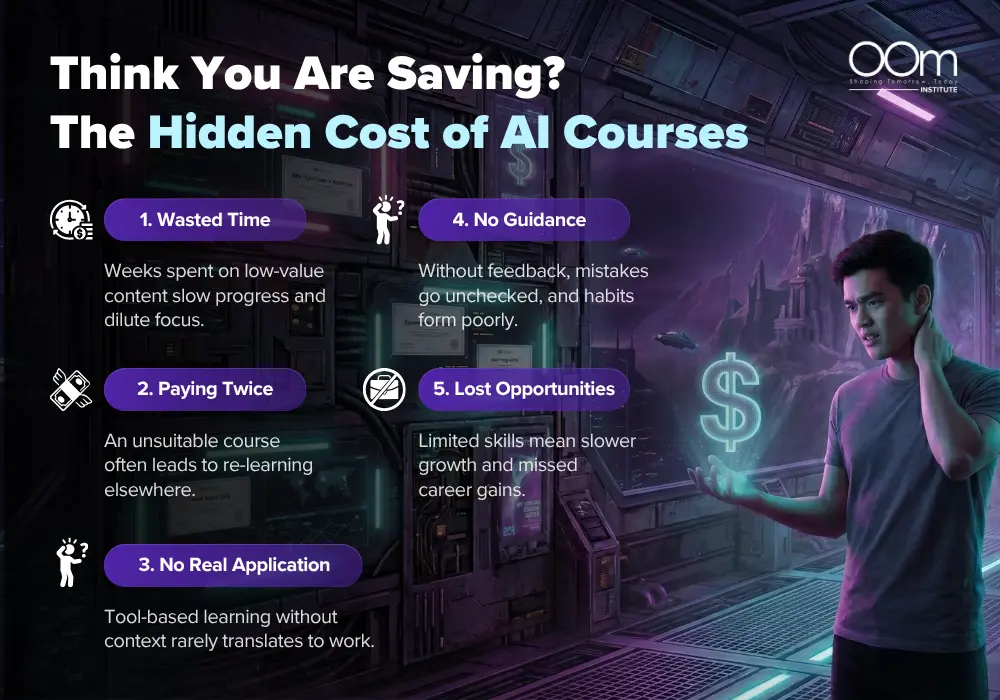
Time is one of the biggest hidden costs.
Weeks spent going through lessons that are too basic or disconnected from real work can slow your progress.
Instead of building momentum, you may find yourself revisiting the same concepts or searching for better explanations elsewhere.
There is also the cost of re-learning, which many do not anticipate.
It is common for learners to enrol in a second, more structured programme after realising the first one lacked depth or guidance.
By that point, the combined spend and effort often exceed what a more suitable course would have required from the start.
Another factor is the lack of support and feedback.
Without guidance, it becomes difficult to know whether you are using AI tools correctly or efficiently. Small misunderstandings can compound over time, leading to habits that are hard to correct later.
Missed opportunity is where the impact becomes more visible.
Without practical, usable skills, the ability to streamline work, improve output, or take on higher-value tasks remains limited.
When you step back and look at the cost of AI courses, the real question shifts.
It is less about how much you paid and more about whether the course actually helped you move forward in a meaningful way.
How to Know If You Are Choosing the Right AI Course
Price rarely tells the full story.
A course can look affordable or even impressive on paper, yet still fall short when it comes to real use.
The clearer test is whether you can apply what you learn confidently in your day-to-day work.
A. Trainer Quality
Trainer experience shapes how practical the learning feels.
Instructors who actively use AI in their work tend to teach with more context, showing not just how tools function, but when and why they are used.
They are also more likely to highlight limitations.
This includes what AI cannot do reliably, where human input is still needed, and how to avoid common mistakes.
These insights often make the difference between surface-level understanding and usable skill.
B. Workflow Training
Learning individual tools can only take you so far.
In real work settings, tasks rarely rely on a single tool.
Instead, they involve a sequence of steps, often combining multiple platforms.
Courses that teach workflows help you see the bigger picture.
For example, instead of just learning how to generate content, you might learn how to move from research to drafting, editing, and refinement using AI.
This structure makes it easier to replicate the process outside the classroom.
C. Hands-On Application
Practical application is where learning starts to settle.
Watching demonstrations can build familiarity, but applying the same concepts yourself builds confidence.
Stronger programmes guide you through exercises that reflect real scenarios.
This could involve solving business problems, improving existing processes, or working through case-based tasks.
The more closely these exercises resemble actual work, the more likely the learning will carry over.
D. Career Support
Some courses extend beyond the training itself.
At OOm Institute, in partnership with AKG, this includes guidance on how to present your skills, build a strong portfolio, and identify where AI can fit into your current role.
For mid-career professionals, this added support can be especially valuable.
It helps bridge the gap between learning a new skill and applying it meaningfully, whether within your current role or as part of a new career direction.
E. Certification Recognition
Certification plays a supporting role rather than a defining one.
While it does not replace practical ability, it can still signal that you have completed structured training.
Programmes aligned with recognised frameworks or funding schemes often carry more weight.
They indicate that the course meets certain standards, which can provide reassurance when comparing options.
When you look at these factors together, the differences between courses become clearer.
Instead of focusing only on fees and duration, a more useful way to compare AI courses is to consider how well the learning translates into real-world use and long-term value.
Calculate Your ROI: Is This Investment Worth It
Looking at return on investment adds a layer of clarity that price alone cannot provide. It shifts the focus from what you spend to what you gain, and how that gain shows up in your work over time.

Short-Term ROI
In the short term, the question is fairly direct.
Can you apply what you learnt within days or weeks of completing the course?
Practical gains often show up in small but meaningful ways.
Tasks that once took hours may take less time. Repetitive processes can be streamlined.
Content creation, research, or reporting can become more efficient with the right use of AI.
There is also a confidence factor.
Being able to approach tasks with a clearer structure or faster turnaround can change how you contribute at work.
Even without a role change, this can improve day-to-day performance and reduce friction in routine tasks.
Long-Term ROI
Over time, the value of AI skills tends to deepen.
As familiarity grows, learners often move beyond basic usage into more advanced applications.
This could include building repeatable workflows, integrating multiple tools, or refining outputs for better quality.
There is also a compounding effect. Skills that are used regularly tend to evolve.
What starts as a simple productivity boost can expand into process improvement, decision support, or even leading small initiatives within a team.
From a career perspective, this can create new pathways.
Roles that require digital fluency, automation thinking, or AI awareness are becoming more common.
Having applied experience can make it easier to take on broader responsibilities or pivot into adjacent functions.
There is, however, a limitation to consider. Not every course leads to this outcome.
Programmes that focus only on basic demonstrations or isolated tools may not provide enough depth for long-term use.
In such cases, the initial investment may not translate into sustained value.
Seen this way, ROI becomes less about immediate results and more about continuity.
The cost of an AI course makes more sense when the learning continues to support your work months after the course has ended, rather than fading shortly after completion.
Conclusion
Choosing an AI course is less about finding the lowest price and more about understanding what you will actually gain.
When you look at the cost of an AI course this way, the focus shifts towards value and long-term use.
Applied skills, structured workflows, and practical relevance tend to shape outcomes far more than cost alone.
When training reflects how work is actually done, the learning is more likely to stick. That is where the real return begins to show, not just in knowledge, but in how confidently you can apply it.
For those looking to move beyond surface-level learning, OOm Institute focuses on practical, workflow-driven training designed for working professionals in Singapore.
Our Generative AI series are built around real business use cases, helping learners integrate tools into marketing, operations, and everyday tasks rather than treating them as standalone features.
Our courses are also funding-eligible, which helps make structured training more accessible for those planning to offset fees through available support schemes.
If you’re looking to offset training costs, read our guide on training grants for employers to understand what support is available for SMEs.
This allows learners to focus on building relevant skills without taking on unnecessary cost.
If you are considering your next step, think about what will still matter six months after the course ends. Explore OOm Institute’s AI courses and take a more deliberate step towards building skills that can be applied, not just learnt.
Frequently Asked Questions
1. What is the average nett cost of an AI course in Singapore after grants?
For subsidised programmes, the nett fee typically ranges from $200 to $800, depending on eligibility and course structure. This makes structured training more accessible, especially when compared to the cost of other AI courses available in the market.
2. How do I know if a course is applied or theory-heavy?
Applied courses focus on real tasks and workflows, often supported by guided exercises or case-based learning. Theory-heavy courses tend to emphasise concepts without clearly showing how they fit into everyday work.
3. Can mid-career professionals benefit from short AI courses?
Yes, especially when the course is designed for practical use. Short programmes can help professionals integrate AI into their current roles without committing to a full career switch.
4. How do SkillsFuture credits apply to AI courses?
Eligible courses allow you to offset fees using your credits. Understanding how to utilise your SkillsFuture credit effectively can reduce upfront costs while still giving you access to structured, guided training.
5. What makes OOm Institute’s AI series different from other programmes?
Our programmes are structured around real-world applications rather than standalone tools. Learners focus on building workflows that reflect actual business use cases, making it easier to apply what they learn after the course.
6. What are the hidden costs in AI courses I need to take note of?
Time investment, lack of practical application, and the need to retake another course are common hidden costs. These factors often have a bigger impact than expected when evaluating the true cost of AI courses.
7. What is the best artificial intelligence course in Singapore?
There is no single answer. The best artificial intelligence course depends on your goals, whether that is exploration, workplace application, or a career transition. Looking at relevance, structure, and outcomes usually leads to a better fit than relying on price alone.