- QUICK ANSWER
Before you hire a corporate training provider, compare the full arrangement, not just the price, and watch for red flags like vague customisation promises or guarantees of business results. The right provider should be able to answer all six clearly, not just the ones that make the sale easier.
Choosing a corporate training provider can seem simple at first. You compare fees, dates and trainer profiles, and that feels like due diligence. But those details don’t actually tell you how useful the training will be for your team.
I’ve seen well-delivered courses miss the mark completely because they were pitched at the wrong level, or had little relevance to what employees actually do day to day. And a cheaper programme isn’t a bargain if your staff walk out unable to apply any of it.
The questions that matter most are the ones that get at course fit, trainer experience, practical application and what happens after the training ends.
Here’s what I’d ask before committing a training budget.
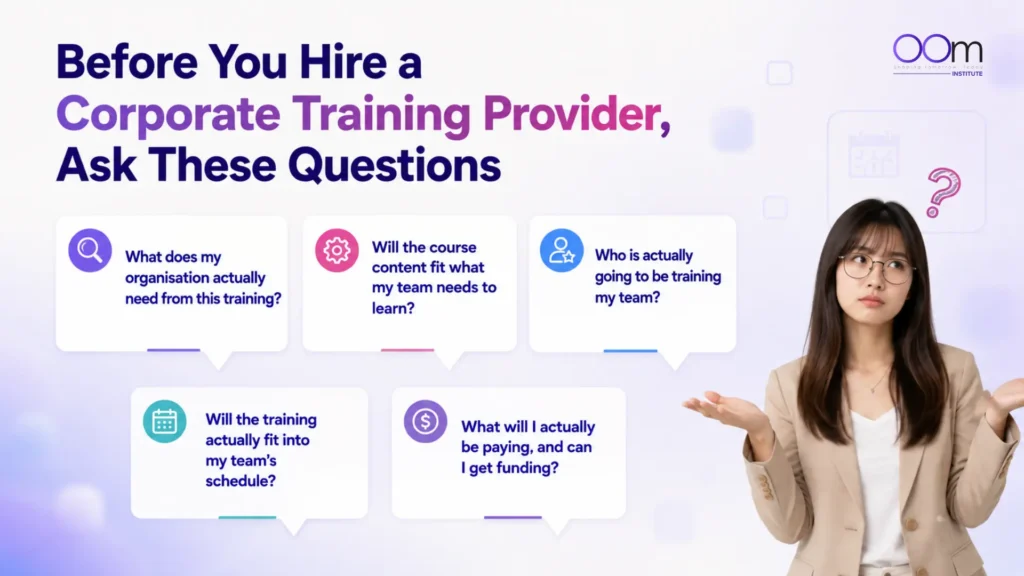
🤔 What Does My Organisation Actually Need From This Training?
Before you even look at course options, get clear on what you actually want to improve. A good provider should help you narrow down the skills gap or workplace challenge, not just point you to something from their catalogue.
01 What Business Problem Will the Training Help Us Solve?
“Our managers need leadership training” is a fine starting point, but it’s still too broad. Look at what’s actually happening at work. New managers might be struggling to delegate, teams might be using AI inconsistently, or customer service staff might be finding difficult conversations hard to handle.
Each of those points to a different training need. If supervisors keep escalating minor disagreements to HR, a focused conflict management programme will probably serve you better than general people-management training.
This is where corporate training should start: with the specific workplace problem you want employees to handle better.
02 What Problems Can Training Realistically Solve?
Not every workplace problem is a skills problem. If your sales team keeps entering incomplete information into a CRM, training helps when employees genuinely don’t understand the process. It does far less if the system itself is clunky, if managers never review the records, or if workloads leave no time for admin.
The same logic applies to soft skills. Communication training can help a manager give clearer feedback, but it won’t fix confusing reporting lines or conflicting instructions from senior management.
I’d ask any provider what the training can realistically improve, and what needs to be fixed internally instead. A good one should be able to draw that line for you.
03 How Will You Assess Our Employees' Current Skill Levels?
Training works best when the content matches what employees already know. An AI course, for example, might include complete beginners, people who rely on basic prompts, and others who already use AI daily.
Put them all in the same session with the same material, and some will struggle to keep up while others get almost nothing out of it.
Ask how the provider assesses participants beforehand, whether that’s a questionnaire, a short skills check, a conversation with managers, or a look at examples of current work. The goal is simple: give the trainer enough to pitch the session at the right level for the group in front of them.
04 Who Should Attend the Programme?
More participants doesn’t automatically mean better value. If a company is introducing AI into its marketing process, training only the content writers might leave managers unsure how to review AI-assisted work, while sending the entire company along could just be overkill.
Focus on the roles that will actually use or oversee the skills being taught. Something like workplace communication might suit a cross-functional group just fine, while more technical training usually works better grouped by role or experience level.
05 What Happens if My Employees Have Different Skill Levels?
Mixed-level groups are common, especially when a whole department attends the same programme. The challenge is keeping beginners from falling behind without leaving the more experienced people bored.
Ask how the provider plans to manage that gap. It could mean pre-course work, tiered exercises, small-group activities, or examples tailored to different roles and experience levels.
It’s also worth comparing in-house training vs outsourced training here, since that choice affects how much flexibility and control you get over exactly this problem.
🤔 Will the Course Content Fit What My Team Needs to Learn?
Once you’re clear on what the training should achieve, check whether the actual course content matches. Two programmes with the same title can teach very different skills, so compare the substance before deciding.
01 Can the Programme Be Customised to Our Organisation?
Ask what “customised” actually means in practice, because a real adjustment goes well beyond swapping the logo or changing one industry example.
Depending on the programme, customisation might touch the exercises, case studies, terminology, difficulty level, or which topics get more emphasis.
The closer the examples sit to employees’ real working situations, the easier it is for them to apply what they’ve learned afterwards.
02 Which Parts of the Course Can and Cannot Be Changed?
Structured or accredited programmes often have limits on customisation. A provider might be able to adjust examples, exercises or case studies while keeping the required learning outcomes, assessments and core content fixed.
Ask what’s actually tailorable before you confirm anything. If your team needs more flexibility than that, it’s worth comparing against existing corporate training courses to see which format fits better.
03 How Will Confidential Company Information Be Handled?
Using real workplace material makes training more relevant, but it can also expose sensitive information, like customer data, internal processes or financial details. This matters especially for AI training, where employees might be working directly with reports, marketing data or internal documents.
I’d ask any provider how this gets handled: what materials they need, who can access them, how long they’re kept, and which external tools participants might use. Anonymised or sanitised examples can still give useful context without exposing anything confidential.
04 How Current is the Course Content?
Content ages at very different speeds. Communication frameworks can stay relevant for years, while training on generative AI, advertising platforms or analytics tools needs much more frequent updates.
Ask what’s changed recently, not just when the slides were last revised. For an AI course, that might mean new tool capabilities, updated exercises, or how the trainer handles a platform change that happened days before the session.
05 Will Employees Work on Examples from Our Organisation?
Training sticks better when employees practise on tasks that resemble their actual work. A marketing team learning prompt engineering will likely get more out of working with a real product brief than writing a generic social media post.
Useful exercises might include turning a brief into campaign angles, analysing customer feedback, or drafting part of a monthly report. The closer the practice sits to day-to-day work, the more likely employees are to use the same approach afterwards.
🤔 Who is Actually Going to Be Training My Team?
The provider matters, but so does the person standing in front of the room. Ask who will actually conduct the training, and whether they have the experience to explain, demonstrate and adapt the content for your team.
For private programmes, try to confirm the assigned trainer before booking, or at least ask when that will be finalised.
01 Has the Trainer Worked with Organisations Like Ours?
Industry experience helps, but a list of client logos on a slide doesn’t tell you much on its own. Ask what kind of work the trainer has actually done with similar organisations, and how closely that matches what your team is dealing with.
One trainer might have worked with dozens of finance teams; another might have worked in finance before becoming a trainer. Both bring something useful, but they’re not the same thing, so it’s worth asking which you’re getting.
02 Does the Trainer Have Practical Experience or Only Teaching Experience?
It’s worth knowing whether the trainer has actually applied these skills in a real workplace, not just taught them. Someone teaching people management might draw on real experience leading teams, handling performance issues or navigating difficult conversations themselves.
Ask how the trainer’s professional background connects to the course content. Practical examples help employees see how a concept holds up when a situation gets messier than a classroom exercise ever does.
03 How Does the Trainer Handle Difficult or Mixed-Level Groups?
Sessions don’t always run to plan. Some participants dominate the discussion, push back on the material, or move through exercises much faster than everyone else.
Ask how the trainer adjusts pace, regroups participants, or changes activities when that happens. A good answer shows they can manage different personalities and skill levels without losing the rest of the room.
04 Can the Trainer Adapt the Session When Necessary?
A good trainer responds to how the group is actually learning, not just to the lesson plan. If participants grasp the theory quickly but struggle to apply it, more time on practice usually beats more explanation.
Structured programmes may limit how much can shift, especially where assessments or required components are involved. Even so, the trainer should generally have room to adjust examples, pacing, discussion time and activities.
🤔 Will the Training Actually Fit into My Team's Schedule?
A good programme also has to fit your team’s workload and availability.
Check how flexible the provider can be on dates, session length and delivery format, especially for shift-based or customer-facing teams.
01 Should We Choose a Public Course or Private Corporate Class?
A public course can work well when only a few employees need training and an existing programme already fits. A private class tends to be better for larger teams, especially when you want more control over scheduling or want examples tailored to your organisation.
The better fit depends on your team size, how much customisation you need, and how much disruption the training will cause to normal work.
02 Should the Training Be Conducted in Person or Online?
The delivery format should match how employees actually need to learn. Online works well for discussion-based or knowledge-focused sessions; role-play, hands-on exercises or anything needing closer trainer observation tends to work better in person.
Your team’s working arrangement matters too.
Online sessions suit regional teams, while onsite or offsite training suits employees based in one location. OOm Institute runs onsite, offsite and online corporate training depending on what an organisation needs.
03 Can the Programme Be Split into Several Sessions?
A full-day session isn’t always practical. A customer service department, for example, might find two half-day sessions much easier to manage than pulling an entire shift off the floor.
Ask whether the programme can be split without hurting the learning outcomes, which topics need to stay together, and how a staggered schedule might affect continuity, attendance and practice.
04 What Facilities and Equipment Are Required?
Sort out the practical setup early so nothing becomes a last-minute scramble. Depending on the programme, you might need laptops, reliable internet, a projector, software accounts, breakout spaces or specific room arrangements.
If laptops are required, confirm whether employees should bring their own and what the alternative is. We generally ask learners to bring their own laptops for relevant courses, and arrange equipment in advance where needed.
05 Can the Programme Support Employees with Accessibility Needs?
Raise accessibility requirements early so the provider has time to plan for them properly. That might mean physical access, seating, visual or hearing support, additional breaks, or changes to how materials are provided.
Don’t assume every venue or online platform handles this the same way. Ask what adjustments are actually possible before you confirm the programme.
🤔 What Will I Actually Be Paying and Can I Get Funding?
The quoted price rarely tells the full story. I’d always ask what the fee includes, how many participants are covered, and which costs might be charged separately, then check whether funding support applies before comparing programmes on price alone.
01 What is Included in the Quotation?
Ask for a clear breakdown of what the fee covers. That might include training delivery, trainer preparation, customisation, materials, assessments, venue, equipment, certificates and post-course support.
A higher quotation can still be better value if it includes more preparation or follow-up. Check how many participants are covered, and which items, if any, get billed separately.
02 Are There Additional or Optional Charges?
Ask about anything that sits outside the main quotation: extra participants, longer training hours, venue rental, equipment, additional content development or rescheduling. These charges can be entirely reasonable, but they should be clear upfront so you can budget for the full cost, not just the headline number.
03 Is the Course Eligible for Employer Training Subsidies?
Training support in Singapore varies by course, employer and employee eligibility, so don’t assume every programme qualifies for the same funding.
Ask what funding may apply, what conditions need to be met, and how much your organisation will still need to pay after that. SkillsFuture Singapore has current information on workforce training and funding support, and our guide to training grants for employers covers the main options worth reviewing while you’re planning your budget.
04 Who Manages the Funding Application and Claim Process?
Funding involves more than just receiving a subsidy, so it’s worth clarifying who owns each step. Your HR or finance team might need to supply employee details, attendance records, assessment results or payment documents, while the provider handles other parts.
A provider who knows the relevant funding scheme well should be able to spell out exactly what falls on your side, what they’ll manage, and by when.
05 What Happens if Funding is Rejected?
Don’t build your budget around the subsidised amount alone. Ask what happens if funding isn’t approved, an employee turns out to be ineligible, or attendance requirements aren’t met. You should know upfront how much you might owe in that situation, when it would be due, and which fees are non-refundable.
06 Can Employees Use Personal SkillsFuture Credit?
SkillsFuture Credit and employer funding follow different rules, so this depends on the course and how registration is handled. It’s worth asking whether employees can use their personal credit alongside company sponsorship, and what conditions apply before payment is made.
🤔 What Can Affect the Success of Corporate Training Beyond the Course Itself?
Even the right provider, the right trainer and the right content can only take a programme so far. A lot of what determines whether training actually sticks happens outside the classroom, in the conditions your organisation creates before and after the course. I’d think through these alongside the questions above.
01 Manager support
Do managers reinforce the skills afterwards? A course can introduce a new way of giving feedback or running meetings, but if a manager never asks about it again once employees are back at their desks, the old habits tend to win out.
02 Opportunities to apply the learning
Can employees actually use the skills in their daily work? Training on negotiation or people management, for instance, is far more likely to stick for someone who negotiates or manages people regularly than for someone who might use it once a year.
03 Access to the right tools
Training on AI, analytics or digital platforms will not help much if employees cannot access the necessary systems afterwards. It’s worth checking that licences, software access and permissions are sorted out before the course, not scrambled together once it’s done.
04 Employee readiness
Are participants attending because the training is relevant to their roles, or simply because they were nominated? Employees who understand why they’re there tend to engage differently from those who were just added to a list to fill a quota.
05 Time to practise
Will employees have time after the course to apply what they learned? A packed schedule that leaves no room to try out a new approach makes it easy for the training to fade, no matter how well it was delivered.
06 Alignment with existing processes
Does the organisation’s current workflow support the behaviours being taught? If a course teaches a more collaborative way of reviewing work but the existing process still routes everything through one person, the two are working against each other.
None of this is a reason to skip training, but it’s worth going in with eyes open. The organisations that get the most out of a programme tend to be the ones who treat the course as one part of a bigger plan, not the whole plan.
How OOm Institute Supports Corporate Training
At OOm Institute, we offer both customised programmes and structured, standard courses, so organisations can pick an approach based on their goals, team needs and how much flexibility they want.
For customised training, we work with organisations to identify the areas that actually need attention and adapt examples and activities to the workplace, whether that’s generative AI, digital transformation, leadership or soft skills.
Practical application is built into how we teach: employees work through exercises, workplace scenarios and case examples designed to connect the material to situations they’re likely to run into on the job.
For organisations looking at standard courses, we also offer programmes in workplace communication, people management, conflict management, problem-solving and employee coaching. Funding availability depends on the course and participant eligibility, so it’s worth confirming what applies before registering.
Ask Better Questions Before You Book Corporate Training
No single provider, course format or funding arrangement suits every organisation. A small marketing team adopting AI has different needs from a large service organisation trying to improve frontline communication, and even two companies both looking for leadership training might be dealing with entirely different problems underneath.
The clearer you are about the problem, the easier it is to judge whether a provider’s recommendation actually fits. The questions that matter most cover what employees will practise, who trains them, what can be customised, what the quotation includes, and how the learning gets applied afterwards.
If you’re planning corporate training in Singapore, OOm Institute can help you explore the right options across AI, digital marketing, leadership and soft skills. Contact us to talk through your team’s needs and get a customised training plan.
Frequently Asked Questions
1. How much does corporate training cost in Singapore?
Corporate training costs vary depending on the programme, duration, number of participants, trainer requirements, delivery format and level of customisation. When comparing quotations, check what is included in the fee, such as preparation, materials, assessments, venue, equipment and course customisation.
Eligible employers and employees may also receive funding support for qualifying courses, subject to the relevant requirements.
2. What is the ideal class size for corporate training?
There is no single ideal class size because it depends on how the training is delivered. Larger groups may work well for presentation-based sessions, while smaller groups are usually better suited to hands-on exercises, role-play and coaching.
Ask how the class size will affect participation, practice time and access to the trainer.
3. Can employees with different skill levels attend the same training?
Yes, provided the programme can accommodate different levels of experience. Providers may use pre-course assessments, grouped activities, differentiated exercises or more advanced tasks for experienced participants.
If the skill gap is too wide, separate sessions for beginners and more experienced employees may be more effective.
4. What should managers do after employees complete training?
Managers should give employees opportunities to apply what they learned in their day-to-day work. This could mean using a new communication approach in meetings or testing a new AI workflow on a recurring task.
Regular check-ins can also help managers review progress, identify difficulties and provide further support so the learning does not end with the course.
5. What criteria should I consider when selecting a training provider?
Look at how well the provider understands your business needs, the relevance of the course content, trainer experience, practical exercises, customisation options, delivery format, funding guidance, pricing clarity and post-training support.
Ask for specific examples where possible rather than relying only on broad claims. The right provider should be able to explain how the programme fits the workplace problem you want to address.
6. Does OOm Institute provide customised corporate training programmes?
Yes. OOm Institute offers customised corporate training designed around organisational goals, team requirements and workplace applications, alongside structured WSQ training options.
The level of customisation depends on the programme, so organisations should discuss their objectives, participant profiles and preferred training format during the planning stage.
7. What types of corporate training programmes does OOm Institute offer?
OOm Institute offers training in areas such as generative AI, digital marketing, leadership, digital transformation, business automation and soft skills.
Soft skills programmes include workplace communication, people management, conflict management, problem-solving and employee coaching.
8. Can one employee replace another after registration?
This depends on the course, registration stage and any funding or assessment requirements involved. Some programmes may have restrictions on participant changes once registration has been submitted.
Check with OOm Institute before making a replacement so you can confirm the applicable process.
9. How far in advance should we book?
Booking early gives you more flexibility when choosing training dates and trainers, especially for private or customised programmes. It also gives the provider more time to prepare suitable materials, examples and logistical arrangements.
If your organisation has a fixed training deadline, share it early so the provider can advise what can realistically be arranged.