
- QUICK ANSWER
- If a competitor shows up in AI answers and you do not, it is often because their content is easier for AI systems to retrieve and verify, not because Google ranks them higher. Your competitor likely wins on relevance, depth, technical health and authority combined, not because their site looks better than yours.
- Copying a competitor’s page structure will not close the gap. You need to know which specific advantage, intent match, depth, backlinks or technical access, is actually driving it. The gap is rarely one issue. It is usually several smaller advantages stacking together, so fixing one thing alone will not close it.
- GEO will not fix weak SEO foundations. Get the fundamentals right first, then build AI visibility on top.
You may have a cleaner website, stronger branding and better-looking content, yet you still watch a competitor rank above you on Google.
The reason usually comes down to factors you cannot see at a glance: how well a page matches what people are searching for, how much useful information it provides, how easily your site can be crawled, how your pages link together, and whether other credible sources support your brand.
AI-powered search adds another layer, since your content also needs to be clear enough for search systems to understand, retrieve and reference.
An SEO competitor analysis helps you work out where a competitor’s advantage is coming from, so you can focus on what is actually holding your own visibility back instead of copying their page.
Is Your Competitor's Website Really Worse, or Does It Just Look Worse?
Appearance is usually what stands out first when you compare two websites. If your site looks cleaner and more polished, you assume it should also perform better in search.
But search systems assess far more than visual presentation, including query relevance, crawlability, content depth, internal linking, external authority, entity recognition and historical performance.
That is also why design is not a direct ranking factor on its own: a visually outdated site can still outrank a modern one if it covers the topic more thoroughly and has stronger authority, and an older, plainer site can outrank a newer one because it has had more time to earn backlinks and build topical depth.
Site speed works the same way. A slow but authoritative website can still outrank a faster one if the speed gap is not severe enough to block crawling or frustrate users.
Take two renovation companies as an example.
Company A has a polished website with professional photography and a concise homepage. Company B has a more dated design, but its site includes separate pages on HDB renovation, condominium renovation, kitchen renovation, costs, timelines and permits, all linked together, and it has been mentioned by several property publications.
Company A may look better at first glance, but Company B gives search systems more context about what it does and where its expertise lies.
Design still matters if poor navigation, slow loading times or a weak mobile experience make your site hard to use. But a redesign will not fix weak content, poor search intent alignment or a thin backlink profile, so diagnose the cause before you decide whether to redesign or invest in SEO first.
Fix content gaps, technical barriers or a lack of authority before you touch the design; redesign only when the site itself, not what is written on it, is the limiting factor.
If you want to apply AI in your current role, a practical workplace-focused Generative AI course is usually enough to get started. More technical certifications are a better fit for those pursuing careers in software development, machine learning or AI engineering.
Why Does My Competitors Rank Higher Than Me on Google?
Your competitor usually ranks above you because of several factors working together: a stronger search intent match, deeper topical coverage, more credible backlinks, better technical health and clearer brand signals, rather than any single factor in isolation.
Content quality alone will not close the gap if your page is not indexed correctly, lacks supporting internal links, or sits on a domain with weaker authority, which is also why a new website can outrank an established domain for specific, less competitive queries even though outranking it for broad, competitive terms takes longer.
There is no fixed timeline for closing a ranking gap. It depends on how large the gap is, how competitive the keyword is, and how consistently you address the underlying issues, with meaningful movement often taking several months.
SEO competitor analysis helps you identify which of these advantages is actually contributing to the gap.
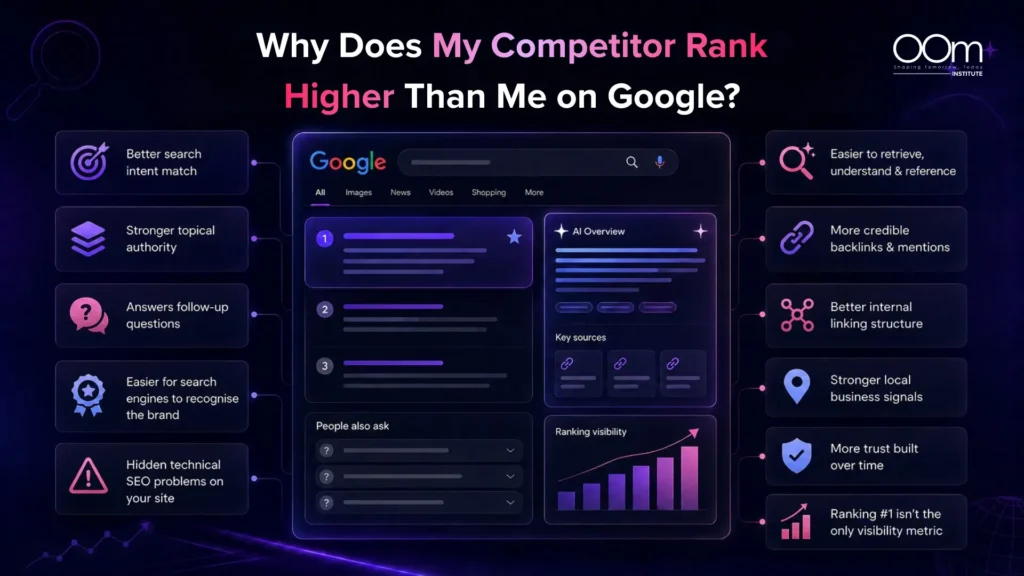
01 Their Page Matches the Search Intent More Precisely
Suppose you sell accounting software and want to rank for “best accounting software for SMEs”. Your page explains your own platform, while your competitor has published a comparison guide covering pricing, business size, GST features and which type of company each option suits.
Your software may be the stronger product, but the competing page is likely more useful to someone still weighing up their options.
💡When you compare pages, look beyond keyword usage and ask what the reader can achieve on the competitor’s page that is harder to do on yours.
02 Their Website Has Stronger Topical Authority
One strong page can only do so much if the rest of your website says very little about the same subject. A large content library filled with thin or repetitive articles adds little either.
💡What matters is whether your website covers the topic with enough depth, across connected pages, to help readers understand it from different angles.
03 Their Content Answers the Questions Users Ask Next
People rarely have just one question.
Someone searching “How much does a solar panel installation cost?” may also want to know how long the panels last and how long it takes to recover the initial cost. A competitor that answers these related questions offers a more complete experience, which has become even more relevant with AI-assisted search, where people phrase queries as detailed questions rather than short keywords.
💡You do not need to turn every page into an oversized FAQ. Identify the questions that naturally follow from your main topic.
04 Their Website Has More Credible Backlinks and Mentions
A competitor may have been quoted by an industry publication, linked to by a trade association, or referenced by other relevant websites.
Quality matters far more than quantity here. A handful of links from trusted, relevant sources can carry more value than hundreds of low-quality directory links.
💡When you analyse backlinks, focus on where they came from and why those websites chose to reference your competitor.
05 Their Brand Is Easier for Search Engines to Recognise
If your company name, services and contact details appear differently across your website and third-party platforms, it becomes harder for search systems to build a clear picture of your brand.
💡A competitor with consistent information across its website, Google Business Profile, media coverage and partner websites helps search systems connect the brand more clearly with a particular service or area of expertise.
06 Their Content Is Easier to Retrieve, Understand and Reference
Useful information can still be hard for search systems to access if it is buried in the wrong place, such as inside a downloadable brochure instead of on a service page.
💡The same principle applies to AI-assisted search, where content needs to be technically accessible before it can be surfaced or referenced.
07 Your Website Has Technical Problems You Cannot See
A useful page might accidentally carry a noindex tag, canonicalise to the wrong URL, or sit behind unnecessary redirects.
💡These issues are easy to miss because your website looks perfectly normal when you browse it yourself, so before assuming a competitor is winning on content alone, check that your own site is not being held back by problems you cannot see.
08 Their Website Has a Better Internal Linking Structure
A competitor can have fewer pages and still organise them more effectively, with a central guide that connects naturally to supporting articles.
💡Internal linking is about structure rather than volume. A smaller number of well-placed links is more useful than adding links everywhere without a clear reason.
09 Their Local Business Signals Are Stronger
For location-based searches, your website is only part of the picture. A competitor with a complete Google Business Profile, accurate listings and relevant reviews may outperform you in local search even with a less polished site.
💡If your business relies on nearby customers, include local signals in your competitor analysis, not just organic rankings.
10 Their Pages Have Accumulated More Trust Over Time
An older page does not rank well simply because it has been online longer.
It may have earned backlinks, gained internal links and been updated regularly, accumulating signals a newly published page has not had time to build.
💡When comparing an established competitor page with a newer page of your own, consider that history as well as the content you can see today.
11 Ranking First Is No Longer the Only Measure of Search Visibility
A competitor may rank below you for a keyword but still appear in an AI Overview, local pack or featured result, so do not judge competitor performance by one ranking position alone.
Keyword rankings still matter, but they are more useful when you view them alongside where else a brand appears.
💡This wider view becomes especially important once people start asking longer, more specific questions through generative search tools.
How Can a Website Rank in Google but Remain Invisible in AI Search?
Traditional search rankings and AI visibility do not always favour the same websites, partly because AI systems draw from a wider mix of sources, including forums and third-party publications, alongside traditional search results.
A page can be cited in an AI answer without ranking highly in Google, and vice versa.
Consider a law firm that ranks fourth for “employment lawyer Singapore” with a page that offers little detail on dismissal disputes or employment contracts.
A firm that ranks seventh but has detailed supporting pages on those exact questions may be the one an AI system surfaces when someone asks “What should I do after receiving a wrongful dismissal letter in Singapore?”, because AI answers frequently reference several sources rather than only the top organic result.
Clearly structured content, including list formats, tends to be easier for AI systems to parse and extract, though structure alone is not enough; the information still needs to be accurate and specific.
This does not mean lower-ranking websites automatically perform better in AI search, but it does show why your competitor analysis now needs to look beyond keyword positions alone.
- Pro Tip: Why Your Website Is Not Appearing in AI Overviews?
The usual reasons are that your content is not detailed enough for the exact question being asked, is difficult for AI systems to retrieve, or lacks the third-party validation that helps a system trust the answer.
Covering the specific follow-up questions a reader would ask, and making that information easy to extract, supports both Google rankings and AI citations at once, so you rarely need separate content strategies for each.
What Is Generative Engine Optimisation, and Is It Different from SEO?
Generative Engine Optimisation, or GEO, focuses on improving how your brand and content appear in AI-generated answers. A closely related term, Answer Engine Optimisation (AEO), focuses more specifically on structuring content to directly answer particular questions. In practice, the two overlap heavily and both sit on top of core SEO rather than replacing it.
Google’s current guidance is that core SEO principles still apply to its generative search experiences: useful content, crawlability, technical accessibility, relevance and authority continue to matter.
AI systems still rely on the same crawlable, well-structured, authoritative content SEO has always required, which is why small businesses can apply GEO principles without advanced AI tools.
Clarifying what your brand is known for and keeping information consistent does not require specialised software. Many businesses can start by strengthening core SEO before considering a specialist GEO agency.
🤔 The main difference between SEO, AEO and GEO is what you pay attention to.
SEO focuses on ranking in traditional results. AEO focuses on structuring content to directly answer questions. GEO focuses on how your brand appears across AI-generated answers more broadly: which prompts trigger brand mentions, which competitors appear more often, and which sources are cited.
A modern GEO course should show you how AI visibility fits into the wider SEO picture rather than treating it as a separate skill.
How Can I Make My Brand More Likely to Appear in AI Answers?
There is no guaranteed way to make an AI system mention your brand, but you can improve your chances by making your business easier to understand, verify and retrieve across the web.
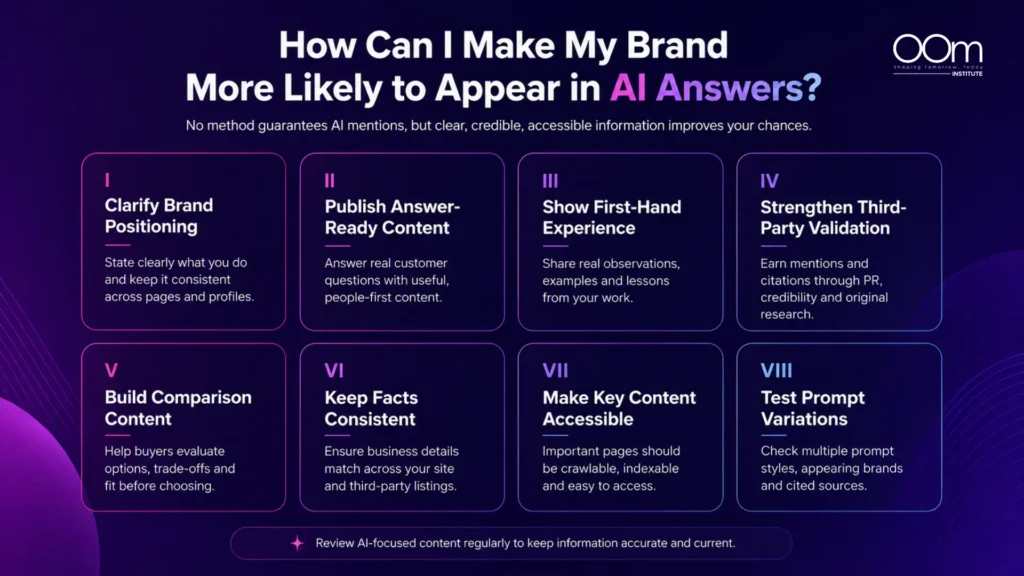
I. Clarify What the Brand Should Be Known For
If your company describes itself as offering “innovative solutions for modern businesses”, both customers and search systems are left with little concrete information.
A company that consistently explains it provides commercial solar installation for warehouses in Singapore creates a clearer association. Keep this positioning consistent across your service pages, company descriptions and third-party profiles.
II. Publish Answer-Ready Content
Address the questions customers are genuinely asking.
For an ERP provider, that may include how long implementation takes, what migration from an old system involves, and when a business may be too small for an ERP system.
Rather than creating content for every possible prompt variation, answer important customer questions thoroughly and let the content stay useful to people first.
III. Demonstrate First-Hand Experience
Generic content is easy to reproduce, which makes first-hand experience valuable.
A stronger piece might explain the mistakes employees commonly make during phishing simulations rather than just listing generic benefits of staff awareness training.
Anonymised observations from real work make your content more credible and give other websites a reason to reference it.
IV. Strengthen Third-Party Validation
Press mentions from established, relevant publications act as third-party validation that helps AI systems corroborate what your own website says.
Publishing original research is one of the stronger ways to earn these citations, because original data gives other websites a genuine reason to reference you rather than a competitor covering the same generic topic.
Review this AI-focused content at least quarterly, since outdated or inconsistent information is one of the more common reasons AI systems misrepresent a brand.
V. Build Comparison and Decision Content
A software provider might publish content comparing cloud ERP with on-premise ERP, or explaining when an ERP system may not be worth the investment.
This works because it addresses real buying concerns instead of assuming your product suits everyone.
VI. Keep Factual Information Consistent
If your homepage says six branches, an old contact page says four, and third-party directories show five, that inconsistency creates confusion for readers and for AI systems trying to verify your business.
Your regular content reviews should include accuracy checks, not only keyword and performance reviews.
VII. Make Important Content Accessible
Before advanced AI optimisation tactics, check whether your important content can actually be crawled and indexed. Useful information hidden behind scripts or poorly configured settings may struggle to appear in search regardless of how strong it is.
VIII. Test Multiple Prompt Variations
Do not judge AI visibility from one prompt alone, since customers describe the same need in many ways. A tuition centre might test “best physics tuition for O-Level students in Singapore” alongside “physics tuition for students struggling with calculations” and “how to choose an O-Level physics tutor”.
Track which competitors appear and which sources are cited, and treat the results as a sample rather than a fixed ranking, since AI responses can vary between runs.
What New Metrics Should I Track Beyond Keyword Rankings?
Keyword rankings remain a useful signal and still influence how often you are considered for citation in AI answers, but they are no longer the complete picture.
To measure AI visibility and brand mentions, test a consistent set of realistic prompts on a regular schedule, then record whether your business appears and which sources are cited alongside it.
Standard analytics only cover part of this. Google Analytics 4 can capture some referral traffic from AI platforms, but it will not capture visibility within an AI-generated answer itself, so you need separate prompt testing for that.
You do not necessarily need a dedicated AI visibility tracking tool to get started; a tool only becomes more valuable as you scale the number of prompts, competitors and markets you want to monitor.
| Metric | What It Tells You |
| Organic clicks | Whether search visibility is bringing visitors to your website |
| Search impressions | How often your pages are appearing in search |
| Non-branded visibility | Whether you are reaching people who do not already know your brand |
| SERP feature presence | Whether your brand appears beyond standard organic listings |
| Indexed important pages | Whether your key pages are eligible to appear in search |
| Referring domains | Whether credible external websites are linking to your content |
| AI brand mention rate | How often your brand appears across a defined set of prompts |
| AI citation rate | How often your website is referenced as a source in AI-generated answers |
| Competitor citation share | Which competitors appear most often across relevant AI answers |
| Local visibility | How strongly different branches or locations appear in local search |
| Organic conversions | Whether search visibility is contributing to enquiries, sales or other business outcomes |
Google Search Console can help track visibility in generative search where available, and third-party AI SEO tools can support broader competitor research. Moving from position six to position three matters more if it also brings in more enquiries or sales, so connect your visibility metrics with what those gains are doing for the business.
How Should I Compare My Website with a Higher-Ranking Competitor?
Copying a competitor’s headings, page structure or content length shows you what they published, not why the page performs better, and their structure reflects their own content strategy rather than a guaranteed ranking formula.
Use it as a reference point instead. Compare your page against theirs across search intent match, content depth, backlink quality, internal linking, technical health, local signals and AI visibility, then identify which advantage is actually driving the gap.
Finding a competitor’s content gaps means mapping the questions they answer that you do not, and vice versa.
The gaps that matter most are tied to real buying or decision-making questions, not every possible subtopic. Whether you use a tool, hire a consultant, or take an SEO course to run this analysis depends on how often you need to do it and how much you want your team to understand independently.
Conversion matters too. A page can attract strong visibility but still underperform if visitors are unsure what to do next. For example, if a competitor has a 3,500-word guide while your article is only 1,400 words, the fix is rarely just to make your page longer.
A closer review may show the competitor includes detailed pricing examples and original photographs from completed projects; those elements are what make the page more useful, not the word count itself.
What Should I Improve First if a Competitor Ranks Above Me?
If search engines cannot crawl or index your page properly, none of your other improvements will matter until that is resolved.
Meaningful movement after a fix typically takes weeks to a few months, depending on how significant the issue was and how competitive the keyword is.
Technical fixes tend to show results faster than authority-building work, which takes longer to compound. Focus on Google and core SEO first: strong foundations directly support your AI visibility too, so you are rarely choosing one over the other.
Update an existing page when it already ranks reasonably and the gap is about depth or freshness; create a new page when the existing one targets a different intent.
Access
Check whether search engines can crawl and index your page without problems. Address blocked or excluded content before you spend time rewriting the page.
Intent
Make sure your page matches what people are actually looking for. If results are dominated by comparison guides and your page is a short product page, more keywords will not fix the mismatch.
Coverage
Look at whether your page answers enough of the questions that matter to the reader, without padding it for the sake of length.
Differentiation
Ask what your page offers that competing pages do not: first-hand experience, original photographs, proprietary data or more specific examples. The stronger the difference, the less your page feels like another version of what is already ranking.
Authority
Review the wider support around your page, including internal links and credible external mentions. If competitors have built stronger authority over time, improving the page alone may not close the gap.
AI Readiness
Check whether your important information is easy to find and technically accessible. You do not need to rebuild content specifically for AI; strong SEO foundations already make it easier for search systems to discover and understand what your pages offer.
Conversion
Once your page is attracting visibility, make sure it also helps visitors take the next step, whether that is an inquiry, a comparison or a quote request. A page that ranks well but leaves users unsure what to do next is still underperforming.
When Is SEO Training More Useful Than Simply Hiring an Agency?
Hiring an SEO agency makes sense when you need specialist expertise or substantial technical work. Training becomes more useful when SEO decisions are being made in-house every day, and this is rarely an either-or choice.
Many organisations use an agency for specialist strategy while training helps the internal team make better day-to-day decisions and work more effectively with that agency.
🤔 Who Should Attend SEO Training?
Anyone directly involved in publishing, editing or approving web content benefits most from this kind of training, since they are the ones making SEO-relevant decisions day to day.
Content writers in particular have good reason to learn AI SEO alongside traditional SEO, so they can structure content correctly the first time rather than relying on someone else to fix it afterwards.
For SMEs managing their own website without a dedicated in-house SEO specialist, a course can be well worth it.
A good SEO course should cover search intent, technical SEO, content strategy, competitor analysis and AI visibility through practical, work-relevant exercises.
Take an in-house marketing team managing a 500-page website. An agency can handle keyword research and technical audits, but the internal team still decides which landing pages are created and which articles are published each month.
If your team does not understand search intent or competitor analysis, the same SEO issues can easily return between agency reviews. Training helps you ask more useful questions, instead of simply asking why a page is not ranking, you can investigate whether the search intent is wrong, why a page has been excluded from the index, and how AI visibility should be measured alongside traditional performance.
OOm Institute’s SEO course focuses on practical digital marketing skills you can apply directly in the workplace, whether you want to manage more of your SEO internally or work more effectively with an agency.
Final Verdict: Why Does a Worse Website Rank Above Yours?
A worse-looking website can still rank above yours because search engines assess far more than visual design. A competitor may simply be doing a better job of matching search intent, covering the topic in useful depth, building authority and keeping technical issues under control.
The purpose of SEO competitor analysis is not to copy what is already ranking. It is to understand where your competitor has an advantage and decide how your own website can respond with stronger content, clearer evidence or a better overall search experience, including how easily your brand can be understood and surfaced beyond traditional rankings.
If you want to build stronger SEO skills and make more informed decisions about where to improve, contact OOm Institute to find out which training options best fit your organisation.
Frequently Asked Questions
1. Can an SEO audit identify exactly why my competition outranks me?
An SEO audit can identify the most likely reasons, but it cannot reveal Google’s exact ranking formula. A good audit compares search intent, content quality, technical health, internal linking, backlinks, site structure and competitor strengths to show where the biggest gaps are likely to be.
2. Should I redesign my website before investing in SEO?
Not necessarily. If the main problems are weak content, poor search intent alignment, indexing issues or limited authority, a redesign may not solve them. Identify what is affecting performance first, then decide whether design changes are actually needed.
3. Is it better to hire an SEO agency or train my internal marketing team?
It depends on how much SEO work happens in-house. An agency can provide specialist strategy and execution, while training helps your internal team make better decisions when creating content, landing pages and campaigns. Many organisations benefit from using both.
4. What should a competitor SEO audit include?
An SEO competitor analysis should compare keyword visibility, search intent, ranking pages, content coverage, internal linking, backlink profiles, technical health, local visibility and conversion paths. It can also include AI visibility checks to see which competitors appear across relevant conversational searches.
5. Can OOm Institute's SEO training help me analyse my competitors?
OOm Institute’s SEO training covers competitor benchmarking, keyword research, content strategy, technical SEO and performance analysis. These skills help you understand where competitors may have an advantage and which improvements are worth prioritising.
6. Does an SEO course now need to cover AI Overviews and ChatGPT?
A current SEO course should explain how search is changing across traditional results and AI-assisted discovery. It should still cover core SEO principles such as crawlability, useful content, authority, technical accessibility and relevance, because these remain important foundations.
7. Can I improve AI search visibility without ranking first on Google?
Yes. AI-generated answers can reference several sources rather than relying only on the top organic result. Your website may still appear for specific questions even if it does not rank first for the broader keyword.
8. How can I find out whether ChatGPT mentions my business?
Test a range of realistic prompts that potential customers might use and record whether your business appears, which competitors are mentioned and which sources are cited. Repeat the exercise over time, because AI responses can vary.
9. What should I ask an SEO agency about GEO?
Ask how the agency’s GEO strategy connects with technical SEO, content quality, brand authority and measurement. Also ask how AI visibility is tested, which metrics are tracked and how GEO recommendations differ from the agency’s standard SEO work.
10. How do I decide which competitor to benchmark against?
Focus on the websites that consistently appear for the searches that matter to your business. Your main commercial competitor may not always be your strongest search competitor, since publishers, marketplaces and specialist websites can compete for the same visibility.
11. How often should I conduct an SEO and AI visibility competitor analysis?
A detailed quarterly review is a practical starting point for many businesses, supported by lighter monthly checks of important rankings, competitors and AI visibility. More competitive industries may need more frequent reviews, especially after major website changes or shifts in search behaviour.