
- QUICK ANSWER
For most beginners, we recommend starting with generative AI, progressing to prompt engineering when more reliable and structured outputs are needed, and exploring agentic AI when they are ready to manage or automate multi-step workflows.
We regularly see professionals who know they need to develop AI skills but are unsure where to begin. Generative AI, prompt engineering and agentic AI are often discussed together, even though they involve different levels of knowledge and serve different workplace needs.
You may not need to master all three areas.
Some roles require advanced AI capabilities, while many employees will gain more value from first building a strong foundation. Once you understand the differences, it becomes easier to choose a learning path that matches your role, current ability and intended application.
For organisations, this distinction is equally important. It allows training programmes to be designed around actual business goals and job requirements rather than sending every employee through the same course.
According to the Future of Jobs Report 2025:
Generative AI vs Prompt Engineering vs Agentic AI
| Area | Generative AI | Prompt Engineering | Agentic AI |
| Main purpose | Create or transform content | Improve the quality and consistency of AI outputs | Complete multi-step tasks towards a goal |
| Typical interaction | User enters a request and receives an output | User designs and refines structured instructions | AI plans, takes actions and evaluates progress |
| Difficulty level | Beginner-friendly | Beginner to intermediate | Intermediate to advanced |
| Coding required | No | Usually no, although technical knowledge may help with advanced applications | Sometimes, more complex implementations may require programming, APIs, system integration and data management |
| Best for | Everyday productivity and content tasks | Reliable, repeatable and higher-quality outputs | Workflow automation and tool-connected processes |
| Main risk | Inaccurate or generic output | Poor context or overconfidence in prompt structures | Unintended actions, access risks and cascading errors |
| Recommended starting point | Most beginners | Regular AI users | Learners with strong AI and workflow foundations |
01 What is Generative AI
Generative AI refers to AI systems that can create new content or transform existing information based on the instructions you provide. Depending on the tool, it may produce text, images, videos, audio, code, summaries, presentations and other forms of content.
ChatGPT is one example of generative AI because it can generate and revise text based on the prompts and context you provide. In the workplace, we see generative AI supporting a wide range of everyday tasks. The way it is used will differ across business functions.
| Business functions | What Generative AI can help with |
| Marketing teams | Develop campaign ideas, produce content drafts, and research audience interests |
| Human resource professionals | Create training materials, summarise employee feedback, and improve internal communications |
| Sales teams | Prepare meeting notes, personalise outreach, and research potential customers |
| Operations teams | Process documents, organise recurring information, and identify opportunities to improve workflows |
You generally do not need coding or technical knowledge to begin using generative AI because many tools accept natural-language instructions.
However, effective use involves more than typing a request into a chat box. You still need to define the task clearly, provide relevant context, choose an appropriate tool and assess whether the output is accurate and useful.
🤔 What Skills Do You Need to Use Generative AI Effectively?
From our perspective, learning to use generative AI effectively should go beyond understanding where to click. You also need to develop the judgement required to decide when and how AI should support your work.
- Applying professional and subject-matter judgement
- Identifying tasks where AI can provide meaningful support
- Protecting confidential and sensitive information
- Refining AI-generated work rather than accepting the first output
- Recognising when human input or approval is necessary
- Giving clear instructions and relevant background information
- Choosing the right tool for the intended task
- Reviewing outputs for accuracy, relevance and completeness
Generative AI also has limitations.
It can produce responses that are incomplete, outdated, biased or incorrect, including information that sounds convincing but is not factual.
For this reason, we encourage learners to verify important claims, especially when AI is being used for legal, medical, financial or business-critical tasks.
You should also avoid entering confidential, personal or sensitive company information unless the tool has been approved by your organisation. Safe use depends on the platform’s security and privacy controls, as well as your company’s own data-handling policies.
🤔 What Does Learning Generative AI Enable You to Do?
A practical generative AI course should not simply teach you how to operate one platform. It should help you understand where AI fits into your work and how to use it responsibly.
After developing a foundation in generative AI, you should be better able to:
- Recognise where generative AI can improve your work
- Identify hallucinations, inaccuracies and unsuitable outputs
- Create clearer and more useful instructions
- Produce and refine content more efficiently
- Evaluate AI-generated responses critically
- Select appropriate AI tools for different tasks
- Use AI responsibly within workplace policies
- Maintain human judgement when making decisions
- Build a foundation for prompt engineering and more advanced AI workflows
02 What is Prompt Engineering
Prompt engineering is the practice of designing, testing and refining instructions so that an AI system can produce more relevant, accurate and consistent outputs.
We do not treat prompt engineering as a separate type of AI. It is a practical skill that helps you use generative AI more effectively.
In simple terms, prompting means asking AI to perform a task. Prompt engineering means improving how that task is instructed so that the output meets its purpose more reliably.
Prompt frameworks can be useful because they give you a structure for organising your instructions. However, we do not believe you need to memorise formulas or search endlessly for one “perfect prompt”.
Different tasks and AI tools may require different approaches. The more valuable skill is learning how to assess the output and refine your instruction when the result does not meet your needs.
👉 Interested in learning how to create ChatGPT image prompts?
- Pro Tip: What Makes a Good AI Prompt?
A good prompt is not necessarily a long prompt. Your goal should be to provide the information that meaningfully affects the output without adding unnecessary instructions.
Depending on the situation, a useful prompt may include a clear objective, relevant background information, intended audience, specific constraints, examples of suitable outputs, information the AI should avoid, and criteria for evaluating the response.
Effective prompt engineering therefore requires judgement, experimentation and refinement rather than simply filling in a template.
Prompt engineering can reduce irrelevant or unsupported responses when you provide reliable source material, set clear boundaries and ask the AI to acknowledge uncertainty.
However, prompt engineering cannot eliminate hallucinations completely, so important information should still be reviewed and verified.
Most prompt engineering does not require coding and can be learned by non-technical professionals. Coding is mainly needed when prompts are integrated into software, APIs, automated workflows or AI agents.
🤔 Is Prompt Engineering Still Worth Learning?
We believe prompt engineering remains useful even as AI models become easier to use. More advanced models may understand casual instructions more effectively, but workplace tasks are often ambiguous, complex or highly specific.
AI cannot always infer the requirements, context or quality standards that matter to your organisation. You may still need to tell an AI:
- Which information to prioritise
- Who the output is for
- What business context applies
- Which format to follow
- What should not be included
- How much detail is required
- Which quality standards must be met
- When the AI should ask for clarification or acknowledge uncertainty
Prompt engineering is therefore not only about writing better sentences. It is about translating your intended outcome into instructions that an AI system can follow and that you can evaluate.
03 What is Agentic AI?
Agentic AI refers to AI systems that can work towards a defined goal by planning and carrying out a series of actions with limited human supervision. Instead of responding to only one instruction at a time, an AI agent can interpret an objective, break it into smaller tasks, use approved tools or information sources, evaluate its progress and adjust its approach when necessary.
This is also what distinguishes agentic AI from traditional automation.
Traditional automation generally follows a fixed sequence of predefined rules. An AI agent may choose its next step based on the information it receives and the result of its previous actions.
However, we would not describe every multi-step workflow as agentic. A system that follows a predetermined process without making decisions or adapting remains a form of automation, even when AI is used within one of the steps.
🤔 What Can AI Agents Do in a Business?
AI agents may support business processes that involve several connected tasks, information sources or decisions. Potential applications include:
- Responding to routine customer enquiries
- Retrieving information from internal knowledge bases
- Preparing and updating reports
- Researching prospects before sales meetings
- Summarising customer interactions
- Qualifying and routing leads
- Monitoring operational issues
- Supporting employee onboarding
- Reviewing documents for missing information
- Coordinating administrative tasks
- Assisting with data analysis
- Recommending the next step in a workflow
AI agents are not necessarily fully autonomous.
Some may only recommend an action. Others may be allowed to complete low-risk tasks independently. Sensitive actions, such as issuing refunds, accessing confidential data, changing contracts or making financial commitments, should usually require human approval.
- Pro Tip: What Is Human-in-the-Loop Oversight?
Human-in-the-loop oversight means a person remains involved at selected points in an AI-assisted process.
We consider this particularly important when a decision has legal, financial or reputational consequences, the agent’s confidence is low, sensitive information is involved, the requested action exceeds an approved limit, an unusual exception occurs, the agent cannot verify important information, and the action would be difficult to reverse.
Because agentic AI can act across multiple systems and workflow stages, it introduces risks beyond those associated with content generation alone.
An agent may use inaccurate information, take an unintended action, repeat errors across several steps or access more data than necessary. Businesses should therefore restrict permissions, define clear escalation rules, maintain activity records, test agents in a controlled environment and regularly review its performance.
Learning about agentic AI does not always require coding.
As a non-technical professional, you may be able to use no-code or low-code platforms to map workflows, define goals, configure instructions and identify approval points.
More advanced or business-critical systems may still require technical expertise in software development, system integration, cybersecurity and data governance.
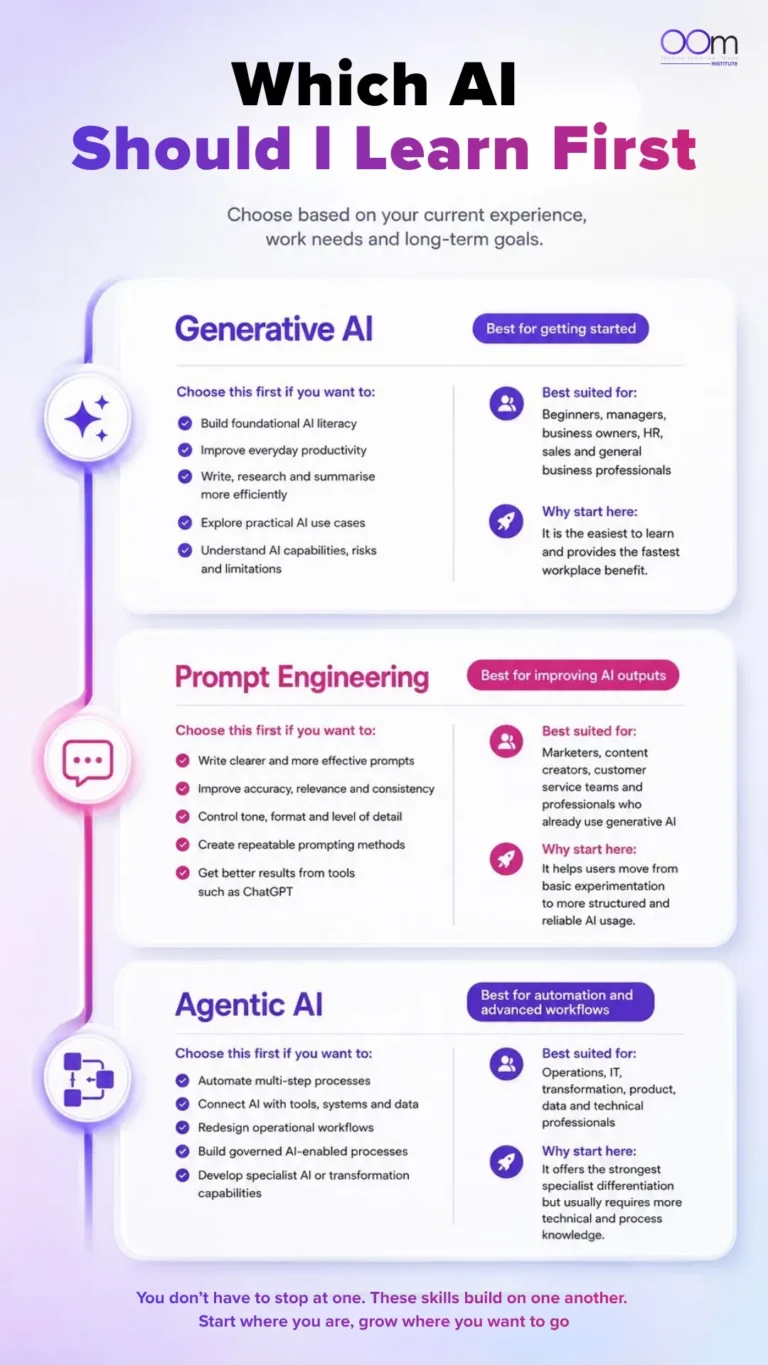
🤔 So… Which AI Course Should I Learn First?
For most learners, we recommend a practical progression:
Start with Generative AI
Develop prompt engineering skills
Move into agentic AI when you are ready
👉 Also read: The Cost of AI Courses in Singapore
|
1 |
Generative AI is the easiest place to start and usually provides the fastest workplace benefit. You can apply it to familiar tasks such as drafting emails, summarising documents, researching topics and preparing reports without needing coding knowledge or technical setup. |
|
2 |
Prompt engineering is the next step when you want more accurate, structured and repeatable outputs. It remains accessible to non-technical professionals, but it requires you to pay closer attention to context, constraints, audience and quality control. |
|
3 |
Agentic AI is generally the most advanced because it may involve multi-step workflows, connected systems, permissions and decision rules. It offers strong potential for workflow automation. However, a fixed and predictable process may still be better suited to traditional automation. |
We view this progression as a useful guide rather than a strict rule.
You may not need to attend a separate generative AI course when a beginner-friendly prompt engineering programme already covers AI fundamentals, limitations and output evaluation.
Similarly, experienced ChatGPT users may be able to skip introductory training when they can already use generative AI confidently across different tasks, identify inaccurate outputs and handle information responsibly.
However, frequent use alone does not necessarily mean you have a strong AI foundation. You may still benefit from foundational training if you rely on vague prompts, accept responses without verification or overlook privacy risks.
Beginners can explore agentic AI through guided no-code exercises. In our experience, however, it is usually easier to design and assess automated workflows after you have learned how to structure instructions, evaluate outputs and manage human oversight.
The most useful AI skill ultimately depends on your role, current ability and intended application. No single course provides the strongest career value for everyone.
💡 The most useful AI skill depends on the learner’s role, current ability and intended application. No single course provides the strongest career value for everyone.
A Recommended AI Learning Path for Beginners
Rather than learning individual tools in isolation, we recommend developing your skills through practical stages. Each stage should prepare you to handle more complex tasks with greater control and confidence.
Build AI Literacy
Improve Your Prompting
Build Repeatable Workflow
Explore Agentic AI
Stage 1 Build AI Literacy
Start by taking a generative AI course to learn what generative AI can do, where it may fail and how to use it responsibly. Your foundation should cover common workplace applications, hallucinations, bias, data privacy and the importance of reviewing AI-generated content.
Practise with familiar tasks such as drafting emails, summarising documents or brainstorming ideas.
At this stage, your goal is not simply to produce an output. It is to recognise when AI is useful, how much you can trust the result and where human judgement remains necessary.
Stage 2 Improve Your Prompting
Once you understand the fundamentals, learn how to give clearer instructions. This includes defining the objective, providing context, setting constraints, specifying the audience and format, and refining the prompt based on the output.
The aim is not to memorise formulas. It is to understand how different instructions affect the result and turn successful prompts into reusable templates.
Practise with familiar tasks such as drafting emails, summarising documents or brainstorming ideas.
At this stage, your goal is not simply to produce an output. It is to recognise when AI is useful, how much you can trust the result and where human judgement remains necessary.
Stage 3 Build Repeatable Workflows
The next step is to connect several prompts into a structured process. For example, a content workflow may include research, outlining, drafting and quality review.
At this stage, you should learn how to divide a task into steps, transfer information between those steps, maintain consistent instructions and add human checkpoints. This creates a bridge between prompt engineering and agentic AI.
Stage 4 Explore Agentic AI
You can progress to agentic AI when you are comfortable structuring tasks, reviewing outputs and designing workflows.
At this stage, focus on how agents use tools, make limited decisions and complete multi-step tasks. Learners should also understand permissions, task boundaries, approval points, exception handling and human supervision.
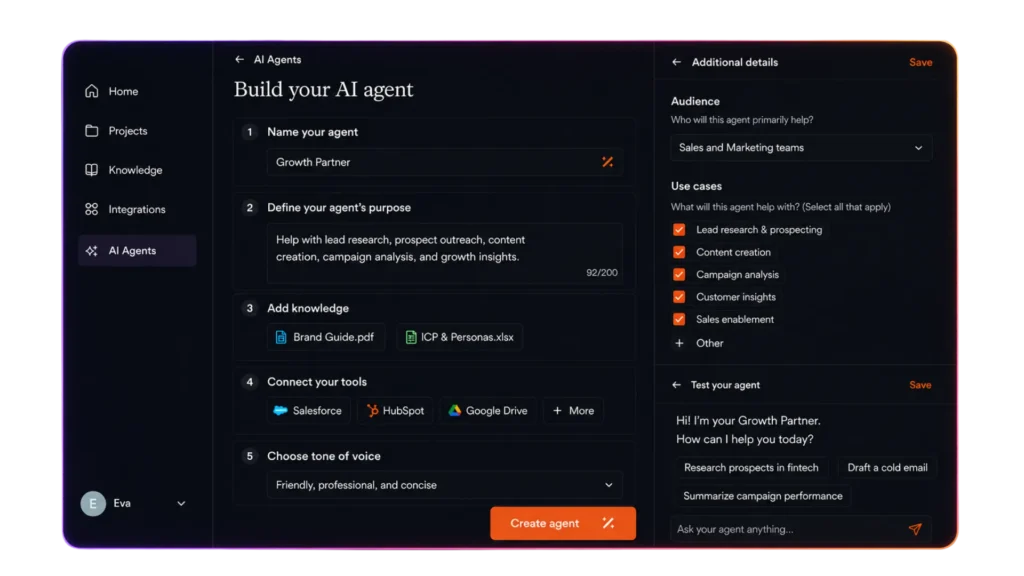
Coding is not always required, as no-code platforms can be used to explore simple agentic workflows. However, we recommend focusing on how to design a reliable process rather than learning only how to configure a particular tool.

Claude Cowork Bootcamp
No coding required. Build AI agents in plain language to automate workflows, surface insights, and handle recurring tasks.
How Long Does It Take to Learn AI?
There is no fixed timeline.
You may become comfortable with basic generative AI tasks relatively quickly. Strong prompting, workflow design and agentic AI generally require continued practice.
Rather than progressing according to a fixed number of days or weeks, we recommend moving to the next stage when you can apply the current skill confidently, review the results critically, and recognise where the approach may fail.
Should You Learn AI Through Projects or Theory?
Both are important, but we believe practical application should form a significant part of the learning process. Theory helps you understand the concepts, limitations and risks. Projects allow you to test instructions, identify errors, and improve your methods.
A strong learning experience should combine short explanations, guided exercises, realistic workplace scenarios and application to the learner’s own role.
What Is the Best Way to Practise AI at Work?
Both are important, but we believe practical application should form a significant part of the learning process. Theory helps you understand the concepts, limitations and risks. Projects allow you to test instructions, identify errors, and improve your methods.
A strong learning experience should combine short explanations, guided exercises, realistic workplace scenarios and application to the learner’s own role.
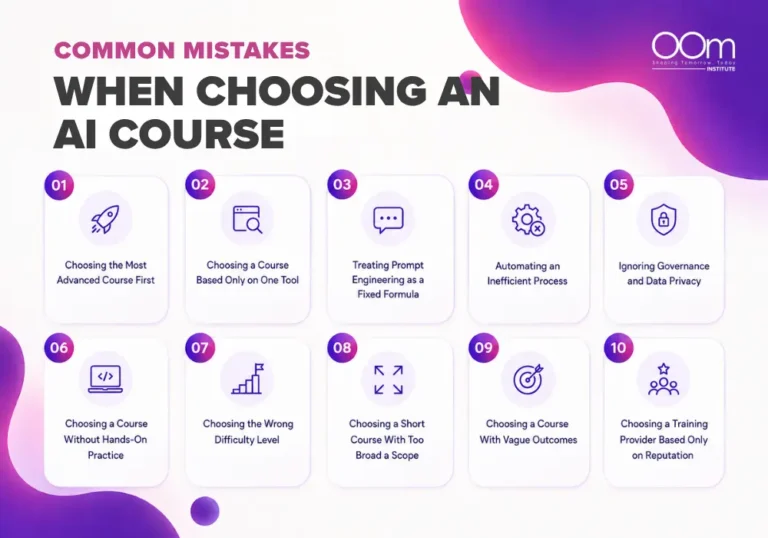
Common Mistakes When Choosing an AI Course
Comparing an AI course based only on its title, popularity or the latest industry trend can lead to a poor learning experience. We would suggest looking beyond the terminology and asking whether the course matches your current ability, workplace needs and intended outcomes.
Mistake 1: Choosing the Most Advanced Course First
Some learners choose agentic AI because it sounds more advanced or future-focused. However, the learning process can become unnecessarily difficult if you have not yet developed a foundation in generative AI or prompt engineering.
You may struggle to understand workflows, integrations, permissions and human oversight without first knowing how AI responds, where it can fail and how its outputs should be evaluated.
A more practical approach is to begin with generative AI, strengthen your prompting skills and progress to agentic AI when you are ready to work with more complex processes.
Mistake 2: Choosing a Course Based Only on One Tool
A course that focuses mainly on the features and interface of one AI platform may initially appear practical. However, the knowledge can become outdated quickly when the tool changes or another platform becomes more relevant.
You may finish the course knowing where to click without understanding how to identify a suitable use case, structure a task or assess the quality of the result.
We recommend choosing a course that combines hands-on tool practice with transferable skills such as prompting, task design, output evaluation and responsible use.
Mistake 3: Treating Prompt Engineering as a Fixed Formula
Prompt frameworks can help you organise instructions, but relying on one formula for every task often leads to prompts that are too rigid, too long or poorly matched to the intended outcome.
You may follow the structure correctly and still receive weak results because the prompt does not account for the context, audience or quality of the response.
A useful prompt engineering course should teach you how to adapt, test, and refine your prompts rather than simply memorise a standard template.
Mistake 4: Automating an Inefficient Process
Using agentic AI to automate a process without reviewing the workflow first can make existing problems worse. Unnecessary steps, unclear approvals, duplicated work and poor-quality data may be completed faster, but the process itself remains inefficient.
Before introducing automation, you should understand how to map the workflow, remove unnecessary steps, identify exceptions and decide where human review is still required.
Mistake 5: Ignoring Governance and Data Privacy
Some AI courses focus heavily on productivity while giving little attention to privacy, governance and responsible use.
This may lead learners to enter confidential information into unapproved tools, rely on inaccurate outputs or allow AI to take actions without sufficient oversight.
A good course should explain data handling, hallucinations, bias, permissions, approved tools and human accountability so that learners can use AI safely in a workplace environment.
Mistake 6: Choosing a Course Without Hands-On Practice
You may understand AI concepts during a lecture but still struggle to apply them independently if the course relies mainly on slides and demonstrations. Without practice, it is difficult to develop the judgement needed to improve prompts, identify errors or adapt AI to real work tasks.
A stronger course should include guided exercises that require learners to test different approaches, review outputs and solve realistic workplace problems.
Mistake 7: Choosing the Wrong Difficulty Level
A course may be labelled beginner-friendly even though it assumes knowledge of coding, automation or technical terminology. This can leave beginners overwhelmed.
At the same time, a course that is too basic may offer little value to experienced users.
Before enrolling, check the prerequisites, tools used, level of guidance and expected learning outcomes to ensure the course matches their current ability.
Mistake 8: Choosing a Short Course With Too Broad a Scope
Short AI courses can be useful, but problems arise when a programme attempts to cover generative AI, prompt engineering, agentic AI, and advanced automation within a limited timeframe.
The content may become rushed, leaving little opportunity for practice, feedback or meaningful application.
We recommend choosing a short course with a focused objective and realistic outcomes rather than one that promises to cover every area of AI.
Mistake 9: Choosing a Course With Vague Outcomes
Promises such as “master AI” or “future-proof your career” may sound attractive, but they do not explain what learners will actually be able to do after the course. This can result in a training experience that feels informative but produces no clear workplace capability.
A better course should state practical outcomes, such as creating reusable prompts, evaluating AI-generated content or identifying a workflow that is suitable for automation.
Mistake 10: Choosing a Training Provider Based Only on Reputation
A well-known provider may still offer a course that is too generic for your role or business need. If the examples, exercises and outcomes are not relevant, you may struggle to apply what you have learned after the training.
Companies should therefore assess whether the provider offers suitable difficulty levels, realistic use cases, hands-on practice, responsible AI guidance and content that can be adapted to their workplace.
- Checklist: What Should You Check Before Engaging an AI Training Provider?
✅ Is the course suitable for the participants’ current level?
✅ Are the examples relevant to their job functions?
✅ Does the programme include hands-on exercises?
✅ Are the learning outcomes specific and measurable?
✅ Does the training cover responsible use and data privacy?
✅ Are the skills transferable across different AI tools?
✅ Can the content be adapted to the organisation’s industry or use cases?
✅ Does the trainer understand both AI tools and workplace application?
✅ Will I leave with methods or resources they can continue using?
✅ Is the programme focused on solving real work problems rather than demonstrating features?
Generative AI, Prompt Engineering or Agentic AI: The Final Verdict
Generative AI helps you use AI. Prompt engineering helps you direct it. Agentic AI helps you apply it across a process.
The right course is not necessarily the one covering the newest or most advanced topic. It is the one that matches your current experience and helps you perform a real workplace task more effectively after the training.
For some learners, this means starting with generative AI to build confidence. For others, the next step may be improving the quality of their prompts or learning how to structure a repeatable workflow.
We believe the most practical learning path is the one that closes the gap between what you can do today and what you want AI to help you achieve next.
Frequently Asked Questions
1. Should companies train employees in Generative AI, Prompt Engineering, and Agentic AI?
We generally do not recommend training every employee in all three areas to the same depth. A layered approach is usually more practical:
- Organisation-wide foundational training
- Role-based capability development
- Specialist training for employees who require advanced skills
You can enrol in OOm Institute’s corporate training programmes to customise the curriculum according to your organisation’s industry, business needs, and workforce requirements.
2. Should I take a prompt engineering course if I already use ChatGPT regularly?
Yes, it can still be valuable. Frequent usage does not always translate into structured prompting. A course can help you produce more consistent outputs, handle complex tasks and create reusable prompt workflows for yourself or your team.
3. Do I need to learn generative AI before attending an agentic AI course?
It is generally advisable. Understanding generative AI, prompting and output evaluation gives you a stronger foundation for designing agents that perform multiple steps and interact with tools.
4. Can a non-technical professional learn agentic AI?
Yes, particularly through no-code or low-code tools. However, you should still be comfortable with process mapping, logical thinking, testing and defining rules for human oversight.
5. Which AI course is most suitable for managers and team leaders?
Managers often benefit from starting with generative AI so they can understand its capabilities, limitations and workplace risks. They can then progress to prompt engineering or agentic AI according to their team’s needs.
6. Which AI skill is most useful for marketing professionals?
Generative AI and prompt engineering are usually the most immediately useful. They can support research, ideation, content creation, campaign planning and the production of brand-aligned outputs.
7. Which AI course should a business send its employees to first?
Most organisations should begin with practical generative AI training that covers approved use cases, responsible use and output evaluation. More advanced training can then be assigned according to job role.
8. Can learning prompt engineering improve results across different AI tools?
Yes. Techniques such as providing context, defining constraints, including examples and specifying output formats can be adapted across many text, image, video and productivity AI platforms.
9. Will an agentic AI course teach me how to automate business workflows?
Agentic AI courses should teach the principles behind agent-enabled workflows, including process mapping, task sequencing, tool use, constraints, human approvals and testing. The level of actual automation will depend on the course scope and platforms covered.
10. How should I choose between a public AI course and corporate AI training?
A public course is suitable for individual professional development. Corporate training may be more appropriate when an organisation wants examples, policies, exercises and workflows tailored to its teams or industry.