
|
What is Prompt Engineering?
Generative AI can create text, images, video, and more.
Prompt engineering is the practice of designing and refining the instructions (called prompts) you give to an AI model (like ChatGPT) so it produces the best possible output.
Unlike traditional software, Generative AI draws from patterns in data, making it flexible but dependent on well-crafted guidance.
Think of it as learning how to ask better questions to get more accurate, useful or creative answers.
Skilled prompt engineers shape prompts that steer AI toward outputs that truly add value.
What Are the Types of Prompt
Prompt types are techniques used to guide AI models to generate specific, accurate, and relevant content.
Key prompt types for AI include:
- Zero-shot Prompting: You give the AI a task without any examples. It relies entirely on its existing knowledge. For example, “Summarise what OOm Institute does”.
- One-shot Prompting: You provide one example to show the desired format or style. For example, “Summarise a business in one sentence. For example, Mike is a global brand that designs and sells sportswear and footwear. Now summarise OOm Institute.”
- Few-shot Prompting: You provide more examples to establish a pattern.
- Chain-of-Thought (CoT): You guide the AI to reason step by step. “Explain what OOm Institute does. Think step by step: Identify the industry, describe its services, and summarise its value.”
- Role-Based Prompting: You assign a specific persona or role. For example, “You are a marketing consultant. Explain what OOm Institute does and how it positions itself in the market.”
- Contextual/Instructional Prompting: You provide background information and context to refine output. For example, “OOm Institute is a training provider focused on Generative AI skills for beginners and professionals. Explain what OOm Institute does in under 100 words for someone new to the industry.”
- Negative Prompting: You tell the AI what to avoid. For example, “Explain what Prompt Engineering Course in OOm Institute covers in simple terms. Do not use technical jargon or marketing buzzwords.”
- Multimodal Prompting: You combine text with other inputs such as images, URLs, and documents. For example, “Here is a brochure of OOm Institute (image/file). Please summarise the AI courses offered by the institute and their costs.”
Using these improves AI accuracy, reduces hallucinations, and handles complex tasks.
Why is Prompt Engineering Important?

Clear guidance is what makes Generative AI truly useful. Even the most advanced AI models can miss the mark without well-structured prompts, offering responses that fall short of expectations.
Here is why this skill matters:
- Bridges the gap between people and AI: Thoughtfully crafted instructions translate human intent into something AI can understand, making interactions feel more natural and seamless.
- Shapes AI outputs: Precise prompts influence the tone, direction, and depth of responses, allowing businesses to tailor outputs for customer service, marketing, and beyond.
- Improves efficiency: Building libraries of successful prompts creates reusable resources, helping teams save time while keeping their AI outputs consistent.
- Enhances user engagement: When prompts are tailored, AI delivers more relevant responses, encouraging stronger connections between users and technology.
- Supports diverse industries: Across Singapore and globally, companies in sectors such as content creation, customer support, and data analysis rely on prompt expertise to fine-tune their AI tools.
By providing this essential layer of guidance, prompt engineers turn AI from a general-purpose tool into a trusted assistant, helping users achieve clearer, faster, and more accurate results.
Prompt Engineering Examples
Prompt engineering finds its way into many everyday tasks, helping to guide AI responses across a wide range of situations.
Whether in simple interactions or complex workflows, well-designed prompts guide AI tools to respond in clear, useful ways that are aligned with human needs.
Here are some real-world examples of prompts in action:
How to Engineer Generative AI Prompts
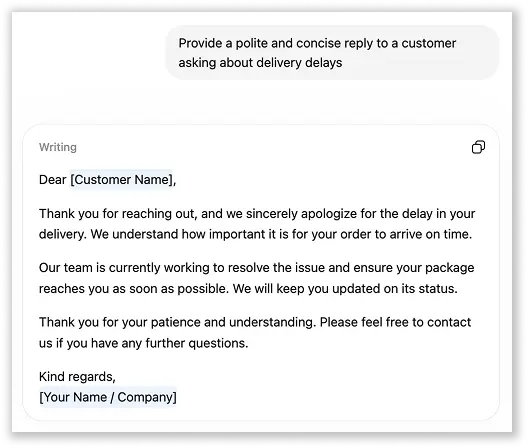
ChatGPTs response
A prompt such as “Provide a polite and concise reply to a customer asking about delivery delays” steers the AI to craft responses that are both informative and considerate.
We’ve also prepared ChatGPT prompts for you if you want to explore more ways they can help!
SEO Content Creation
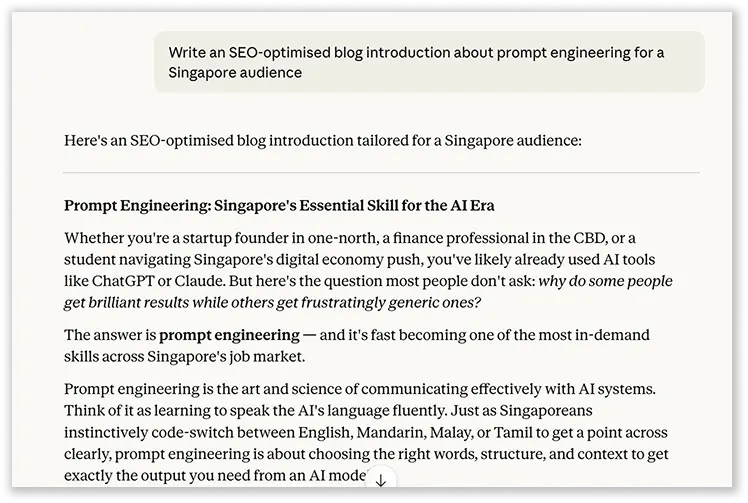
Claude’s response
Giving the AI a prompt like “Write an SEO-optimised blog introduction about prompt engineering for a Singapore audience” helps marketers and writers produce content that aligns with their goals and audience expectations.
Market Research Summaries
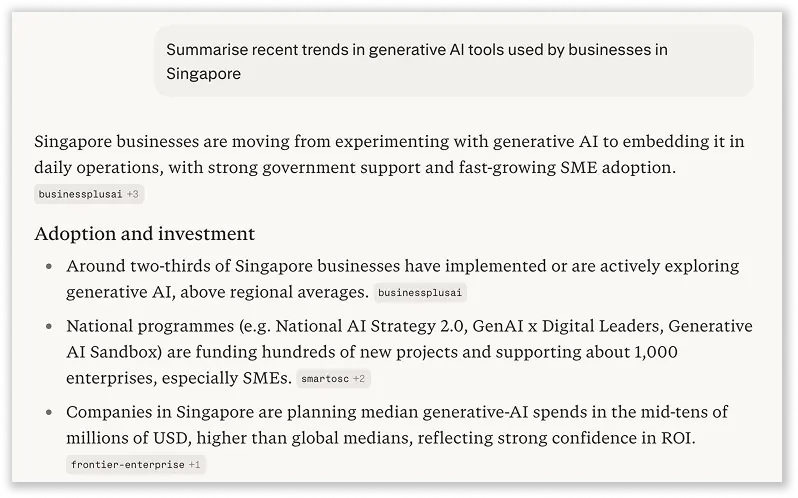
Perplexity’s response
With explicit instructions such as “Summarise recent trends in generative AI tools used by businesses in Singapore.” AI can filter data and deliver concise, relevant insights.
Market Research Summaries
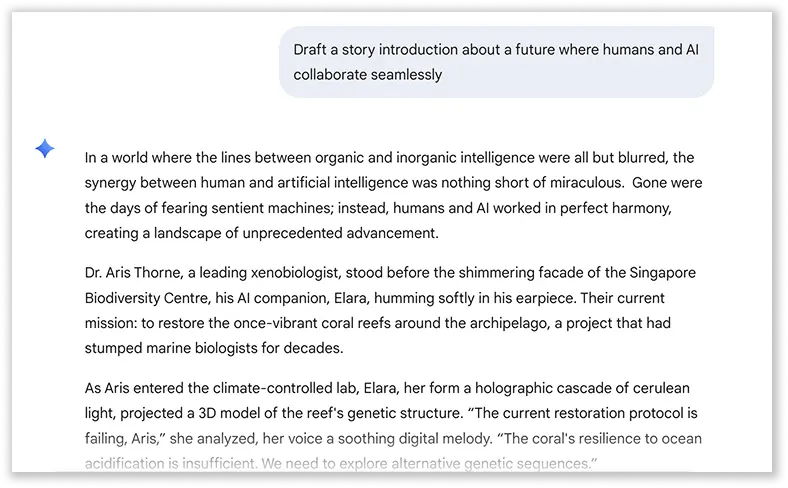
Gemini’s response
Prompts like “Draft a story introduction about a future where humans and AI collaborate seamlessly” encourage the AI to explore imaginative ideas and support writers in their creative process.
Ad Creatives Ideas

Grok’s response
Prompts like “Generate 1 high-converting ad creative for dental services in Singapore targeting women who are looking for teeth whitening treatment” guide AI to produce compelling, audience-specific marketing content.
You might be curious about the difference between Grok 3 and ChatGPT.
How to Engineer Generative AI Prompts
Crafting effective prompts is both a skill and an art. It calls for a good understanding of how AI models function, a clear vision of the desired outcome, and well-structured instructions that the AI can easily interpret.
Here is how you can approach prompt creation successfully:
1. Define your goal
Start by being clear about the outcome you want.
Do you need a detailed explanation, a creative draft, or a short, focused answer?
A well-defined goal sets the direction for your prompt and helps the AI produce relevant results.
For example, instead of simple asking:
“Write an article for “12 Best AI Courses in Singapore to Enrol”
you could make your goal more specific:
“Write a 12 Best AI Courses in Singapore to Enrol article, targeting business owners in Singapore, with the content objective of helping them compare each AI course in detail and the goal of driving enquiries after reading the article.”
2. Be specific and precise
Once your goal is clear, refine your prompt by adding details about tone, format, length, and target audience.
Avoid vague wording to make it easier for the AI to understand exactly what you want.
You could add on detailed instructions like this:
“…
Follow these instructions:
- Tone: Professional but friendly
- Format: Listicle Style
- Length: 2800–3000 words
- Target audience: Business owners from SMEs in Singapore”
3. Use examples where helpful
Then, you can further improve your prompt by including examples.
Showing the AI as a sample output helps it better understand the structure, style, and depth you’re looking for.
Instead of just saying:
“Write an article with the title of “12 Best AI Courses in Singapore to Enrol” in listicle format.”
You can guide the AI more effectively by providing a structure to follow:
“…
Use a listicle format with numbered lists to keep the content clear, engaging, and easy to skim.Follow this structure:
- Introduction
- List items (for each course, include: training provider, course name, cost, duration, mode of delivery, and URL)
- Conclusion
- Call-to-action”
4. Test and refine
Once you know what type of output you want, start experimenting with different ways of asking for it.
See if adding extra details, like specifying a tone, makes a difference.
You can also try changing your wording and see how the AI responds. Sometimes even small tweaks can make the answer much clearer and more relevant.
For example, should you say “in a professional tone” or “in a formal tone”?
5. Follow up with instructions or questions
After generating content, take a step back and evaluate whether it’s clear, engaging, and useful for your readers.
You can always ask AI to refine the output by asking:
“Suggest additional points that would make this article more useful.”
The generator can do this based on the output it provided earlier.
Iteration is your friend. Continue to “engineer” the prompt until you achieve your desired results.
6. Consider AI limitations
AI can sometimes miss subtle meanings. Design your prompts to reduce ambiguity and make your expectations as straightforward as possible.
Practical experience builds confidence in prompt design. Programmes that focus on generative AI, including specialised ChatGPT courses, often offer exercises that bring these techniques to life.
Through practice and ongoing refinement, you will learn how to guide AI tools with both precision and creativity.
Let’s compare the results of prompt fine-tuning, before and after.
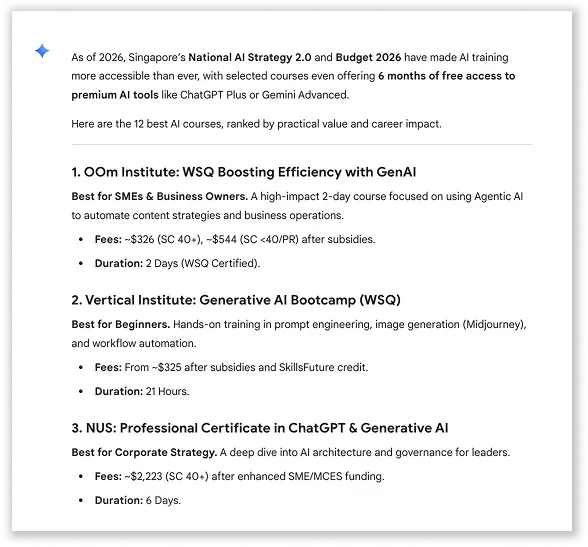
Before
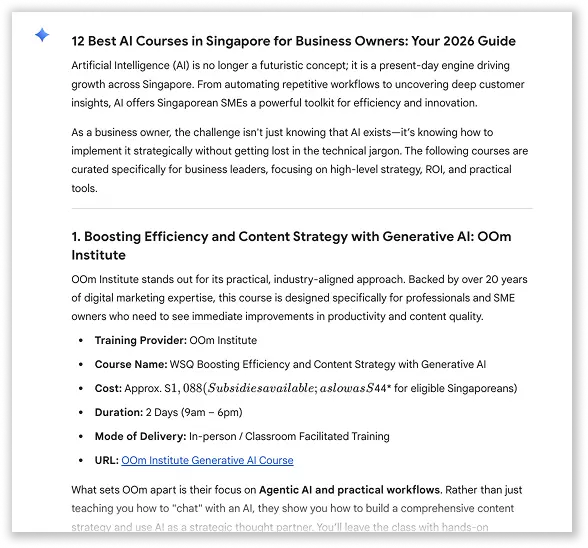
After
Prompt Engineering Best Practices

Prompting an AI system is not just about technical accuracy. Consistent and meaningful results come from a thoughtful blend of strategy, creativity, and sound judgement. Good practice in this field balances clarity with imagination while keeping responsibility at its core.
Here are some guiding principles to keep in mind:
- Think like your audience:
Consider who will read or use the AI output. Shape your prompts to respect cultural context, user intent, and different levels of understanding. - Balance creativity with control:
Give the AI space to explore ideas, but always provide enough guidance to keep responses relevant and accurate. - Build and maintain a prompt library:
Keep a collection of prompts that have worked well across different scenarios. A well-maintained library improves efficiency and helps maintain consistent quality. - Prioritise ethical responsibility:
Design prompts that reduce bias and encourage fairness. Stay alert to ethical concerns, such as reinforcing stereotypes or overlooking cultural nuances. Ethical prompts lead to AI outputs that are respectful and inclusive. - Collaborate and share insights:
Prompting improves through shared experiences. Exchange ideas with others to refine your techniques and uncover fresh approaches. - Stay informed about AI developments:
AI tools evolve quickly. Staying informed about new features and updates will help you adjust your strategies and make the most of emerging possibilities.
Whether you are upskilling or applying AI tools in your work, following these principles will help you achieve more consistent, ethical, and effective outcomes.
To strengthen your skills further, explore our AI Prompting Framework. This resource offers step-by-step guidance to help you write better prompts and confidently apply these best practices.
Master the Art of Prompt Engineering for Future-Ready Skills
In the age of Generative AI, prompt engineering is fast becoming an essential skill. Whether you want to streamline workplace processes, create more engaging content, or open doors to new career opportunities, learning to write effective prompts gives you a clear advantage.
As AI tools continue to reshape industries, prompt engineers play a vital role in bridging the gap between human intention and machine output.
By building both technical and soft skills, staying curious, and applying best practices, you can place yourself at the forefront of this exciting field.
Demand for these skills is rising, particularly in AI-driven markets like Singapore, making this the ideal time to upskill.
If you are ready to advance your skills, discover OOm Institute’s Generative AI learning series. These courses provide practical, hands-on knowledge, covering everything from ChatGPT techniques to ethical AI practices and real-world applications.
FAQs
1. What exactly is a prompt in AI?
A prompt is the instruction or input you give to an AI system to guide its response. It can be a question, a command, or a detailed instruction. The clearer and more specific your prompt, the more accurate, relevant, and useful the AI’s output will be. Think of it as telling the AI exactly what you want it to do.
2. Is prompt engineering difficult?
Prompt engineering is not technically difficult, but it does require practice. Anyone can learn it, even without coding skills, because it’s mostly about clear communication, testing different approaches, and understanding how AI interprets language. The more you experiment, the better your prompts become.
3. Are there certifications available for prompt engineering?
Yes, there are now courses and programmes that offer certifications in prompt engineering, especially as AI tools like ChatGPT and other generative AI platforms become widely used.
These certifications typically cover skills such as designing effective prompts, refining outputs, and applying prompt engineering in real-world scenarios. You can also check out OOm Institute’s AI Prompt Engineering Course!
4. What are common mistakes to avoid when writing prompts?
The common mistakes to avoid when writing prompts include:
- Being too vague – “Write something about AI” won’t give useful results
- Leaving out important details like tone, format, or target audience
- Assuming AI understands context without explanation
- Using too much jargon or complex instructions
- Not testing or refining prompts to see what works best
Do I need technical knowledge to do prompt engineering?
No, you don’t need coding or technical skills. Prompt engineering is about clear communication, structure, and experimentation. Understanding the AI’s behavior and practicing different approaches is far more important than technical expertise.
How can beginners practice and improve their prompt engineering skills?
You can start with the following steps, or refer to this section for more details:
- Experiment with different prompts and observe how small changes affect the output.
- Specify details like tone, format, length, and audience.
- Use examples to show the AI exactly what you want.
- Refine content after generation, simplify jargon, add examples, or improve clarity.
- Review and compare outputs to learn which prompts work best.
- The key is consistent practice. Over time, you’ll develop intuition for writing effective prompts.