
Key Takeaways
|
Introduction
The pressure on content teams can, at times, feel relentless. Deadlines stack up, search algorithms change with little warning, and audiences expect depth, originality and authority in a single piece of content. Somewhere between juggling research tabs and refining yet another draft, mental fatigue becomes a very real concern.
It is little surprise, then, that AI content writing tools are becoming part of everyday writing routines, rather than occasional experiments.
Content writers today are rarely focused on drafting alone. Many are building topic clusters, aligning with search intent, shaping broader content strategies, and responding to the growing influence of AI in digital marketing. That often means more research, sharper positioning and more deliberate workflows.
The question, then, is not simply whether to use AI, but how to use it in a way that genuinely supports the work rather than complicates it.
In this guide, you will find a carefully selected list of AI content writing tools, organised by use case: blog writing, social media, ad copy and email marketing. Each platform is examined based on where it tends to fit, where it may fall short, who it is most suitable for and what it typically costs. The intention is to offer grounded guidance that helps you decide what works best for your own workflow.
Best AI Tools for Blog Writing (SEO & GEO-Friendly Content)
Writing long-form blog posts is rarely just a simple case of putting words on a page.
It entails sifting through search results, carefully structuring ideas, and ensuring the content comprehensively answers users’ queries.
Credibility is also paramount, particularly in highly competitive landscapes.
The tools listed below are frequently employed to streamline research and drafting, while simultaneously addressing SEO and GEO considerations.
1. Frase
Frase is an SEO-focused research and content optimisation tool that helps writers analyse search results and structure blog content around real ranking data.
| Category | Details |
|---|---|
| Why it fits | Frase supports content writing by combining SERP analysis with AI drafting inside the same workspace. When a keyword is entered, it pulls top-ranking results, extracts headings, related questions, competitor coverage and topic gaps, and turns that into a structured outline or content brief. |
| Best use case | Frase is best suited for SEO-focused content teams and agencies prioritising in-depth research and ranking optimisation
|
| Limitations | Outputs still need human oversight to tailor voice and accuracy. It may also feel complex for beginners without SEO experience. |
| Best for | SEO teams, content strategists, in-house marketers and agencies focused on search performance. |
| Pricing | Starter plans typically begin around USD 49 per month, with higher tiers for more seats, domains and content volume. |
2. SEOWind
SEOWind is an SEO research and content planning tool that generates data-backed outlines and detailed content briefs before drafting begins.
| Category | Details |
|---|---|
| Why it fits | SEOWind is built around research-first content writing. When you input a topic or keyword, it analyses SERPs, competitor coverage, People Also Ask questions and topical gaps to generate a structured, data-backed content brief. Its AI then drafts long-form content aligned to that research, helping writers produce articles that reflect search intent rather than guesswork. The platform focuses on building comprehensive outlines before writing begins, reducing revision cycles and strengthening topical depth from the start. |
| Best use case | SEOWind is best suited for producing in-depth blog posts and pillar articles where search alignment matters
|
| Limitations | Less suited for short-form content such as social captions or quick ad copy. It is primarily built for in-depth SEO planning. |
| Best for | In-house SEO teams, content strategists and agencies producing long-form, search-focused content. |
| Pricing | The Platform plan is priced at USD 189 per month when billed annually. SEO Services start from USD 3,000 per month on a custom retainer basis. White-label content pricing is customised based on scope and volume. |
3. Writesonic
Writesonic is an AI writing platform that combines content generation, SEO support and marketing copy tools within one workspace.
| Category | Details |
|---|---|
| Why it fits | Writesonic combines AI drafting with content templates and SEO-oriented workflows in one platform. Writers can generate blog posts, landing pages and marketing articles from prompts, then expand, rewrite or refine sections directly within the tool. |
| Best use case | Writesonic is best suited for marketing teams, e-commerce, or businesses who need fast, high-volume output
|
| Limitations | Outputs may still require fact-checking and editing to strengthen accuracy, tone and originality. |
| Best for | Freelancers, small marketing teams and content writers who want an all-in-one AI drafting and optimisation tool. |
| Pricing | Paid plans start from USD 49 per month, with higher tiers available for expanded usage limits and advanced features. |
4. ChatGPT (GPT-4 and Advanced Models)
ChatGPT is a general-purpose AI assistant used for research, drafting, editing, brainstorming and content repurposing across formats.
| Category | Details |
|---|---|
| Why it fits | ChatGPT acts as a flexible AI writing assistant that supports ideation, outlining, drafting and editing across formats. Through natural-language prompting, writers can define audience, tone, structure and constraints to guide output. |
| Best use case | ChatGPT is best suited for all copywriters that work on versatile, end-to-end content creation and iteration
|
| Limitations | Output quality depends heavily on prompt clarity and user direction. It does not automatically verify facts, so editorial review remains necessary. |
| Best for | Content writers, freelancers, agencies and in-house marketing teams who are looking for a versatile AI assistant across multiple writing tasks. |
| Pricing | ChatGPT offers a Free plan with usage limits. The Go plan is priced at USD 8 per month, while the Plus plan costs USD 20 per month. Higher tiers, including Pro, Business and Enterprise, are available for users who require expanded features and team capabilities. |
Best AI Tools for Social Media Content Writing
Short-form content moves quickly. Captions need to feel timely, relevant and aligned with brand tone, often within tight turnaround windows.
At the same time, engagement still depends on clarity and intent.
The tools below are commonly used to support faster drafting while helping writers maintain consistency across platforms.
1. Jasper
Jasper is an AI writing platform built for marketing teams that need on-brand social content at speed, with brand voice controls and workflow-friendly templates.
| Category | Details |
|---|---|
| Why it fits | Jasper supports content writing for social media through purpose-built apps and structured workflows. Its Social Media Posts App converts campaign ideas into platform-ready content, while Brand Voice ensures tone consistency across posts. |
| Best use case | Jasper is best suited for teams and brands creating organic social media content at scale with consistent brand voice
|
| Limitations | It is priced for teams and can feel heavy if you only need occasional caption help. |
| Best for | In-house marketing teams and agencies with established brand guidelines and repeatable social workflows. |
| Pricing | Jasper’s Pro plan is USD 69 per month per seat on monthly billing, or USD 59 per month per seat on yearly billing. Business pricing is custom. |
2. Hootsuite OwlyWriter AI
OwlyWriter AI is Hootsuite’s built-in AI assistant for generating captions, post ideas and variations directly within the scheduling dashboard.
| Category | Details |
|---|---|
| Why it fits | Hootsuite OwlyWriter AI is embedded directly within the Hootsuite publishing dashboard, allowing content writers to generate captions, post ideas and variations while managing scheduling and analytics in one place. |
| Best use case | Hootsuite OwlyWriter AI is best suited for teams already managing social media through Hootsuite
|
| Limitations | It is primarily designed for short-form social writing and idea generation, not deep research or long-form drafting. |
| Best for | In-house social media teams and brands managing multiple channels from a central dashboard. |
| Pricing | OwlyWriter AI is included within Hootsuite’s paid plans. Hootsuite plans start from USD 249 per month, with higher tiers available depending on features, users and organisational needs. |
3. Anyword
Anyword is an AI copywriting platform built with a performance focus, offering predictive scoring to help marketers assess how content may perform before publishing.
| Category | Details |
|---|---|
| Why it fits | Anyword focuses on performance-driven copywriting, using predictive scoring to estimate engagement and conversion potential before publishing. For content writers working on paid campaigns, it offers AI-assisted drafting combined with data signals that highlight which variations may resonate more strongly. This shifts writing from purely creative generation to measurable optimisation, especially for ad-focused content. |
| Best use case | Anyword is best suited for performance marketers focused on paid social and search ad copy where conversion and engagement metrics drive decisions
|
| Limitations | A strong focus on analytics and scoring can sometimes make outputs feel structured or less expressive without manual refinement. |
| Best for | Performance marketers, paid media teams, and agencies focused on measurable ROI. |
| Pricing | Paid plans start from USD 49 per month. Higher-tier plans are available with expanded features, user seats and advanced performance analytics. |
4. Buffer AI Assistant
Buffer AI Assistant is built into Buffer’s publishing platform, helping users generate captions, rewrite posts and repurpose content directly within the scheduling workflow.
| Category | Details |
|---|---|
| Why it fits | Buffer AI Assistant is integrated into Buffer’s publishing platform, helping content writers generate captions, rewrite posts and repurpose existing content directly inside the scheduling interface. |
| Best use case | Buffer AI Assistant is best suited for freelancers and small teams focused on consistent, efficient social media posting
|
| Limitations | It focuses on short-form social writing and does not offer advanced SEO research or long-form drafting capabilities. |
| Best for | Freelancers, small businesses and lean marketing teams managing social media through Buffer. |
| Pricing | Buffer offers a Free plan. Paid plans start from USD 6 per channel per month on the Essentials plan, with higher tiers available for expanded features and collaboration needs. |
Best AI Tools for Ad Copy (Conversion-Focused Writing)
Ad copy leaves little room for hesitation.
Every word needs to be deliberate, persuasive and aligned with a clear objective.
Headlines must capture attention quickly. Body copy must build interest without drifting.
Calls to action need to feel natural yet decisive.
The tools below are commonly used to support faster testing, sharper messaging and stronger conversion intent across paid campaigns.
1. Hypotenuse AI
Hypotenuse AI is built for scaling product content, especially when you need consistent product descriptions and bulk workflows across an e-commerce catalogue.
| Category | Details |
|---|---|
| Why it fits | Hypotenuse AI supports conversion-focused writing by generating structured product descriptions, ad variations and performance-oriented marketing copy at scale. |
| Best use case | Hypotenuse AI is best suited for high-volume e-commerce and promotional copy
|
| Limitations | It is strongest in product-content workflows, so it may be less suitable for nuanced B2B messaging that depends on deeper stakeholder context. |
| Best for | E-commerce brands, retailers and marketplaces managing large or frequently updated inventories. |
| Pricing | Plans include Basic, Ecommerce Pro and Ecommerce Enterprise, which are offered on a custom pricing basis, with businesses required to request a demo or contact the team for a tailored quote. |
2. Unbounce Smart Copy
Unbounce Smart Copy is an AI writing tool integrated within the Unbounce platform, designed to help marketers generate and test landing page and conversion-focused copy more efficiently.
| Category | Details |
|---|---|
| Why it fits | Unbounce Smart Copy is designed to support landing page and performance marketing workflows. It assists in generating headlines, calls to action, value propositions and short-form persuasive copy that can be directly integrated into conversion pages. |
| Best use case | Unbounce Smart Copy is best suited for marketers focused on landing page copy and conversion optimisation
|
| Limitations | Its strongest value sits within the Unbounce ecosystem. It is less suited for broader long-form or research-heavy writing tasks. |
| Best for | Paid media teams, growth marketers and businesses running landing page-driven campaigns. |
| Pricing | Smart Copy is included within Unbounce plans. Unbounce pricing starts from USD 29 per month, with higher tiers available depending on traffic limits, features and optimisation capabilities. |
3. Copy.ai
Copy.ai is a GTM-focused AI platform that helps teams generate marketing copy and run repeatable workflows, with templates that suit high-velocity campaign writing.
| Category | Details |
|---|---|
| Why it fits | Copy.ai provides structured workflows and templates tailored to marketing and campaign writing. Its AI can generate multiple ad variations from a single brief, helping writers explore different angles, hooks and offers quickly. |
| Best use case | Copy.ai is best suited for performance marketers and agencies creating paid ad copy at scale
|
| Limitations | Variations can start to sound similar if prompts are vague, so it works best when you feed it clear audience, offer, and angle details. |
| Best for | Agencies managing multiple accounts, performance marketers, and teams producing high volumes of campaign copy. |
| Pricing | The self-serve Chat plan starts at USD 29 per month on monthly billing (or USD 24 per month when billed annually). Higher tiers are designed for larger organisations and scale up significantly based on seats and workflow credits. |
4. Jasper
| Category | Details |
|---|---|
| Why it fits | Jasper’s strength in brand voice and tone control makes it well-suited for ad campaigns that require consistent messaging across platforms. Its AI apps and templates support writing headlines, promotional messaging and calls to action tailored to specific audiences. |
| Best use case | Jasper is best suited for established marketing teams running multi-channel ad campaigns with consistent brand voice
|
| Limitations | It is positioned at a higher pricing tier compared to lighter AI writing tools, which may not suit solo creators or small teams. |
| Best for | Established marketing teams and agencies running structured, ongoing campaigns that prioritise brand alignment and workflow control. |
| Pricing | Jasper AI (writing assistant) pricing includes a Pro plan at USD 59 for one user per month, featuring 2 Brand Voices, 5 Knowledge assets and 3 Audiences. A custom Business plan is available for larger organisations. |
Best AI Tools for Email Writing
Email writing calls for more than persuasive wording.
It needs structure that guides the reader, clarity that prevents confusion, and messaging that reflects different audience segments.
Subject lines must spark interest without feeling exaggerated. Body copy should stay focused while still sounding personal.
The tools below are often used to support faster drafting while keeping campaigns organised and targeted.
1. MailerLite
| Category | Details |
|---|---|
| Why it fits | MailerLite integrates its AI writing assistant directly into the drag-and-drop email editor (and across campaigns, landing pages, and pop-ups). Powered by OpenAI, it generates subject lines, email body text, CTAs, and more from simple prompts while letting you choose tone, style, and length for quick refinements. Because it sits right inside the editor, you can generate, rewrite, or tighten wording without leaving your workflow, no copy-pasting or tool-switching required. This streamlines creation for small teams and creators, boosts productivity on engaging copy, and keeps everything seamless in MailerLite’s intuitive, beginner-friendly environment. |
| Best use case | MailerLite AI Writing Assistant is best suited for email marketers and small businesses creating engaging campaigns quickly within their existing workflow
|
| Limitations | It helps with drafting, but it is not a research tool, so topic validation and fact-checking still sit with the writer. |
| Best for | Small to mid-sized businesses and lean marketing teams running regular email campaigns. |
| Pricing | There is a Free plan available. Paid plans start from USD 10 per month on the Growing Business plan, with pricing scaling as your subscriber list grows. |
2. ActiveCampaign
ActiveCampaign is an email marketing and automation platform built for segmentation, personalisation, and behaviour-based email journeys.
| Category | Details |
|---|---|
| Why it fits | ActiveCampaign integrates generative AI directly into its email builder and campaign workflows. Its AI features can generate subject lines, email body drafts, CTAs and even structured campaign sequences from natural-language prompts. |
| Best use case | ActiveCampaign AI is best suited for marketers and teams building automated, personalised email campaigns with integrated copy generation
|
| Limitations | Setup can feel heavier than simpler email tools, especially when you start building multi-step automations and segmentation rules. |
| Best for | Growing businesses, in-house marketing teams and agencies that run structured email funnels and need automation depth. |
| Pricing | Pricing starts from USD 15 per month on the Starter plan when billed annually, and scales based on your contact volume and plan tier. |
3. Brevo
Brevo is an email marketing and CRM platform that combines campaign management, automation and AI-assisted drafting within one system.
| Category | Details |
|---|---|
| Why it fits | Brevo combines email marketing, CRM and automation features with AI-assisted drafting inside its campaign builder. Writers can generate or refine email content while referencing contact data and segmentation rules. Its AI support helps streamline repetitive drafting tasks, particularly for promotional or transactional messaging. |
| Best use case | Brevo AI features are best suited for teams running lifecycle, transactional, and CRM-integrated email campaigns
|
| Limitations | While it includes AI support, its drafting features are more assistive than specialised, so copy may still require refinement for tone and depth. |
| Best for | Marketing teams that want email, CRM and automation in one platform without relying on multiple tools. |
| Pricing | Brevo offers a Free plan. Paid plans start from SGD 10 per month on the Starter tier, with pricing increasing based on sending volume and additional features. |
4. GetResponse
GetResponse is an email marketing and automation platform designed for structured campaigns, funnels and behaviour-based journeys, with AI-assisted drafting built into the editor.
| Category | Details |
|---|---|
| Why it fits | GetResponse centres on automation and funnel-based email marketing, with AI assistance embedded in its editor. Writers can generate structured email drafts and integrate them directly into multi-step campaigns. |
| Best use case | GetResponse AI is best suited for businesses and marketers building structured sales funnels, drip sequences, and behaviour-based email campaigns
|
| Limitations | The wide range of features can feel complex for beginners who only need simple newsletters. |
| Best for | Businesses and marketing teams scaling structured email automation. |
| Pricing | There is a Free plan available. Paid plans start from SGD 24.01 per month on the Starter tier (monthly billing), with pricing increasing based on contact list size and additional automation features. |
How to Integrate AI Content Writing Tools into Your Workflow
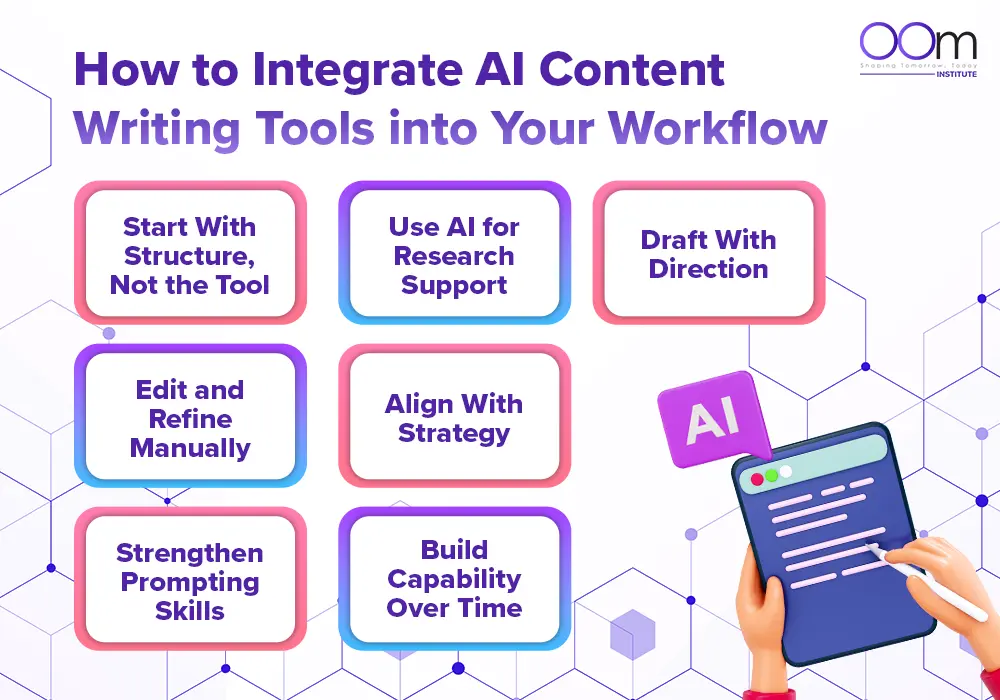
AI content writing tools can support efficiency, but outcomes often depend on how they are integrated into your existing process. A structured workflow usually makes more difference than the tool itself.
One approach is to begin with research support. AI can help uncover topical angles, summarise large volumes of information, or organise related questions. From there, drafting becomes more manageable because the structure is clearer. The initial output, however, should rarely be treated as final. Editing remains essential for tone, accuracy, and credibility.
Many writers find that clarity improves once they understand what prompt engineering is. Clear instructions, defined objectives, and specific constraints tend to produce more focused drafts. Vague prompts often lead to vague content. Small adjustments in how you frame requests can noticeably improve quality and reduce rewriting time.
AI can also be used during refinement. It may help tighten sentences, suggest alternative phrasing, or restructure sections. Even so, alignment with your broader content direction still relies on human judgement. When each piece connects back to a clear content marketing strategy, the workflow feels more deliberate rather than reactive.
For those who prefer structured skill development, a generative AI course can provide guided practice in refining prompts and integrating AI tools more smoothly into daily writing routines. Rather than experimenting in isolation, structured training can help clarify where AI adds value and where editorial oversight remains necessary.
Used thoughtfully, AI content writing tools tend to work best as a support layer, accelerating parts of the process without replacing the thinking behind it.
AI Writing Do’s & Don’ts
AI can be helpful, yet it also introduces new risks. A measured approach usually produces steadier results than relying on automation alone. The goal is not to avoid AI, but to use it with awareness and discipline.
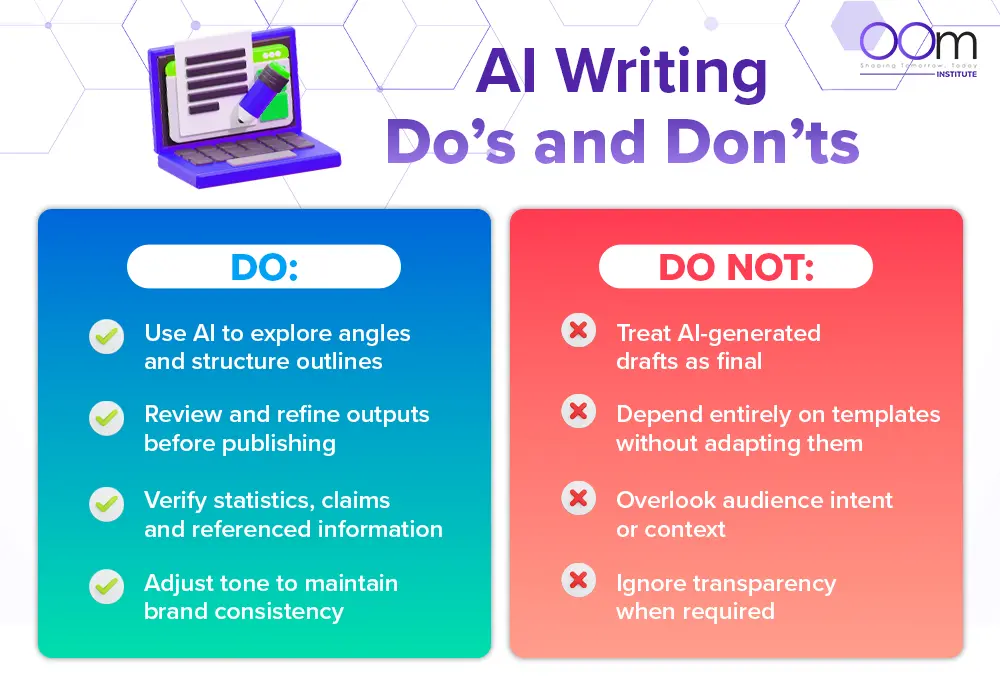
Do:
Use AI to explore angles & structure outlines
Treat it as a thinking partner at the early stage. It can help surface alternative perspectives, organise key points and map out a logical flow before you begin drafting properly.
Review & refine outputs before publishing
First drafts often require tightening, clarification and tonal adjustments. Editing ensures the content reflects your standards rather than the tool’s default phrasing.
Verify statistics, claims and referenced information
AI-generated text may sound confident even when details are incomplete or inaccurate. Cross-check data and ensure references are credible before including them.
Adjust tone to maintain brand consistency
AI can shift tone unexpectedly. Refining language helps preserve brand voice and ensures messaging remains aligned across channels.
Do not:
Treat AI-generated drafts as final
Publishing without revision can introduce inaccuracies or generic phrasing that weakens credibility. Human oversight remains essential.
Depend entirely on templates without adapting them
Templates can speed up structure, but over-reliance may lead to repetitive or predictable content. Customisation keeps writing distinct.
Overlook audience intent or context
AI may not fully understand nuance, market sensitivity or cultural context. Writers still need to evaluate relevance and appropriateness.
Ignore transparency when required
In some industries or organisations, disclosure of AI use may be necessary. Ethical considerations should remain part of the workflow rather than an afterthought.
How to Choose Your AI Content Writing Tools
There is rarely a single best AI tool for writing that suits everyone. The right choice often depends on context rather than popularity.
When evaluating options, consider:
- Budget: Monthly subscriptions vary widely, especially once team seats and advanced features are added.
- Team size: Solo writers may need flexibility, while larger teams may require collaboration controls and shared workspaces.
- Content volume: High-output environments may benefit from tools that support bulk drafting and workflow automation.
- SEO requirements: Some tools prioritise research and optimisation features, while others focus mainly on drafting.
- Technical comfort level: More advanced platforms may offer greater control but can require time to learn and configure properly.
Different roles naturally prioritise different factors. Freelancers may value adaptability and lower commitment costs. Agencies may look for scalability and multi-client management. In-house teams often consider how well a tool integrates with their existing systems.
Instead of focusing solely on features, it can help to assess how well a tool fits your workflow. Cost matters, but so does compatibility. Whenever possible, testing a platform before committing can provide clearer insight than feature comparisons alone.
Conclusion: Turning AI Tools into Real Capability
AI content writing tools can make research faster and drafting more structured. They can help reduce repetitive effort and surface new angles. Yet speed alone does not equal quality. The strength of the final piece still depends on how thoughtfully the tool is used.
Meaningful results often come from combining clear prompts, editorial judgement and alignment with a wider content marketing strategy. Even the best AI tool for writing benefits from human oversight to ensure tone, accuracy and relevance remain intact.
For professionals who want to apply AI more confidently in real marketing environments, OOm Institute offers structured programmes designed for working adults. The focus is practical application, helping you integrate AI into everyday workflows rather than treating it as a shortcut.
Explore OOm Institute’s WSQ Courses to strengthen how you use AI and build capability that keeps pace with changing tools and expectations.
Frequently Asked Questions
1. How can AI tools help content writers save time?
AI can reduce time spent on early-stage tasks such as research summaries, outline creation and first drafts. Instead of starting from a blank page, writers can begin with a structured base and focus more attention on refining arguments, strengthening clarity and improving flow. When used thoughtfully, AI content writing tools can also support repurposing long-form pieces into shorter formats.
2. Are AI-generated contents good for SEO?
AI-assisted content can perform well in search results when it aligns with search intent, demonstrates topical depth and is properly edited. Optimisation, structure and factual accuracy still matter. Search performance is rarely driven by automation alone. Human review remains important to ensure credibility and relevance.
3. Is it safe to use AI tools for client work?
It can be appropriate, provided outputs are reviewed carefully and aligned with client guidelines. Sensitive or confidential information should not be entered into public AI systems. Clear internal policies and disclosure standards can also help manage expectations.
4. What are the common mistakes content writers make when using AI?
Common issues include publishing unedited drafts, overlooking brand tone, and failing to verify statistics or claims. Over-reliance on generic templates can also result in repetitive or shallow content.
5. Is AI-generated content considered plagiarism?
AI systems generate text based on learned patterns rather than copying directly. However, similarity checks are still advisable, especially for formal or client-facing work. Reviewing phrasing and verifying originality helps reduce risk.
6. Is ChatGPT enough for writing good content?
It can be a useful drafting and brainstorming tool. In many cases, combining it with research-oriented or SEO-focused platforms may produce stronger, more comprehensive results.