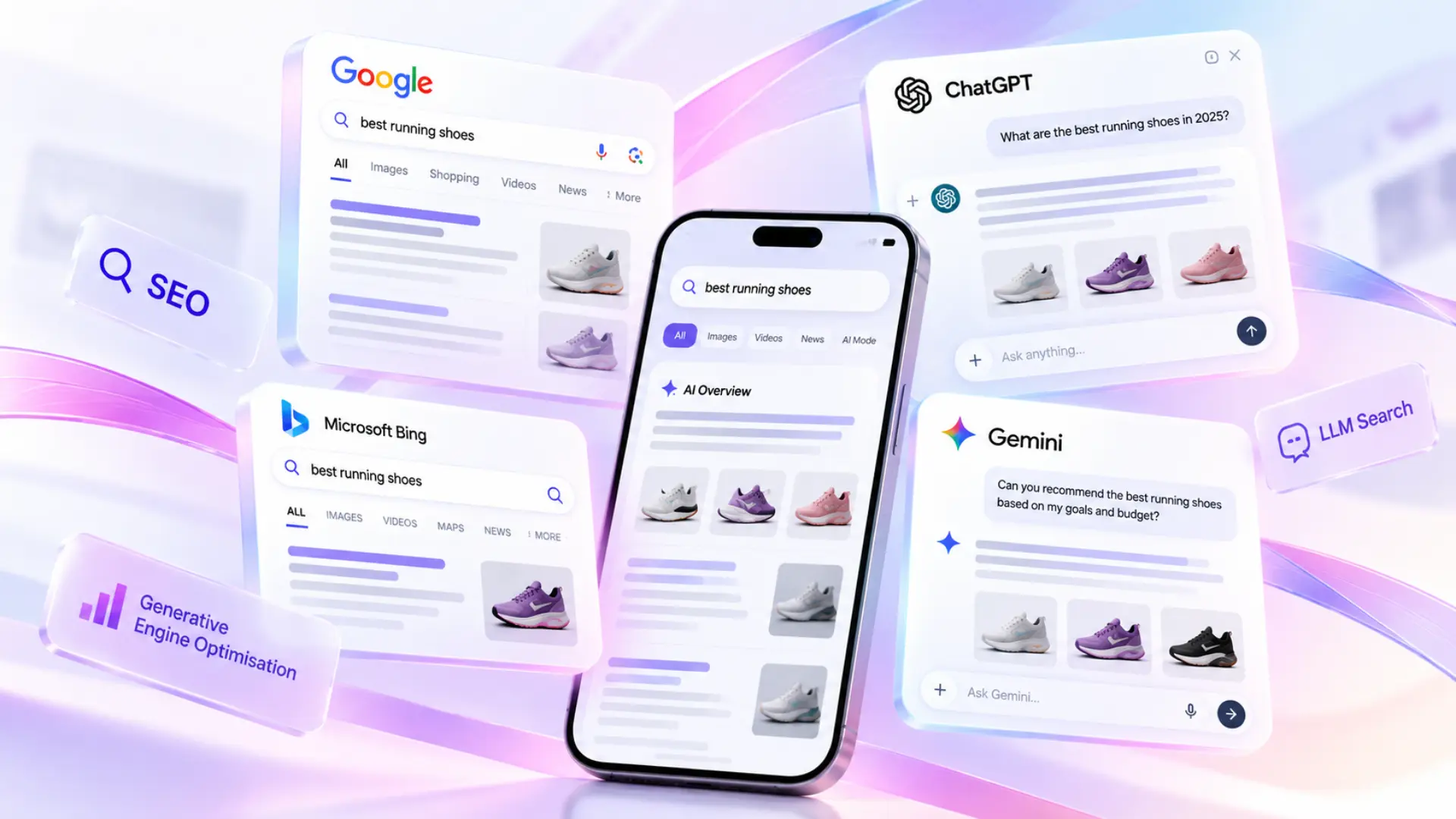
Artificial intelligence has quietly become part of the digital marketing toolkit. You might notice it when content gets written faster, when ad performance improves without manual tweaks, or when insights appear before questions are even asked.
In Singapore, many businesses and professionals are already adapting. Some are testing tools that suggest headlines or refine targeting. Others are reshaping how they manage content, campaigns, and customer journeys with real-time data and automation.
At this point, the real question is not what AI in digital marketing is. It is about using it in a way that supports your goals, keeps your messaging sharp, and adds real value. Whether you are just getting started or looking to deepen your approach, this guide will walk you through what matters and how to move forward with confidence.
What is AI in Digital Marketing
AI in digital marketing refers to the use of artificial intelligence technologies to support and enhance how marketers plan, manage, and deliver their campaigns. It brings together machine learning, data analysis, and automation tools to improve decision-making, reduce manual work, and create more personalised experiences for each audience.
Rather than replacing the human touch, AI works as a capable assistant. It can process vast amounts of data in moments, identify patterns that are easily missed, and offer insights that help marketers act quickly and with greater precision. Whether it is predicting what a customer might buy next or adjusting ad spending in real-time, AI is helping brands work smarter.
You have likely come across it without even noticing. A chatbot that answers your questions, a product recommendation that seems spot on, or an email that feels unusually tailored. These are all everyday examples of AI quietly shaping your digital experience.
How AI is Used in Digital Marketing
AI is no longer something distant or experimental. It is already woven into many of the tools marketers rely on every day, from the content we publish to the way campaigns are tracked, tweaked, and tailored. It helps teams move faster, uncover new insights, and deliver more precise messages to the right people at the right time. Here are the ways it is showing up across the marketing mix.
• Content Creation & Copywriting
Writers are no longer starting from a blank page. AI can help generate article headlines, draft product descriptions, suggest edits, and even reshape tone to suit different audiences. It is not replacing creativity but making the early stages of writing quicker and more collaborative. If you are interested in building hands-on experience with these tools, consider enrolling in a Generative AI course that focuses on real-world marketing applications.
• Social Media Scheduling & Captions
Posting at the right time and saying the right thing used to rely on trial and error. AI tools now review engagement history, spot patterns, and recommend the best moments to post. Some even generate captions tailored to different channels, helping brands stay active and engaging without needing to write every post from scratch.
• Email Marketing Personalisation
Generic email blasts have lost their edge. With AI, marketers can personalise subject lines, adjust content based on user behaviour, and make product suggestions that reflect individual interests. These subtle shifts lead to higher open rates, stronger engagement, and more meaningful connections over time.
• SEO & Content Optimisation
Keeping up with search algorithms is a full-time job, but AI makes it easier. It can highlight relevant keywords, cluster related topics, score your content for readability, and suggest edits that align more closely with search intent. If you are exploring SEO through an AI lens, a Google Analytics course can provide practical insights into tracking performance and refining content strategy.
• SEM Ad Performance & Campaign Optimisation
Behind every high-performing ad lies a substantial amount of data, and this is where AI excels. Platforms like Google Ads utilise machine learning to refine bidding strategies, match search intent more precisely, and test variations of ad copy in real time. A Google Ads course can help you understand how to maximise the benefits of these evolving features.
• Data Analysis & Predictive Insights
Marketers today are surrounded by data, but knowing what to act on is the challenge. AI can sift through massive datasets, group audiences based on behaviour, and predict future trends or buying patterns. It turns past performance into forward-looking insights, helping teams plan with more confidence.
• Task Automation
Not every task needs hands-on effort. AI can run A/B tests, assign lead scores, pull weekly reports, and even flag anomalies before they become problems. By automating routine work, teams get more time to focus on strategy, creativity, and campaign refinement.
• Social Listening & Sentiment Analysis
AI listens when your audience speaks. It tracks brand mentions, reads customer reviews, and scans online forums to detect public sentiment. More than just counting likes or comments, it helps marketers understand tone, emotion, and the context behind what people are saying, which is valuable for shaping their brand voice and reputation.
• Design & Video Production
AI is also transforming how visuals are created. It can generate layouts, resize content for different platforms, automate video edits, and even suggest colour schemes that align with your brand identity. These tools make production faster and more accessible, especially for smaller teams without in-house designers.
• Customer Service
Chatbots and virtual assistants are now familiar features on many websites. They help users find answers, complete transactions, or connect to human support when needed. More advanced systems can understand natural language, making conversations feel less scripted and more responsive. For businesses, this means better service coverage without added strain on their support teams.
Benefits of AI in Digital Marketing
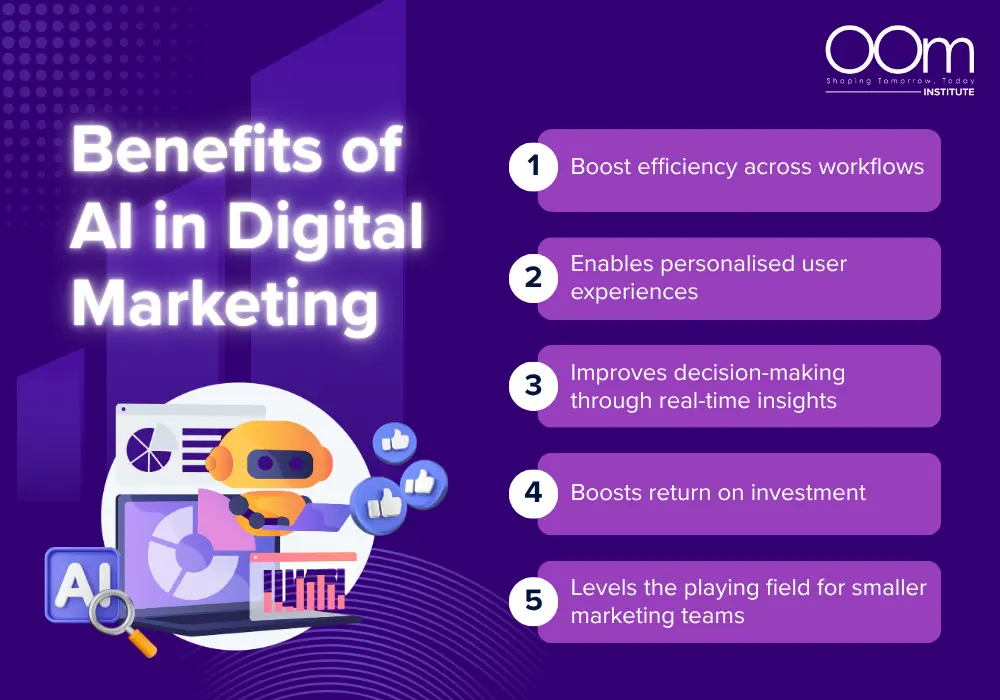
- Boosts efficiency across marketing workflows: AI helps reduce the time spent on repetitive tasks such as data analysis, scheduling, and reporting. This allows marketing teams to focus more on strategic planning and creative work.
- Enables highly personalised experiences: By analysing user behaviour, AI can tailor content, emails, and advertisements to match individual interests. This makes messaging more relevant and improves engagement.
- Improves decision-making with real-time insights: AI uses predictive analytics and trend recognition to show what is working and where adjustments are needed. This helps marketers make faster, more informed decisions.
- Drives better return on investment: Through smarter targeting, ad bid optimisation, and personalised content delivery, AI supports more efficient use of marketing budgets and stronger campaign outcomes.
- Levels the playing field for smaller teams: Smaller marketing teams can use AI tools to scale their efforts. Automation aids in various tasks, from content generation and keyword research to customer support, making it easier to stay competitive.
Challenges of Using AI in Digital Marketing
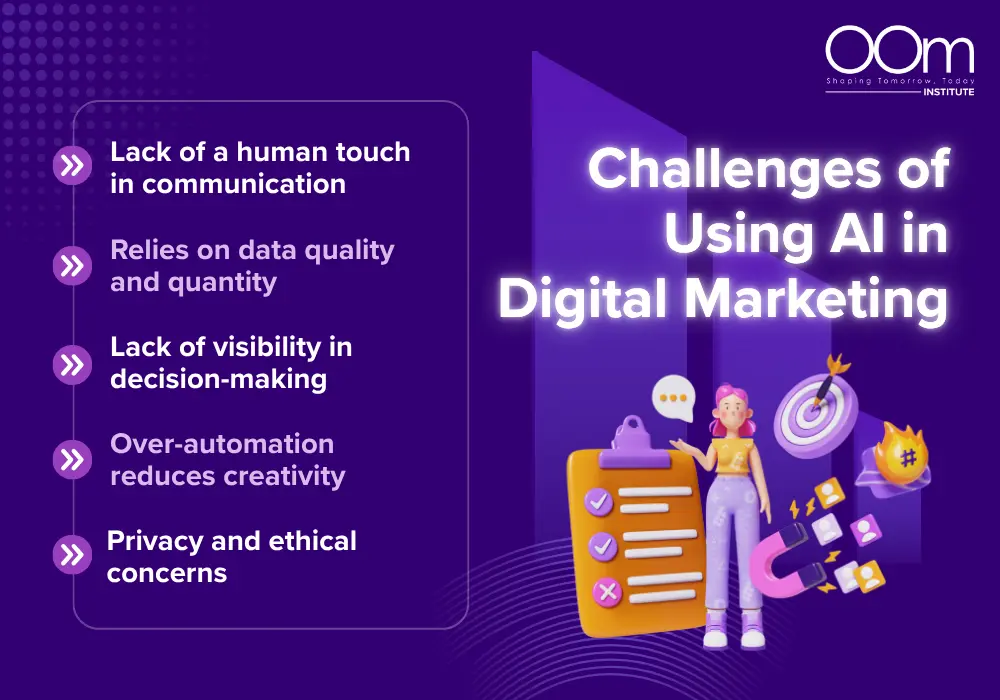
- Lack of human nuance in communication: AI can write, but it often struggles with subtlety. It may overlook emotional cues, cultural context, or the unique tone of a brand, resulting in messaging that feels flat or off-key.
- Dependence on data quality and quantity: AI is only as good as the data it learns from. Inaccurate, outdated, or incomplete datasets can lead to poor targeting, unhelpful recommendations, or even biased content outputs.
- Limited transparency in decision-making: Many AI systems make decisions in ways that are not always easy to explain. This lack of visibility can make it hard for marketers to understand why certain actions were taken or how results were generated.
- Over-automation risks reducing creativity: Using AI for everything can result in formulaic campaigns that lack originality. When overused, automation may reduce the creative depth that sets a brand apart.
- Privacy and compliance concerns: AI tools often rely on user data to deliver personalised experiences. Without careful oversight, this can raise concerns about data privacy, particularly when regulations are stringent, and consumer trust is at stake.
Examples of AI Tools in Digital Marketing
AI tools are now integral to everyday marketing, supporting everything from strategy and design to content creation and performance tracking. They come in many forms, ranging from highly advanced to those designed for ease of use. Regardless of complexity, many of these tools are accessible to teams of all sizes and offer practical solutions for a wide range of tasks.
Here are some examples of how AI is reshaping day-to-day marketing work:
- AI tools for graphic design help generate banners, social media visuals, and branded templates using generative models. These tools are especially useful for teams without dedicated designers, as they speed up production while maintaining a professional look.
- AI tools for video allow marketers to create short-form content, edit clips, generate subtitles, and even produce animated explainers with minimal manual effort. They reduce the technical barriers to video production, making it easier to maintain quality across platforms.
- AI tools for SEO assist with keyword clustering, content gap analysis, on-page optimisation, and competitive research. They help marketers identify what their audience is searching for and how to align content more effectively with evolving search trends.
- AI tools for social media streamline various tasks, including caption generation, hashtag recommendations, audience targeting, and performance monitoring. These tools help teams schedule content more strategically and boost engagement using insights from past activity.
From automation to optimisation, AI is now present at nearly every stage of a marketing campaign. As more platforms continue to adopt machine learning capabilities, these tools will become increasingly integrated and intuitive, offering even greater support to marketers navigating a rapidly changing digital landscape.
Future of AI in Digital Marketing
The future of AI in digital marketing is not only about faster automation. It is about building more intuitive and responsive experiences that follow users across channels, devices, and moments.
One major shift is already underway: real-time personalisation at scale. AI is learning to respond in the moment, adjusting content, visuals, and calls to action based on user behaviour, mood, and preferences. Instead of relying on broad audience segments, campaigns will respond to individuals as they engage with the content.
Voice and conversational AI are also gaining ground. As more people interact through voice search and digital assistants, marketers will need to rethink how they present information. Dialogue-based content, audio optimisation, and natural language interactions will shape the way brands connect with audiences.
Deeper integration between AI and analytics tools will open new possibilities. Marketers will not just see what happened; they will forecast what is likely to happen next. With more accurate predictive models, customer lifetime value estimates, and behavioural insights, decision-making will become more proactive than reactive.
At the same time, this progress will place new demands on marketing professionals. Understanding how to guide, train, and fine-tune AI systems will become an essential part of the job. Those looking to develop these skills may benefit from a prompt engineering course that emphasises practical, real-world use cases.
Ultimately, AI is not here to replace marketers. It is here to support those who can combine creativity with strategy and intuition with data. The marketers who thrive will be the ones who learn to use AI not as a shortcut but as a powerful extension of their craft.
Learn to Use AI in Digital Marketing
As AI continues to advance, today’s marketers must adapt to it. Knowing how to use AI in digital marketing is not just about adding tools to your workflow. It requires a shift in mindset: asking better questions, interpreting data with purpose, and designing campaigns that are driven by insight rather than guesswork.
For professionals in Singapore seeking to develop these capabilities, OOm Institute offers practical training across key areas, including Google Ads, AI-powered analytics, and applied digital strategy. These programmes are designed to bridge the gap between understanding technology and using it effectively in real-world campaigns.
If you are ready to sharpen your skills and lead with confidence in a changing digital landscape, explore OOm Institute’s training courses today. Gain the knowledge to use AI not just efficiently but meaningfully.