- QUICK ANSWER
Many businesses focus on the cost of training but overlook the much higher cost of skill gaps. Investing in employee development can improve productivity, reduce inefficiencies and help organisations adapt to changing business needs. To deliver lasting business impact, corporate training should be aligned with organisational goals, supported by managers and evaluated based on measurable improvements in performance, behaviour and operational efficiency.
When budgets get tighter, training is often one of the first expenses to come under scrutiny. Unlike sales, marketing or technology, the return is not always immediate or easy to track, so an investment into corporate training can feel easier to delay.
The problem is that skill gaps do not disappear when training is put on hold. Employees still need to manage people, use new technology, communicate clearly and keep up as their roles change. When those skills fall behind, businesses often feel the effects in slower work, repeated mistakes and tools that are not being used to their full potential.
The World Economic Forum’s Future of Jobs Report 2025 found that 63% of employers see skill gaps as a major barrier to business transformation, while 85% plan to prioritise workforce upskilling.
So, is corporate training worth the investment? Here, we look at where its value really comes from, why some programmes fall short and how companies can make better training decisions.
🤔 Why Many Companies Still See Corporate Training as a Cost...
Business leaders are right to question training budgets. Every expense needs to support a clear business need, especially when companies are balancing hiring, technology and other operational priorities.
The challenge is that training often delivers results gradually. A marketing campaign can be tied to leads and sales, while software may save time almost immediately. By comparison, the impact of training can be harder to see.
A manager may become better at giving feedback, delegating work or handling difficult conversations. An employee may learn to use AI more effectively and complete tasks faster. These improvements matter, but they may take time to show up in business results.
Some companies are also sceptical because they have experienced training that was too theoretical, too generic or difficult to apply at work. In other cases, corporate training is treated as an HR activity rather than part of a wider business plan, with more focus on attendance than on what should improve afterwards.
These concerns are valid. However, focusing only on the upfront cost can make companies overlook the cost of unresolved skill gaps.
A worthwhile corporate training investment should therefore be judged by the problems it helps solve, not simply by the cost of the course.
The Hidden Cost of Not Investing in Employee Development
Reducing the training budget may lower costs in the short term, but skill gaps can create expenses elsewhere. Repeated mistakes, inefficient workflows, slow technology adoption and managers spending too much time fixing avoidable problems can all affect productivity.
A corporate training investment can help address these gaps before they become more costly or difficult to manage.
I. Employees Keep Making Avoidable Mistakes
Small mistakes may not seem costly on their own, but they add up quickly. An unclear brief can lead to extra clarification, a poorly written email can create unnecessary back-and-forth, and an employee who misunderstands a process may need to redo part of the work.
This is where employee training and development can make a practical difference. Stronger communication, problem-solving and working habits can reduce repeated errors and save time across everyday tasks.
II. Managers Spend Too Much Time Fixing Problems
When employees lack certain skills, managers often have to step in. They may end up correcting work, resolving conflicts, repeating instructions or taking over tasks that should be handled by the team.
The same problem appears when technically strong employees move into management without enough preparation. They may know the work well but struggle with feedback, delegation or underperformance. Training in people management, communication and coaching can help managers handle these responsibilities more confidently and consistently.
III. Technology Investments Deliver Less Than Expected
Buying new technology does not automatically improve productivity. Employees still need to know how to use it effectively.
A company may invest in AI tools across an entire department, yet see limited returns if staff only use them for basic tasks. Training can help employees understand where AI adds value, how to use it more effectively and how to build it into everyday workflows.
IV. Hiring Becomes the Default Solution
When a business needs a new capability, hiring can seem like the quickest answer. In some cases, that is necessary, especially when highly specialised expertise is required.
However, some skill gaps can be addressed by developing existing employees. A marketing team, for example, may be able to build stronger AI capabilities through training rather than hiring a new specialist for every new task.
The same applies to leadership. If internal employees are rarely ready to step into management roles, the organisation may need to strengthen how it develops people over time.
IV. The Business Becomes Slower to Adapt
One of the less obvious costs of skill gaps is slower change. New systems take longer to adopt, employees rely on familiar ways of working and managers may struggle to guide teams through new processes.
Over time, this can make the organisation less responsive as technology, customer expectations and workplace demands continue to change. Regular upskilling helps employees adjust faster and use new tools and methods with greater confidence.
High-Performing Companies Think About Training Differently
A weak training plan often starts with, “What courses should we send employees to this year?” A stronger approach starts by identifying the business problem.
If project delays are caused by poor communication between departments, a general productivity course may not help. The company first needs to understand the cause, such as unclear briefs, weak communication or poorly defined responsibilities, before choosing the right training.
The same applies elsewhere. Low use of AI tools may point to an AI skills gap, while frequent conflict escalations may signal a need for stronger conflict management.
Training is more valuable when success is measured by what employees can do better afterwards, not simply by how many people completed a course. A good corporate training investment should begin with a clear business need.
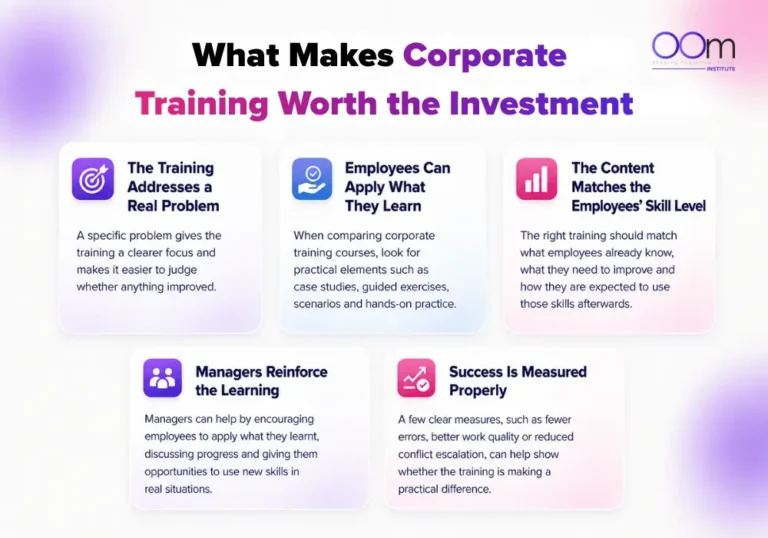
What Makes Corporate Training Worth the Investment?
Not every training programme delivers the same value. Two companies can spend similar amounts and see very different results depending on what the training covers, who attends and how the learning is applied afterwards.
AI certification demonstrates that you have completed a programme or met a recognised assessment standard. It does not, however, prove that you can apply AI effectively in real-world situations.
Employers increasingly look for practical evidence of capability.
A marketer should be able to use AI to research, create and refine content, while a developer should understand how to build, evaluate and deploy AI solutions. The strongest candidates combine recognised learning with hands-on experience, practical projects and measurable results.
I. The Training Addresses a Real Problem
The purpose of the training should be clear from the start.
Saying “our managers need leadership training” is too broad. A clearer goal might be to help new managers delegate better, give useful feedback or handle difficult conversations.
A specific problem gives the training a clearer focus and makes it easier to judge whether anything improved.
II. Employees Can Apply What They Learn
Training is more useful when employees can connect it directly to their work.
An AI course, for example, should give participants opportunities to practise using AI for tasks they actually perform. A conflict management course should include realistic workplace situations rather than only theories and definitions.
When comparing corporate training courses, look for practical elements such as case studies, guided exercises, scenarios and hands-on practice.
III. The Content Matches the Employees' Skill Level
More advanced does not always mean more useful.
A beginner learning to use generative AI at work may gain little from a technical machine learning course. Likewise, experienced managers may find an introductory leadership programme too basic.
The right training should match what employees already know, what they need to improve and how they are expected to use those skills afterwards.
IV. Managers Reinforce the Learning
A workshop can introduce useful skills, but employees still need opportunities to practise them at work.
Without reinforcement, people can easily return to old habits. Managers can help by encouraging employees to apply what they learnt, discussing progress and giving them opportunities to use new skills in real situations.
What happens after the course can make a big difference to whether the learning sticks.
V. Success Is Measured Properly
Attendance shows who completed the training, but it does not show whether the programme worked.
The right measures depend on the goal. Communication training might be assessed through fewer misunderstandings or project delays, while AI training could be measured through adoption, time saved or workflow improvements.
There is no need to overcomplicate it. A few clear measures, such as fewer errors, better work quality or reduced conflict escalation, can help show whether the training is making a practical difference.
How to Choose Corporate Training That Creates Business Impact
There are many corporate training providers, so price alone should not drive the decision. A cheaper programme can still be poor value if employees spend time learning skills they rarely use.
A better approach is to look at how closely the training matches the organisation’s actual needs.
Start With the Skill Gap
Look at How Practical the Training Is
Consider the Trainer's Experience
Decide Between Standard and Customised Training
Consider How the Training Fits Into Work
Define What Should Change Afterwards
A. Start With the Skill Gap
Begin by identifying what is slowing people down or causing repeated problems.
A team may struggle with difficult client conversations. New managers may avoid giving feedback. Employees may have access to AI tools but lack confidence using them.
These issues provide a much clearer starting point than simply choosing from a list of popular courses.
B. Look at How Practical the Training Is
Find out what participants will actually do during the programme.
- Will they practise using the skill?
- Will they work through workplace scenarios?
- Will they receive feedback?
- Will the examples be relevant to the kind of work they do?
Employees are more likely to remember and apply what they learn when training involves active practice rather than passive listening.
C. Consider the Trainer's Experience
Subject knowledge matters, but practical experience adds context.
A digital marketing trainer should understand real campaign challenges, while a people management trainer should be able to relate concepts to team issues, difficult conversations and workplace decisions.
This helps make the learning more relevant and easier to apply.
D. Decide Between Standard and Customised Training
Structured courses can work well for common needs such as workplace communication, people management, conflict management and problem-solving.
Customised training may be more suitable when the challenge is specific to the organisation, such as improving AI use within an existing workflow or preparing managers for particular responsibilities.
In these cases, the examples and exercises can be tailored more closely to the way the team actually works.
E. Consider How the Training Fits Into Work
The programme also needs to fit the organisation operationally.
Consider team size, schedules, time away from work and the most suitable delivery format. Onsite, offsite and online training can all work well depending on the team.
The goal is to make learning practical without creating unnecessary disruption.
F. Consider How the Training Fits Into Work
Before approving a programme, complete this sentence:
“After this training, employees should be better able to…”
The answer should be specific, such as giving clearer feedback, using AI more effectively or handling difficult customer conversations.
If the expected improvement is hard to define, the training objective may still be too vague.
How OOm Institute Helps Companies Build Future-Ready Teams
OOm Institute helps organisations build practical skills across areas such as AI, digital transformation, leadership and soft skills.
Companies can choose from customised programmes built around specific business needs or structured SkillsFuture-aligned courses that employees can attend individually or as a team.
Our training focuses on practical application through exercises, real-world scenarios and hands-on learning. Programmes can also be delivered onsite, offsite or online, while customised options can be tailored to specific workflows, challenges and business priorities.
For eligible organisations and courses, funding support may also be available, subject to prevailing eligibility requirements.
Conclusion: The Cost of Standing Still Is Rising
Training budgets should be reviewed carefully. Companies need to know what employees are expected to learn, how those skills will be used and what should improve afterwards.
But reducing training does not remove the cost of skill gaps. Repeated mistakes still waste time, managers still step in to fix avoidable problems, and technology delivers less value when employees do not know how to use it well. Over time, the bigger risk is falling behind as skills, tools and customer expectations continue to change.
A good corporate training investment helps employees build the capabilities needed to solve real workplace problems and adapt with greater confidence.
For companies exploring corporate training options in Singapore, OOm Institute offers customised programmes and WSQ courses across AI, digital transformation, leadership and soft skills.
Speak with OOm Institute to find a training approach that fits your team, goals and business needs.
Frequently Asked Questions
1. Is corporate training an asset or expense?
From an accounting perspective, employee training is generally treated as an expense rather than a capital asset.
From a business perspective, however, a corporate training investment can still create long-term value through better productivity, fewer mistakes, stronger management and improved technology adoption. The key is whether the training addresses a genuine business need.
2. Do profitable firms typically invest more in employee training than less profitable firms?
Not necessarily. Higher spending on training does not automatically lead to higher profits.
What matters more is how closely training supports business priorities. A company may spend heavily on courses and see little value if employees never apply the skills, while a more targeted programme can deliver stronger results.
3. What is the strategic value of a comprehensive training programme?
A well-planned programme helps companies build important skills before gaps become serious business problems.
It can prepare employees for new technology, strengthen future managers, improve collaboration and reduce the need to hire externally for every new capability.
4. How often should companies provide corporate training?
There is no fixed schedule that suits every organisation.
Training is most useful when tied to a clear need, such as new technology, changing job responsibilities, recurring performance issues or employees moving into management roles. Companies should also review skill gaps regularly as workplace needs evolve.
5. What types of corporate training provide the greatest business impact?
The most effective training usually addresses a specific workplace problem.
This could include AI training to improve efficiency, people management for new managers, or communication training for teams facing frequent misunderstandings. The right choice depends on the organisation’s priorities and skill gaps.
6. Should companies prioritise upskilling existing employees or hiring new talent?
Most companies need a balance of both. Upskilling makes sense when existing employees can realistically develop the required skills, while hiring may be better when highly specialised expertise is needed. Companies should consider whether the capability truly requires a new hire before recruiting externally.
7. Why do some corporate training programmes fail to deliver results?
Common reasons include unclear objectives, overly theoretical content and limited opportunities to apply what was learnt.
Training is more likely to deliver results when it addresses a clear skill gap, includes practical learning, matches participants’ experience levels and is reinforced back at work.
8. How do I sign up for corporate training with OOm Institute?
Companies can contact OOm Institute to discuss their workforce needs and explore suitable training options.
Depending on their goals, organisations can choose from structured courses or customised programmes across areas such as generative AI, digital transformation, leadership, workplace communication, people management and other soft skills.