Key Takeaways
|
Overview of Corporate Training Landscape in Singapore
The corporate training landscape in Singapore is a rapidly expanding market, valued at approximately SGD 400 million, with strong growth in areas such as AI, data analytics, digital transformation, and soft skills development.
Corporate training demand is driven by widening workforce skills gaps, accelerating technological change, talent retention challenges, and increasing pressure on organisations to improve productivity and business agility.
As a result, companies are investing heavily in learning and development programmes to build future-ready capabilities, support workforce transformation, and remain competitive in a rapidly evolving economy.
In 2025, around 606,000 individuals and 23,000 enterprises participated in SkillsFuture-supported training programmes.
Also read: Top Corporate Training Companies in Singapore
What is Corporate Training
Corporate training refers to organised learning programmes that companies provide to their employees to improve skills, knowledge, and performance at work.
In simpler terms, it’s how businesses teach their employees to do their jobs better and make fewer mistakes.
Beyond improving day-to-day performance, corporate training also delivers long-term benefits for both employees and organisations, such as:
- Increasing employee retention, as staff are more likely to stay with companies that invest in their growth
- Helping teams stay up to date with rapidly evolving technologies and industry practices
- Building a highly skilled workforce that can innovate and adapt more quickly than competitors
To achieve these outcomes, companies typically invest in different types of corporate training, depending on their goals and workforce needs. The most common types include:
- Onboarding & Orientation: Familiarises new hires with company culture, values, and essential procedures
- Compliance Training: Educates staff on legal regulations and internal policies, such as data privacy or workplace safety
- Hard Skills Training: Focuses on job-specific technical abilities, like software development, sales techniques, or equipment operation
- Soft Skills Training: Develops interpersonal skills like communication, conflict, and people management
- Leadership Development: Prepares current or potential managers for executive roles by honing strategic thinking and team management
In-House vs Outsourced Training Providers
Selecting between an in-house team and an external provider depends on your budget, the subject matter, and how much control you need over the content.
The main difference between in-house and outsourced training providers is who designs and delivers the training, and how closely it’s tailored to your organisation.
Here’s a practical comparison:
| Aspect | In-house Training | Outsourced Training |
|---|---|---|
| Who delivers it | Your company’s internal trainers | External consultants, academies, or training companies |
| Business Stage | Suitable for organisations with internal expertise | Useful for companies developing new capabilities |
| Customisation | Highly tailored to company processes, systems, and culture | Usually standardised, though custom programmes are possible |
| Budget Flexibility | Lower recurring cost once established | Requires programme-based investment |
| Expertise depth | Strong company-specific knowledge | Strong industry-wide or specialist expertise |
| Scalability | Limited by internal resources | Easier to scale quickly |
| Speed to deploy | Faster for recurring internal topics | Faster for niche expertise you don’t already have |
| Confidentiality | Better for sensitive internal information | Requires external sharing agreements |
| Innovation exposure | May become internally focused over time | Brings outside practices and market trends |
⚡ Pro Tip: Many successful companies use a 70/30 hybrid model. They handle culture and technical onboarding in-house, but outsource specialised leadership or technical certifications.
Pre-Made Courses vs Customised Corporate Training
Both pre-made courses and customised corporate training aim to enhance skills and knowledge, but they differ significantly in terms of content, delivery, and business impact.
| Aspect | Pre-made Courses | Customised Corporate Training |
|---|---|---|
| Target Audience | Open to the public or multiple organisations | Designed specifically for one organisation |
| Content | Standardised and broad | Tailored to company needs and challenges |
| Flexibility | Fixed structure and schedule | Flexible delivery and learning outcomes |
| Cost | More affordable per participant | Higher initial investment |
| Relevance | General knowledge and skills | Directly applicable to workplace situations |
| Engagement | Less personalised | More interactive and contextual |
| Scalability | Easy for individual enrolment | Suitable for department or company-wide rollout |
| Business Impact | Focuses on learning concepts | Focuses on improving performance and results |
Which Corporate Training Course You Should Choose
Pre-made courses are useful for foundational learning, certifications, and broad skill development. They are cost effective and easily accessible, making them suitable for individuals or small teams.
Customised corporate training is more effective when organisations require training aligned with internal processes, business goals, or industry-specific challenges. Although it requires more planning and investment, it often delivers stronger long-term organisation impact.
⚡ Pro Tip: Many organisations adopt a hybrid approach. Employees may first attend generic courses to build foundational knowledge before participating in customised workshops that apply the concepts directly to the company’s environment.
Why Corporate Training is a Strategic Priority in Singapore
Corporate training has become a strategic priority in Singapore because the nation’s greatest competitive advantage is its human capital.
To maintain its position as a leading global business hub, Singapore depends on a workforce that can rapidly adapt to technological shifts, economic restructuring, and evolving industry demands.
For forward-thinking enterprises, workforce development is a core business strategy built around 4 modern pillars.
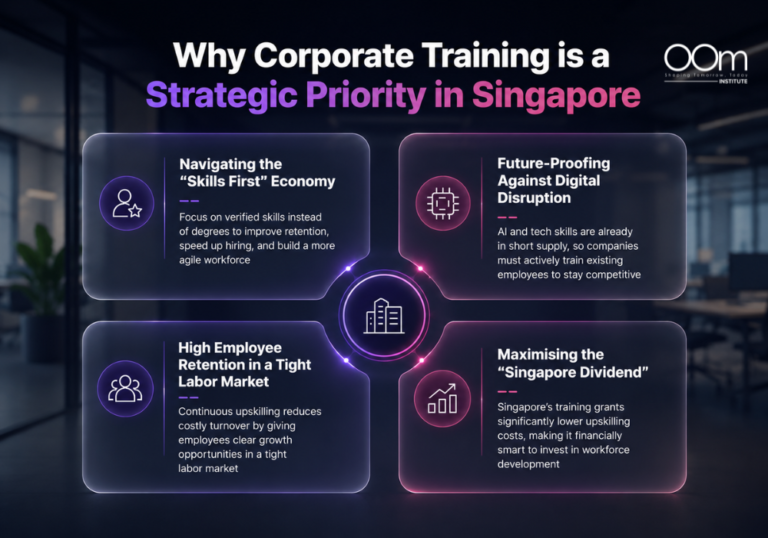
1. Navigating the “Skills First” Economy
The traditional obsession with academic credentials is giving way to a focus on verifiable competencies.
Data from the IHRP Jobs-Skills Insights confirms that Singapore companies adopting skills-first talent practices enjoy a 27% increase in new-hire retention alongside a 22% reduction in total hiring time.
By defining exactly what your workforce can do rather than what their diplomas say, you build an inherently more agile organisation.
2. Future-Proofing Against Digital Disruption
The skills gap is no longer approaching. It is already here.
ManpowerGroup’s recent local talent data points to AI literacy and application development as the single hardest-to-fill capabilities in the country.
Businesses that wait for the market to supply these skills will be left behind; businesses that deliberately upskill their current staff to leverage automation and AI will define the future of their industries.
3. High Employee Retention in a Tight Labor Market
Finding top-tier talent in Singapore remains a fierce bottleneck.
Given that replacing a departed employee can drain 150% to 300% of their annual salary in lost productivity and recruitment costs, keeping your people is vital.
Because a lack of professional advancement opportunities is the number-one driver of local resignations, embedding constant upskilling into your company culture turns a revolving door into an enduring retention tool.
4. Maximising the “Singapore Dividend”
The state provides unparalleled, aggressive corporate safety nets for workforce development.
Through schemes like the SFEC, eligible employers can leverage a S$10,000 credit to clear up to 90% of their out-of-pocket training costs.
With the current scheme remaining in place until the redesigned SFEC launches in the second half of 2026, leaving these subsidies on the table means voluntarily accepting a strategic disadvantage.
Ultimately, corporate training is no longer an HR perk.
For the modern Singapore business owner, it is the fundamental driver of productivity, retention, and long-term enterprise value.
5 Types of Corporate Training Courses: What Does Your Team Actually Need
Different teams need different capabilities depending on growth stage, industry pressure, leadership maturity, and operational gaps.
What your team actually needs is to close specific, immediate skill gaps to drive performance, rather than simply consuming content.
In Singapore, corporate training generally falls into 5 critical categories.
Leadership & Management
- Core focus: Transitioning high-performing individuals into strategic leaders and effective managers
- Key examples: Performance coaching, agile team management, change management, and conflict resolution
- When your team needs them: Junior managers struggle with delegation, team morale is low, or the company is undergoing major restructuring
- Recommended course: OOm Institute’s People Management Course
Digital Transformation & AI
- Core focus: Upskilling employees to leverage emerging technologies, automate tasks, and adopt data-driven workflows
- Key examples: Generative AI for business, data analytics, cloud computing architectures, and cybersecurity awareness
- When your team needs them: Daily tasks involve slow manual data entry, or your firm is adopting new digital software and agentic AI tools
- Recommended course: OOm Institute’s AI Course
💡 Interested in enrolling in AI courses in Singapore? Check out the best Artificial Intelligence courses in Singapore!
Soft Skills
- Core focus: Enhancing interpersonal dynamics, emotional intelligence, resilience, and workplace collaboration
- Key examples: High-stakes negotiation, business storytelling, emotional intelligence, and cross-cultural communication
- When your team needs them: Inter-departmental friction is high, customer satisfaction scores drop, or sales teams miss cross-selling opportunities.
- Recommended course: OOm Institute’s Soft Skills Training
💡 What essential soft skills at work should your team build in today?
Compliance & Regulatory
- Core focus: Meeting mandatory legal and industry standards to avoid financial penalties and reputational damage
- Key examples: Personal Data Protection Act (PDPA) compliance, Anti-Money Laundering (AML), and Workplace Safety and Health (WSH)
- When your team needs them: Local laws change, onboarding new hires in regulated roles, or preparing for an annual regulatory audit
Industry Specific Training
Core focus: Delivering niche technical skills required by unique sectors to maintain operational excellence
Key examples: Good Manufacturing Practices (GMP) for biomed, maritime logistics tracking, and sustainable green building design
When your team needs them: Your business pivots into a new specialised market or needs to adopt sector-specific technology
Stay Competitive & Relevant




5 Popular Corporate Training Formats Available
Instead of wasting money on check-box training that goes through the motions without achieving measurable results, you should invest in effective training efforts.
We will examine 5 training methods you may choose to implement in your organisation.
1. In-Person Classroom Training
Traditional face-to-face training remains popular for workshops that require high interaction, collaboration, or hands-on activities.
These sessions are typically conducted at training centres, hotels, or company premises.
| Best suited for | Advantages | Consideration |
|
| Classroom training may involve venue, travel, and scheduling costs, especially for larger teams. |
2. Online Live Training
Online live training, also known as virtual instructor-led training (vILT), is delivered through platforms such as Zoom or Microsoft Teams.
It became widely adopted during the pandemic and continues to be a preferred option for many organisations in Singapore.
| Best suited for | Advantages | Consideration |
|
| Participant engagement can vary depending on session design and attention span. |
3. Hybrid Training
Hybrid training combines both physical and online learning components.
Employees may attend some sessions in person while completing others virtually or through self-paced modules.
| Best suited for | Advantages | Consideration |
|
| Hybrid programmes require careful coordination to ensure a seamless learning experience across formats. |
4. Customised In-House Programmes
Customised in-house training programmes are designed specifically around a company’s industry, processes, challenges, or business objectives.
Training can be conducted either onsite or online.
| Best suited for | Advantages | Consideration |
|
| Customisation may require a larger upfront investment, but the training is often more relevant, engaging, and effective. |
5. On-the-job Training
On-the-job training involves employees learning directly in the workplace through practical experience, coaching, and supervision.
| Best suited for | Advantages | Consideration |
|
| The effectiveness of OJT depends heavily on the quality of supervision and mentoring provided. |
Which Corporate Training Format Is The Best
So, which of these 5 options is the most effective corporate training method? The answer is… it depends.
The best training format depends on factors such as:
- Your company’s learning objectives
- Team size and work arrangements
- Budget and available subsidies
- The type of skills being developed
- Employee learning preferences
In many cases, combining in-person classroom training with customised programmes can be especially effective.
It helps maximise learning impact while reducing reliance on less consistent online live training methods, which can sometimes be time- and resource-intensive.
Government Subsidies & Funding Support in Singapore
In Singapore, corporate training is heavily supported by the government through a mix of grants, subsidies, and credits designed to help employers upskill workers and transform their businesses.
Below is a clear breakdown of the main schemes relevant to companies.
✅ SkillsFuture Singapore: This is the “baseline” fee reduction. When you send staff for SkillsFuture Singapore (SSG)-approved courses, the training provider usually bills you only the net fee after these subsidies.
✅ SkillsFuture Enterprise Credit: This is a $10,000 credit automatically given to eligible employers. It is used to offset up to 90% of your remaining “out-of-pocket” costs after other subsidies are applied.
✅ Absentee Payroll Funding: This is a cash grant to help you cover the salary costs of your employees while they are away at training. As of 2026, the fixed rate is generally $4.50 per hour.
✅ Enterprise Innovation Scheme: This is a tax incentive. You can claim a 400% tax deduction on training expenses for SSG-approved courses, or choose to convert a portion of this into a cash payout of up to $20,000.
To qualify for most of these corporate grants, your business generally must:
Be Registered: Must be a company, society, or non-profit legally registered in Singapore
Employ Locals: Trainees must be Singapore Citizens or Permanent Residents
Contribute CPF: You must be making regular Central Provident Fund (CPF) contributions for your employees
Pay SDL: For schemes like SFEC, you must have contributed a minimum amount to the Skills Development Levy (SDL) during the qualifying period
⚡Want to learn more about Training Grants for Employers? Read our comprehensive guide to find out what they are, how to apply, and whether you’re eligible!
How to Choose the Right Corporate Training Provider in Singapore
With many corporate training companies in Singapore, choosing one can be overwhelming.
The wrong choice risks wasted resources and unmet goals, while the right partner can boost employee performance and secure your company’s future.
Here’s a concise guide with 6 practical tips to help Singaporean business leaders find a training partner that aligns with your needs and builds a future-ready team.
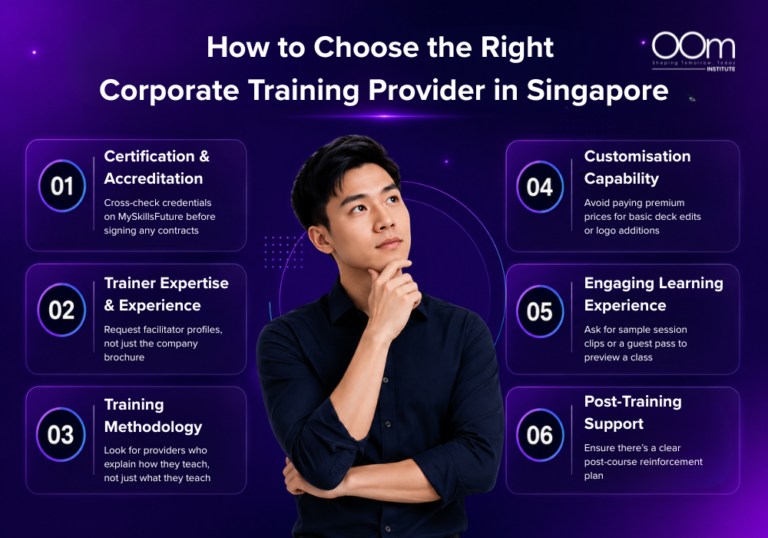
1. Certification & Accreditation
Accreditation ensures that a training provider adheres to strict national and international education standards.
In Singapore, choosing an accredited provider can directly affect your training budget eligibility, funding support, and compliance tracking.
When evaluating providers, look out for:
- SkillsFuture Singapore (SSG) registration
- Workforce Singapore (WSG) recognition
- Relevant industry certifications
- A strong portfolio of client partnerships
⚡ Takeaway: Always cross-reference a provider’s credentials on the official MySkillsFuture portal before signing any contracts.
2. Trainer Expertise & Industry Experience
A strong curriculum fails if the person delivering it lacks real-world experience.
Corporate learners respect practitioners who have faced and solved the exact industry challenges they face daily.
Ask your training providers if the trainers have:
- Real industry experience
- Ability to engage adults, not lecture
- Case studies or real-world applications
- Trainer reviews or testimonials
⚡ Takeaway: Ask the vendor for the specific profiles of the facilitators handling your cohort, rather than just the company’s corporate brochure.
3. Proven Training Methodology
Effective training relies on instructional science, not just charismatic speakers.
A structured methodology ensures that learning is systemic, scalable, and repeatable across different departments.
Look for providers that demonstrate:
- A clear training framework from needs analysis to post-training reinforcement
- Customised programme design based on business objectives
- Interactive and experiential learning methods
- Strong focus on real-world application and workplace transfer
Post-training support to reinforce learning outcomes
⚡ Takeaway: Look for vendors who can clearly articulate how they teach, not just what they teach.
4. Customisation Capability
Off-the-shelf training programs rarely address unique organisational bottlenecks.
Customisation ensures that the exercises, case studies, and terminology directly mirror your daily business operations.
Many Singapore organisations prefer in-house or customised programs because they deliver stronger ROI and alignment with business strategy.
⚡ Takeaway: Avoid providers who charge massive premiums for basic edits like adding your corporate logo to standard slide decks.
5. Engagement & Learning Experience
Employee fatigue is the biggest enemy of corporate learning.
High engagement directly correlates with knowledge retention and positive employee sentiment toward company-mandated training.
Look for providers that incorporate:
- Interactive discussions and group activities
- Real-world case studies and practical exercises
- Role-playing, simulations, or hands-on learning
- Opportunities for participant collaboration and feedback
- Experienced trainers who can facilitate engagement effectively
A strong learning experience helps improve participation, motivation, and long-term learning outcomes across the organisation.
⚡ Takeaway: Ask the provider for sample video clips of their live sessions or a guest pass to preview an ongoing class.
6. Post-Training Support & Evaluation
Most learning is lost within days if it is not reinforced on the job.
True business value is unlocked during the weeks after the classroom session concludes.
Strong providers offer:
- Coaching or mentoring after workshops
- Learning reinforcement tools
- Progress tracking
Refresher sessions
⚡ Takeaway: A training programme without a clear post-course reinforcement plan is simply an expensive networking event.
How to Get Started with OOm Institute
At OOm Institute, we specialise in highly customised corporate training for SMEs and enterprises in Singapore.
Our learners report 82% improvement in work performance, and we have successfully supported more than 1,200 enterprises, including Singtel, Mediacorp, Epson, National University Hospital, and many others.
What sets us apart?
- Customised programmes with governance
- Dedicated training coordination support
- ACTA/ACLP-certified training with over a decade of experience
- Post-training support and follow ups
- Designed for workplace application
- Safe and professional learning setting
And, getting started with OOm Institute is simple and straightforward.
We begin with a no-obligation consultation to understand your organisation’s goals, challenges, and skill gaps. From there, we develop a fully customised training roadmap tailored to your needs.
You can then choose your preferred delivery mode (onsite, virtual, or hybrid). Throughout the programme, we provide engaging training sessions along with post-training support and resources to ensure your team can immediately apply what they’ve learned.
Frequently Asked Questions
1. Who are the top corporate training providers in Singapore?
Singapore has many reputable corporate training providers, including OOm Institute, SMU Academy, ILS Performance, and others. OOm Institute stands out for SMEs and enterprises seeking practical, customised training in high-demand areas such as Generative AI, Google Marketing, and Soft Skills.
To help you choose the provider that best suits your organisation’s needs, we’ve prepared a useful list of top corporate training providers in Singapore too!
2. What industries benefit most from corporate training?
Almost every industry benefits, but those undergoing rapid change gain the most. These include Finance, Healthcare, Retail & E-commerce, Hospitality, Logistics, Manufacturing, and Professional Services. Training helps teams adapt to digital transformation, AI adoption, regulatory changes, and rising customer expectations.
3. Should I choose WSQ courses or customised corporate training?
WSQ courses are nationally recognised, often subsidised, and great for standardised skills with certification. Customised corporate training is ideal when you need content tailored to your company’s specific goals, challenges, processes, and team size.
Many organisations choose a hybrid approach, using customised programmes built on WSQ frameworks. At OOm Institute, we offer both and can recommend the best fit after understanding your needs.
4. Are there any training grants available for businesses in Singapore?
Yes. Singapore offers strong government support:
- SkillsFuture Enterprise Credit (SFEC), a one-time S$10,000 credit for transformation and training
- Absentee Payroll support and other sector-specific grants
- Enterprise Innovation Scheme (EIS), a tax incentive scheme
Our team at OOm Institute will gladly guide you on funding eligibility during the needs assessment. Feel free to check out our Training Grants for Employers Guide for a helpful overview of available subsidies.
5. What are the trending corporate training courses in Singapore now?
In 2026, the hottest areas include:
- Generative AI and AI for Business/Productivity
- AI-powered Digital Marketing
- Leadership & People Management in hybrid teams
- Digital Transformation & Data Analytics
- Workplace Communication and Emotional Intelligence
These skills help companies stay competitive amid fast technological change.
6. Is corporate training suitable for small teams or SMEs?
Absolutely. OOm Institute designs our programmes to be highly flexible for small teams (even 5–10 people). Customised training is often more cost-effective and impactful for SMEs because every session directly addresses your specific challenges and goals.
7. Will training be conducted at our company or at a training centre?
With OOm Institute, you decide what works best, onsite at your premises or our training centre. This flexibility minimises disruption to your operations while maximising participation and learning outcomes. Talk to our consultants to learn more.