
Key Takeaways
|
Introduction
Search behaviour in Singapore is shifting once again, and many marketers can feel the change unfolding right before them. Google has released two significant AI-driven experiences that influence how people find information, evaluate options, and decide which brands deserve attention. If you are trying to understand why visibility feels different today, the conversation around AI mode vs AI overview is becoming impossible to ignore. These features shape what users see long before they decide to visit any website.
Search is no longer just a simple list of blue links. It has grown into an environment where AI-generated summaries, conversational answers, and layered insights sit alongside traditional organic results. Users receive information more quickly and with far less effort, which means marketers must rethink how content is written, organised, and supported with evidence. This shift touches every part of digital work, from topic selection and formatting to user intent and long-term brand positioning.
As Google continues to expand its generative search capabilities, understanding how these two features work is becoming an increasingly essential skill. Marketers who adapt early position themselves in a stronger position to grow awareness, maintain relevance, and build a search presence that remains resilient as AI increasingly shapes the user journey.
What Is AI Mode?

AI Mode is Google’s conversational search environment that helps users explore information in a deeper and more interactive way. It behaves like a blend of a search engine and a dialogue partner, allowing Google to understand context, break complex queries into smaller parts, and produce explanations that grow more detailed with every follow-up question.
When someone chooses to use AI Mode, Google begins running multiple searches simultaneously. These results are then combined into a single, structured response that may include summaries, comparisons, visual breakdowns, and links to supporting sources. The experience is built for users who want more than a quick definition and prefer a fuller, more guided understanding of a topic.
AI Mode is powered by the Gemini model, which enables it to interpret nuanced prompts and support multi-step reasoning. A user asking how to choose a digital marketing certification, for instance, may receive key considerations, learning pathways, cost factors, curriculum details, and a summary of reviews. When relevant, the tool can also display local options and ratings to support more confident decision-making.
One defining feature of AI Mode is its support for follow-up questions. Each refinement becomes a new exploration, allowing the search session to unfold like a conversation. This makes the tool especially useful for early research stages, complex comparisons, and situations where users need to evaluate several layers of information before forming a conclusion.
For marketers, AI Mode signals a clear shift in how Google selects and presents content. It tends to favour pages that are well structured, carefully organised, and rich in semantic detail. Content that demonstrates expertise and provides comprehensive explanations is more likely to be cited and referenced. This makes AI Mode particularly important for brands that depend on search visibility to reach learners, professionals, and individuals seeking development opportunities or an AI course to support their growth.
What Is AI Overview?
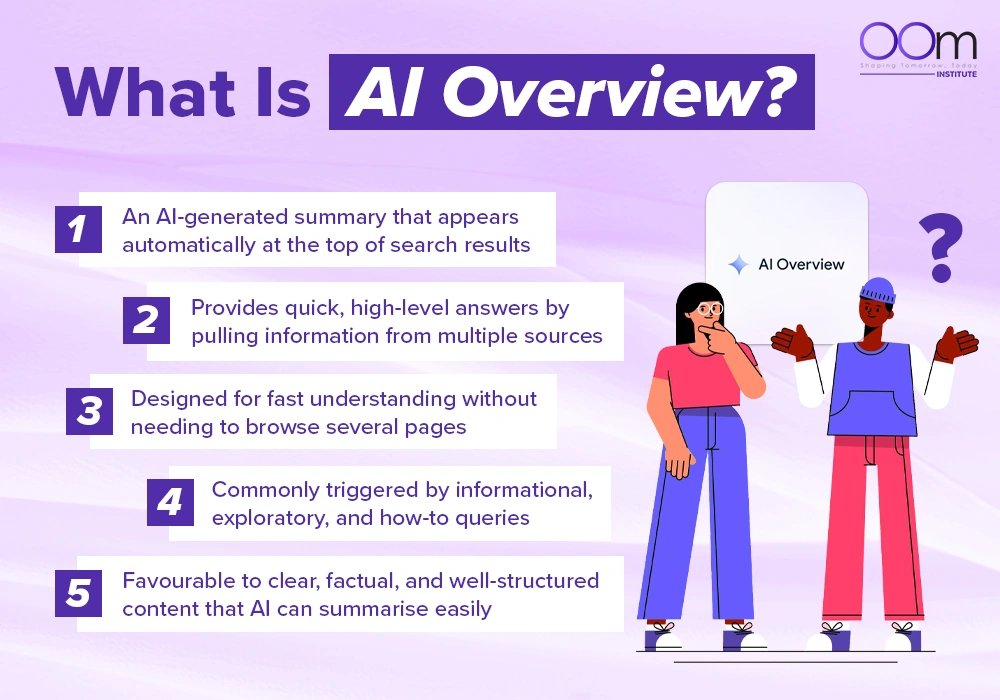
AI Overview is Google’s AI-generated summary that appears at the top of certain search results. It provides users with a quick, streamlined explanation of a topic by combining information drawn from multiple sources across the web. The goal is simplicity. Users receive an instant snapshot of what they need to know without having to browse several pages.
Instead of listing links for users to explore, AI Overview attempts to answer the question directly. It combines key facts, examples, and short explanations into a concise summary that resembles earlier versions of Google’s Search Generative Experience. Within this summary, Google may include supporting links that allow users to continue reading if they wish to explore more details.
AI Overview appears automatically when Google believes a consolidated answer would be helpful to the user. This makes it common for informational queries, broad exploratory searches, and common how-to questions. For many users, AI Overview becomes the very first place they encounter a brand or topic, often before they see the traditional organic results.
The feature is designed for speed rather than depth. Its purpose is to deliver a clear, high-level answer rather than guide a user through a multi-step exploration. Because the summary is created through generative processes, the quality and clarity of the underlying sources influence what appears. Well-structured, factual, and easy-to-interpret content is more likely to be selected or cited.
For marketers, AI Overview creates a new level of competition at the top of the results page. A page may still rank on page one, yet lose valuable visibility if it is not included in the summary. Brands that appear in AI Overview gain early exposure, while those that do not may struggle to maintain the same level of discoverability. Understanding how AI Overview works helps marketers recognise where search journeys begin and how initial impressions are formed.
AI Mode vs AI Overview: Key Differences
Both features are powered by Google’s generative AI systems, but they serve very different purposes and influence search behaviour in distinct ways. Understanding how they compare helps marketers see why the conversation around AI mode vs AI overview has become so crucial for long-term digital strategy.
AI Overview is designed for quick clarity. It condenses information into a single summary that aims to answer the user’s question immediately. AI Mode offers a different experience. It supports deeper exploration, handles complex or multi-step queries, and prompts users to refine their thoughts through follow-up questions.
AI Mode draws from multiple parallel searches to build a more detailed and structured response, while AI Overview selects information that can be summarised quickly and efficiently. These differences impact how content is selected, how links are displayed, and how users interact with brands throughout their search journey.
Here is a simple comparison to help visualise these distinctions.
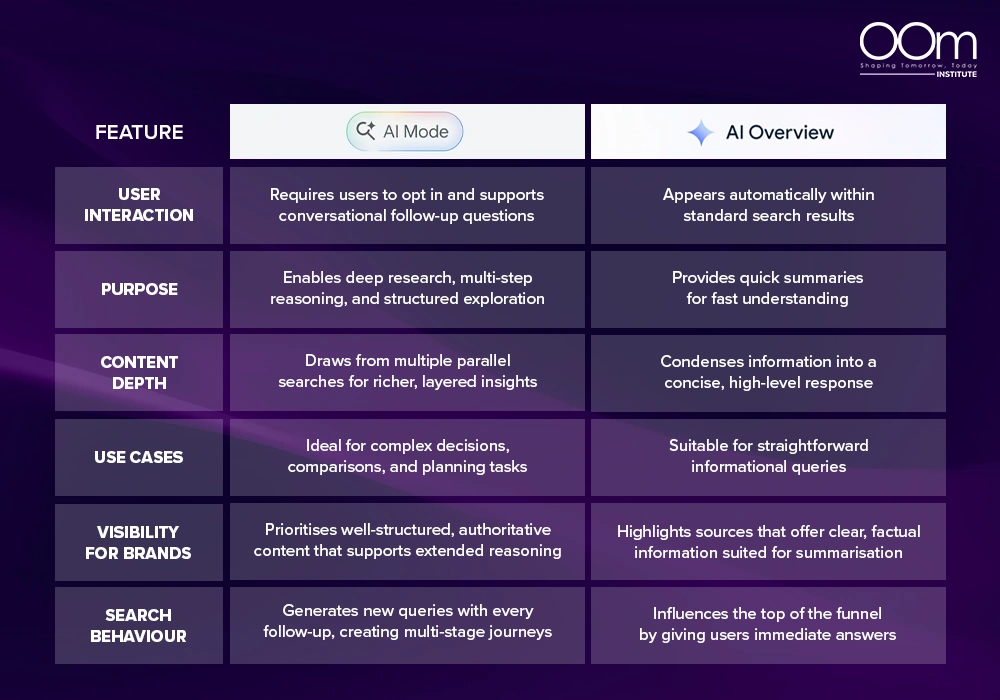
These differences explain why marketers benefit from optimising content for both experiences. A user may start with a quick summary to understand the basics, then shift into deeper exploration within AI Mode as their questions become more specific. Brands that remain visible in both environments are more likely to stay present throughout the entire search journey and build stronger recognition as a result.
Why Marketers Need to Understand Both
The shift from traditional search results to AI-driven summaries and conversational responses is transforming the way brands present themselves online. These developments influence visibility, discovery, and the opinions users form long before they land on a website. For marketers, understanding how both features operate is essential for creating content that aligns with modern search behaviour. The discussion around AI mode vs AI overview is not simply a technical comparison. It reflects a larger movement towards search journeys that are more fluid, layered, and shaped by AI decisions.
a. Influences How Audiences Discover and Engage with Content
Users in Singapore now receive information at remarkable speed. Many questions are answered directly on the results page, long before a link is clicked. AI Overview creates immediate first impressions by presenting a ready-made explanation at the top of the screen. AI Mode, in contrast, encourages deeper exploration by guiding users through clarifications, comparisons, and follow-up prompts. These behaviours shape what users notice, how they interpret a topic, and which brands they encounter repeatedly. Marketers who recognise this pattern can create content that remains visible in both quick-view and deep-dive scenarios.
b. Guides Smarter Content Strategy
A clear understanding of how the two features differ helps marketers design content that performs well across both environments. AI Overview tends to surface content that is cleanly structured, easy to follow, and directly relevant to a query. On the other hand, AI Mode places emphasis on depth, semantic richness, and logical progression. As a result, brands must strike a balance between simplicity and thoroughness. The ongoing discussion about AI mode vs AI overview becomes a helpful way to evaluate how topics should be organised, how explanations should be expanded, and how user intent should be addressed at different stages of the search journey.
c. Highlights Emerging Opportunities and Threats
Zero-click behaviour is increasing, and many websites are noticing drops in visits even while maintaining strong rankings. Visibility has not disappeared. It has simply shifted to different parts of the search experience. AI Overview often becomes the first point of exposure, while AI Mode may display a brand multiple times as users probe deeper. These touchpoints can strengthen recognition, but they also create the risk of being overlooked if the content does not meet the criteria for AI selection. Understanding these patterns helps marketers stay alert to both the opportunities and the vulnerabilities created by AI-driven results.
d. Drives More Efficient Resource Allocation
Without a clear understanding of how AI surfaces information, content efforts may drift in the wrong direction. When brands recognise the strengths of each feature, they can invest resources more effectively. Detailed guides, long-form explainers, and research-focused material tend to perform well in AI Mode. Straightforward summaries, factual sections, and clearly organised answers are more aligned with AI Overview. This awareness reduces guesswork, supports better planning, and ensures that content remains useful across a variety of search behaviours.
e. Positions Teams for Long-Term Competitiveness
Google’s search environment is steadily moving towards a future where AI-generated experiences form the core of discovery. Marketers who understand both features are better prepared to remain competitive as the landscape changes. This knowledge supports stronger planning, clearer reporting, and more resilient digital strategies. Every brand benefits from understanding how first impressions are shaped and how deeper engagement develops over time. Teams that adapt early place themselves in a stronger position to maintain visibility as AI becomes more influential in search.
Understanding both features gives marketers the clarity needed to build strategies that remain effective as Google continues to evolve.
Key Takeaways for the Future of Digital Marketing
- The rise of AI-driven search marks a major turning point for marketers. Google’s new AI experiences are not temporary experiments but a deeper shift in how information is delivered, interpreted, and trusted. As AI Overview and AI Mode become more embedded in everyday search behaviour, marketers who understand their differences will be better equipped to adapt.
- The ongoing discussion around AI mode vs AI overview highlights how modern search is no longer linear. A user may begin with a quick snapshot and then transition immediately into a deeper, conversational exploration. Brands need content that can stand out in both environments by offering clarity, structure, and factual accuracy, along with richer context for more complex topics.
- Success metrics must evolve. Traditional rankings remain relevant, but they no longer reflect the full search journey. Marketers will need to understand how AI selects, cites, and displays content across both features. Brand perception can now be shaped long before a user reaches a webpage, making AI-driven impressions an essential part of performance analysis.
- The future belongs to teams that treat AI-led search as an opportunity. Brands that refine their content, strengthen topical authority, and prepare for multi-layered search experiences will be better positioned to maintain visibility. A firm grasp of how both AI features operate allows marketers to anticipate shifts, respond with intention, and build content strategies that remain valuable as search continues to evolve.
Frequently Asked Questions
1. What is the key difference between AI Mode and AI Overview?
The main difference lies in their purpose and depth. AI Overview provides a concise summary that appears automatically at the top of search results, while AI Mode enables users to explore a topic in greater detail through a conversational and multi-step experience. Many marketers compare AI mode vs AI overview because each influences visibility in different ways across the search journey.
2. What is AI Mode in marketing?
AI Mode is a conversational search environment that helps users unpack complex topics through follow-up questions, deeper comparisons, and structured guidance. For marketing teams, AI Mode highlights the need for well-organised and authoritative content that supports extended interactions. This distinction becomes clearer when examining AI mode vs AI overview in the context of search behaviour.
3. How does AI Mode and AI Overview affect digital marketing strategy?
Both features shape how users discover and evaluate brands. AI Overview influences early impressions by presenting concise, comprehensive summaries. Meanwhile, AI Mode facilitates deeper consideration by providing structured answers and allowing for clarification. Marketers who understand the difference between AI mode and AI overview can plan content that performs well in both settings.
4. How can marketers combine AI Mode and AI Overview for better results?
Marketers can bring these features together by striking a balance between clarity and depth. Clean, factual sections support visibility in AI Overview, while detailed and semantically rich content makes a stronger impression in AI Mode. This blended approach enables brands to appear during both initial discovery and deeper research stages. Understanding the difference between AI mode and AI overview makes this strategy easier to implement.
5. Do I need to attend courses to learn AI Mode?
Formal training is not required, but learning how AI-driven search works can strengthen a marketer’s approach to content and optimisation. Many organisations offer short courses and workshops that explain generative search and emerging ranking signals. Those seeking structured guidance can explore short courses on AI to build practical skills and confidence.
6. Is AI Mode the same as ChatGPT?
AI Mode and ChatGPT share certain similarities because both use conversational, generative AI to deliver answers. However, AI Mode is integrated directly into Google Search and draws information from multiple real-time web sources. ChatGPT functions as a standalone AI assistant, utilising various data inputs and serving distinct use cases.
Conclusion
Google’s move toward AI-driven search experiences is reshaping the digital marketing landscape. Users now navigate search in ways that feel more intuitive and conversational, which means brand visibility depends on content that supports both quick understanding and deeper exploration. This shift calls for more intentional content planning, clearer structure, and a stronger focus on accuracy and authority.
Marketers who understand how these AI features work will be better prepared to meet the evolving expectations of users in Singapore and beyond. Well-organised pages, clear explanations, and comprehensive topical coverage help brands stay visible across an increasingly complex search environment. Treating these AI-driven results as part of the broader customer journey, rather than isolated features, creates a more resilient strategy.
Teams that recognise these patterns early will be able to adjust their approaches with confidence and build content that remains relevant, trustworthy, and engaging. If you are ready to strengthen your capabilities in SEO, analytics, and AI-driven marketing, contact OOm Institute today to explore training programmes that support your professional growth.