Key Takeaways
|
What WSQ Corporate AI Training Means for Singapore Businesses
In Singapore, WSQ Corporate AI training means companies may send employees for WSQ-recognised AI courses or engage training providers to conduct customised AI training aligned with WSQ standards.
Unlike online AI workshops or self-directed training, WSQ AI corporate training follows a structured learning framework focused on workplace application.
As AI adoption accelerates across Singapore workplaces, more organisations are investing in structured AI training to ensure employees can use AI effectively, responsibly, and productively.
Successful AI adoption requires mindset first, strategy second, and tools last.
The organisations seeing meaningful results are not simply providing employees with access to AI software.
They are building AI-ready teams through structured learning programmes that develop practical skills, critical thinking, and responsible AI practices.
Also read: Top Corporate Training Companies in Singapore
Why Singapore Companies Are Turning to WSQ Corporate Training for AI
Singapore companies are adopting WSQ AI corporate training to rapidly close digital skill gaps, drive immediate operational productivity, and leverage substantial government funding.
This specialised upskilling allows organisations to safely embed AI into daily workflows while offsetting the financial costs of enterprise development.
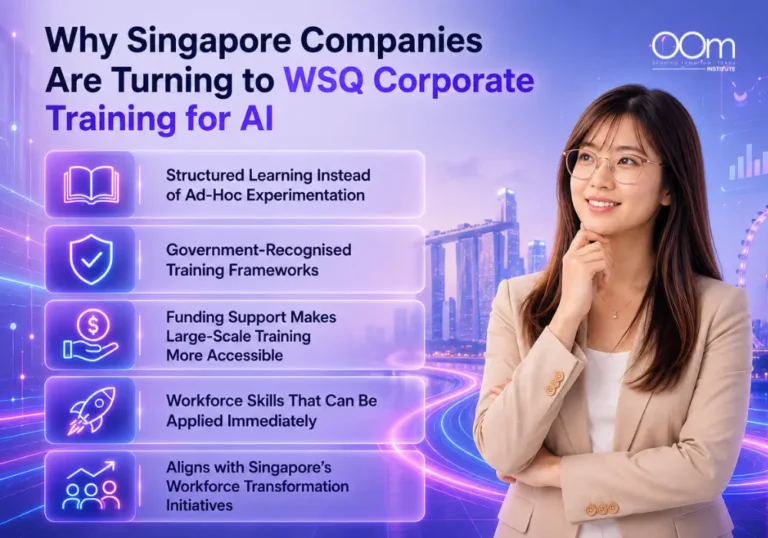
A. Structured Learning Instead of Ad-Hoc Experimentation
In many organisations, AI adoption starts from ground up.
A few employees begin experimenting with ChatGPT.
One team discovers ways to automate routine work. Another uses AI for content creation.
Meanwhile, other departments remain unsure where AI fits into their workflows.
Over time, this creates uneven adoption across the organisation. Some employees become highly proficient, while others struggle to move beyond basic prompting.
WSQ AI corporate training provides a structured learning pathway that helps employees develop common skills, frameworks, and best practices.
Instead of relying on individual experimentation, organisations can establish a shared foundation for AI usage across teams.
This creates greater consistency and reduces the learning curve when introducing AI into daily operations.
B. Government-Recognised Training Frameworks
When investing in workforce development, organisations want confidence that the training delivers recognised and relevant skills.
The WSQ framework provides that assurance.
Programmes are designed around workplace competencies and industry needs, helping employers invest in skills that support long-term workforce development rather than short-term trends.
For employers, this provides greater confidence that training programmes follow recognised competency standards and focus on workplace application rather than purely theoretical knowledge.
C. Funding Support Makes Large-Scale Training More Accessible
One of the biggest barriers to workforce transformation is often scale.
Training a handful of employees is relatively straightforward. Equipping an entire department or organisation with new skills requires significantly more investment.
WSQ-supported programmes can help reduce this challenge through available funding support, making it easier for organisations to extend AI training beyond management teams and create broader workforce capability.
This allows businesses to focus on building organisation-wide AI readiness rather than limiting training opportunities to a select group of employees.
If you’re new to WSQ corporate training, we’ve put together a comprehensive guide to help employers understand the training grants available in Singapore.
D. Workforce Skills That Can Be Applied Immediately
Unlike purely academic programmes, effective WSQ AI training focuses on skills employees can apply immediately after training.
Participants learn how to use AI-assisted marketing, prompt engineering, workplace productivity, content creation, design workflows, and responsible AI practices
This practical approach helps shorten the gap between learning and implementation.
Instead of returning to work with theoretical knowledge, employees can begin applying AI techniques within their existing roles and workflows.
The goal is immediate workplace application rather than knowledge acquisition alone.
E. Aligns with Singapore’s Workforce Transformation Initiatives
Singapore’s workforce transformation efforts are increasingly focused on helping businesses adapt to an AI-driven economy.
As AI reshapes industries, organisations are expected to build capabilities that allow employees to work alongside emerging technologies rather than be disrupted by them.
The refreshed National AI Strategy (NAIS 2.0) and the rollout of WSQ 2.0 reflect this broader shift towards practical, industry-relevant skills that improve workforce adaptability and productivity.
For employers, investing in WSQ corporate training is not simply about learning a new technology.
It is about preparing teams with the skills needed to remain competitive in a rapidly changing business landscape.
Stay Competitive & Relevant


What Businesses Increasingly Expect from WSQ AI Trainers
As AI becomes more widely adopted, expectations around corporate training are evolving.
Companies are no longer looking for trainers who can demonstrate AI tools.
They want WSQ trainers to deliver commercially viable, job-role specific, and measurable workplace outcomes.
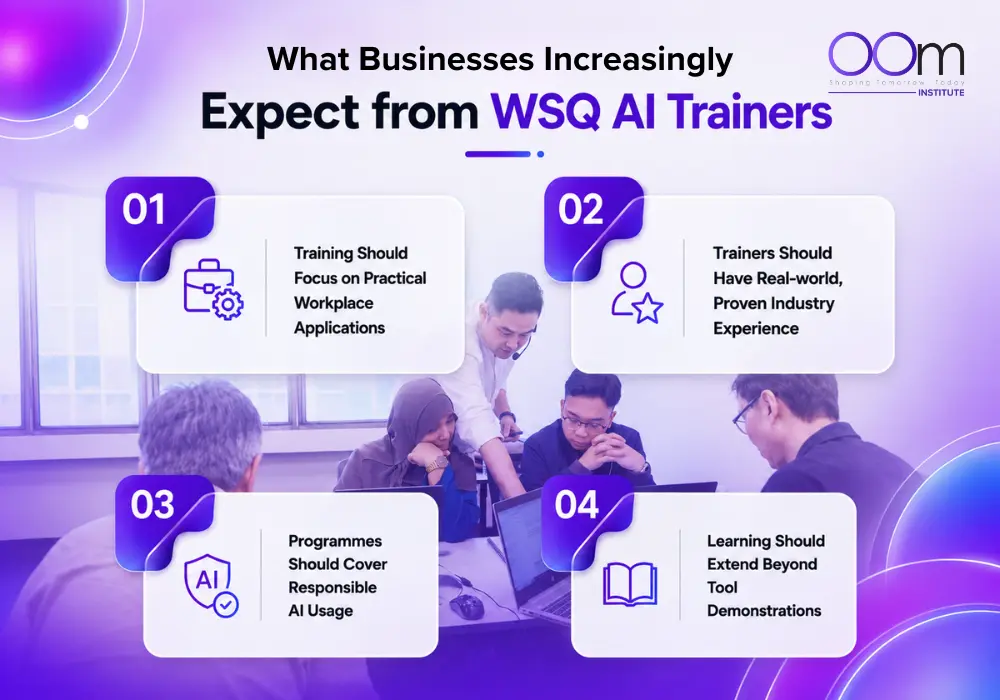
1. Training Should Focus on Practical Workplace Applications
Employees learn best when training is directly connected to their daily responsibilities.
Rather than spending hours exploring features and generic demonstrations, effective AI training focuses on real business scenarios such as content creation, market research, data analysis, workflow automation, and more.
When employees can immediately see how AI fits into their existing responsibilities, adoption becomes far more natural.
2. Trainers Should Have Real-world, Proven Industry Experience
AI changes quickly. New models, new capabilities, and new workflows emerge every few months.
As a result, organisations increasingly value trainers who actively work with AI and understand how businesses are applying it in the real world.
They want practical insights, current examples, and lessons drawn from actual implementation, not theories that may already be outdated.
3. Programmes Should Cover Responsible AI Usage
Many organisations are now asking a different question.
Instead of “What can AI do?”, they are asking “How should our employees use AI responsibly?”
Concerns around data privacy, intellectual property, misinformation, and compliance have made responsible AI usage an essential part of workforce training.
Employees need clear guidance on where AI can help, where human judgement is still required, and how to use these tools safely within organisational policies.
4. Learning Should Extend Beyond Tool Demonstrations
The most effective AI training programmes teach more than prompting techniques or platform features.
They help employees learn how to evaluate AI-generated outputs, challenge assumptions, verify information, and incorporate AI into existing workflows thoughtfully.
After all, the value of AI does not come from knowing which button to click.
It comes from knowing when to trust AI, when to question it, and how to use it to make better decisions at work.
Why WSQ AI Training Delivers Better Results Than Self-Learning
Most employees can create a ChatGPT account, explore various Google free AI tools, watch a few YouTube tutorials, and start experimenting within an afternoon.
This often leads organisations to assume that formal training is unnecessary.
However, the challenge is not getting employees to use AI. The challenge is helping them use AI effectively, consistently, and responsibly.
1. Focus on Mindset Before Tools
What is often less obvious is when AI should be used, where its limitations exist, and when human judgement is still required.
Without this understanding, employees may over-rely on AI for tasks that require expertise, context, or critical thinking.
Structured training helps teams develop a more practical and balanced approach to AI adoption.
2. Develops Stronger AI Critical Thinking
AI tools are remarkably good at sounding confident even when they are wrong. Employees therefore need more than prompting skills.
They need the ability to evaluate outputs, verify information, challenge assumptions, and recognise when AI-generated responses require further review.
These are workplace skills that are rarely developed through casual experimentation alone but become increasingly important as AI usage grows.
3. Enables Faster Workplace AI Adoption
In many companies, a small group of employees become highly effective with AI while others struggle to move beyond basic use cases.
This creates pockets of innovation rather than organisation-wide transformation.
Structured AI training helps create a common foundation across teams, making it easier for employees to adopt proven workflows, share best practices, and apply AI more confidently in their daily work.
The result is often faster and more consistent adoption compared to relying solely on self-directed learning.
Stay Competitive & Relevant
How Companies Are Applying AI Skills Across Different Teams
AI is no longer limited to technical departments. Today, organisations are applying AI across multiple business functions.
A. Marketing Teams Are Using AI for Content and Campaign Development
Marketing teams use AI to support:
- Content ideation
- SEO research
- Email campaigns
- Ad copy generation
- Customer insights analysis
Rather than replacing marketers, AI enables faster execution while allowing teams to focus on strategy and creativity.
B. Design Teams Are Exploring AI-Assisted Creative Production
Design professionals increasingly use AI to:
- Generate creative concepts
- Create visual references
- Explore design variations
- Accelerate asset production
AI helps reduce repetitive production work while expanding creative possibilities.
C. Video Teams Are Accelerating Production Workflows
Video production teams are adopting AI for:
- Script development
- Storyboarding
- Voice generation
- Video editing assistance
- Visual asset creation
This enables faster turnaround times without compromising creative quality.
D. Business Teams Are Improving Productivity Through Prompt Engineering
Across operations, HR, finance, and administration, employees are using AI to:
- Draft reports
- Summarise documents
- Conduct research
- Create presentations
- Improve communication workflows
Prompt engineering skills help employees obtain more reliable and useful outputs from AI systems.
How OOm Institute Approaches Corporate Training for AI
At OOm Institute, corporate AI training is designed around workplace application rather than tool familiarity.
Instead of focusing solely on AI features, programmes emphasise how employees can integrate AI into real business processes and daily workflows.
Training is customised based on organisational objectives, workforce readiness, and departmental needs.
Depending on business requirements, programmes may cover:
- Generative AI for content strategy
- Prompt engineering
AI-assisted design workflows - AI in videography and creative production
- Workplace productivity and automation
- Responsible AI practices
Participants work through practical scenarios that mirror real workplace challenges, enabling them to apply their learning immediately after training.
This practical approach helps organisations move beyond AI curiosity and towards meaningful workplace adoption.
Building AI-Ready Teams Starts With People
Tools will continue to evolve. Platforms will continue to change.
But the ability to think critically, collaborate effectively with AI, and apply AI responsibly will remain valuable regardless of which technologies emerge next.
That is why more organisations are investing in WSQ corporate training in Singapore not simply to teach employees how to use AI tools, but to build AI-ready teams capable of adapting, learning, and creating value in an increasingly AI-driven workplace.
For businesses looking to develop long-term AI capability, structured learning may be one of the most important investments they make.
Frequently Asked Questions
1. Can you recommend me WSQ AI training providers in Singapore?
Singapore has a growing number of WSQ AI training providers offering programmes in generative AI, prompt engineering, Claude AI, marketing, and digital transformation. When evaluating providers, compare factors such as trainer experience, curriculum relevance, workplace applicability, class size, and post-training support.
To help you choose the provider that best suits your organisation’s needs, we’ve prepared a useful list of top corporate training providers in Singapore too!
2. What are the benefits of taking a WSQ AI course compared to an online AI course?
Online AI courses can be useful for self-paced learning, but they often lack instructor guidance, structured assessments, and opportunities to apply learning in a workplace context.
WSQ AI courses are designed around job-relevant competencies and practical application. Many programmes also provide recognised WSQ Statements of Attainment (SOAs) and may qualify for SkillsFuture funding support, making them a popular option for both individuals and employers.
3. How do I choose the best WSQ AI course in Singapore?
There is no single “best” programme for everyone. The best AI courses are often those that align closely with your job role, learning objectives, and workplace requirements.
We’ve prepared a comprehensive guide to help you compare AI courses.
4. Does OOm Institute offer customised AI corporate training?
Yes. OOm Institute provides customised AI corporate training programmes designed around an organisation’s goals, industry requirements, and workforce needs.
Training can be tailored for different departments, including marketing, design, HR, operations, management, and business teams. Depending on the objectives, programmes may cover generative AI, prompt engineering, workplace productivity, content creation, automation workflows, and responsible AI usage.
5. Should companies choose WSQ AI training or customised corporate AI training?
WSQ AI training is often suitable for organisations looking for structured, nationally recognised programmes that may qualify for funding support. Customised corporate AI training may be more appropriate when a company wants to address specific business challenges, workflows, or departmental requirements.
Many organisations combine both approaches by sending employees to WSQ courses while also conducting customised in-house training for specialised use cases.
6. How can I choose between similar WSQ courses for the same AI topic?
When comparing similar WSQ courses, look beyond the course description. Consider the trainer’s industry experience, the practical exercises included, the AI tools covered, the intended audience, and the expected learning outcomes.
Two courses may cover the same topic but differ significantly in terms of depth, workplace relevance, and hands-on application.
7. What other WSQ corporate training courses are available beyond AI?
In addition to AI training, many organisations invest in other corporate training courses such as Google marketing, social media marketing, and soft skill management.
The right training programme depends on the organisation’s workforce development goals, skills gaps, and business priorities.