Key Takeaways
|
Introduction: Why Most DEI Efforts Fail
Most organisations talk about Diversity, Equity, and Inclusion (DEI), yet very few embed it into their operational practices.
Policies exist, and statements are published, but daily decisions often remain unchanged. This gap between intention and execution is precisely where most DEI efforts lose impact.
A common issue is ‘cosmetic DEI’, where visibility replaces substance. Teams may appear diverse on paper, but influence often remains with the same group, and outcomes do not shift.
Tokenism often ensues, where individuals are included symbolically rather than meaningfully.
This inevitably creates a quiet disconnect.
Employees notice when their input is not considered or when opportunities are perceived as uneven.
Over time, this erodes trust, reduces engagement, and leads to higher turnover among underrepresented groups.
To move beyond surface-level efforts, it is therefore necessary to understand what DEI truly entails in practice.
This begins by reframing what each element truly represents within a working environment.
What Diversity, Equity, and Inclusion Actually Mean
Diversity reflects the composition of an organisation.
It encompasses differences in background, experience, perspectives, and ways of thinking that influence how teams approach problems.
Without diversity, organisations risk operating within a narrow lens.
Inclusion determines who gets heard once they are present within an organisation.
It manifests in everyday interactions, from meetings to informal discussions, where ideas are either acknowledged or overlooked.
Inclusion is visible in behaviour, not merely in policies.
Equity addresses how opportunities are distributed.
It ensures fair access to resources, development, and progression, rather than relying on informal networks or unconscious bias.
Equity requires structure, not mere assumption.
When these elements align, a sense of belonging begins to form.
Employees are more likely to remain, contribute, and take initiative when they feel valued and fairly treated.
Without belonging, even diverse teams struggle to perform sustainably.
The Business Case: Why DEI Is Now Operational, Not Optional
Diversity, equity, and inclusion in the workplace directly influence how effectively organisations make decisions.
Studies show that diverse teams can make better decisions up to 87% of the time because they challenge assumptions and reduce blind spots, leading to more balanced and informed outcomes.
Different perspectives also drive innovation.
When teams approach problems from varied angles, they are more likely to identify unconventional solutions and adapt to change.
Homogeneous teams, on the other hand, tend to reinforce existing patterns.
Talent expectations have shifted, particularly in competitive markets like Singapore.
Around 72% of Southeast Asians expect companies to actively promote DEI, making it a key factor in attracting and retaining skilled professionals.
Organisations that overlook this risk losing candidates to competitors with stronger workplace cultures.
DEI also reduces hiring mistakes.
Structured and inclusive hiring processes help organisations assess candidates more objectively, leading to better role fit and lower turnover.
This has a direct impact on costs associated with recruitment and onboarding.
The 4-Layer Diversity, Equity, and Inclusion Operating System
Diversity, equity, and inclusion become meaningful only when embedded into core organisational systems. Otherwise, they remain abstract ideas that do not influence tangible outcomes.
Four key layers determine whether DEI is truly operational.
1. Hiring system: Who gets in
The hiring system defines who initially enters the organisation.
Job descriptions, sourcing channels, and interview structures all influence the diversity of candidates considered.
Without clear and standardised processes, decisions can easily be shaped by familiarity or unconscious bias.
2. Decision-making system: Who gets heard
The decision-making system determines whose ideas are considered and acted upon.
Meeting formats, leadership styles, and communication norms influence whether contributions are acknowledged.
Inclusion is reflected in how consistently diverse voices are invited, heard, and taken seriously.
3. Growth and opportunity system: Who advances
The growth and opportunity system shapes career progression within the organisation.
Access to promotions, mentorship, and high-impact projects must be guided by clear and transparent criteria.
Without structure, advancement often depends on visibility or informal relationships rather than performance.
4. Culture and signals system: What gets reinforced
The culture and signals system reflects what the organisation values in practice.
Recognition, feedback, and leadership behaviour send consistent signals about what is rewarded or overlooked.
Over time, these signals shape employee behaviour and define the organisation’s true culture.
How to Avoid Tokenism: Building an Inclusive Culture Today
Tokenism typically arises when representation is prioritised, but individuals lack genuine influence.
While people may be included in teams or initiatives, their perspectives are often not actively sought or meaningfully considered, thereby creating the appearance of inclusion without true participation.
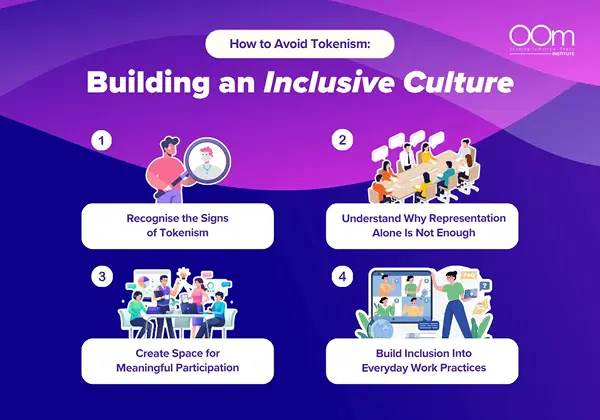
One clear indicator of tokenism is an uneven distribution of contributions in discussions.
If certain individuals consistently dominate conversations while others remain silent, genuine inclusion is likely absent.
Similarly, decisions made before all viewpoints have been thoroughly explored also indicate a lack of genuine participation.
Achieving genuine inclusion necessitates intentional behaviour.
Leaders must actively create opportunities for participation and ensure that all feedback is not only acknowledged but also acted upon.
This approach fosters trust and encourages more consistent contributions from all team members.
Consistency is paramount.
Inclusion cannot rely on individual leaders or isolated initiatives; rather, it must be embedded in the daily operations of team communication, collaboration, and decision-making.
What Actually Works: 4 Practical Actions for Employers
Turning diversity, equity, and inclusion into tangible impact requires more than intent.
It depends on consistent actions that shape how people are hired, heard, developed, and supported.
These four practices focus on where DEI makes the most practical difference in day-to-day operations.
1. Standardise hiring decisions
Standardising hiring decisions reduces bias and improves consistency across teams.
Through structured interviews, clear evaluation criteria, and predefined scoring systems, organisations can assess candidates based on capability rather than subjective impressions, ensuring decisions align with role requirements rather than familiarity or instinct.
This approach also improves accountability.
Documented and consistently applied hiring criteria facilitate easier review of decisions and identification of process gaps, ultimately leading to stronger hiring outcomes and a more diverse talent pipeline.
2. Run structured meetings
Running structured meetings improves participation and decision quality.
By setting clear agendas, defining objectives, and allocating time for input, discussions remain focused and inclusive, reducing the likelihood that certain voices dominate while others go unheard.
Such a structure also supports better outcomes.
Techniques like rotating facilitators, using round-robin sharing, or setting speaking guidelines encourage balanced participation, creating a more inclusive decision-making process without adding undue complexity.
3. Make promotions transparent
Transparent promotion frameworks support equity by clarifying how progression works within the organisation.
Employees should understand the expectations, performance benchmarks, and behaviours required to move forward, thereby reducing reliance on informal networks or subjective judgement.
This transparency also builds trust.
When employees can see how decisions are made, they are more likely to perceive the process as fair, even if outcomes vary, which, over time, strengthens engagement and retention.
4. Provide DEI training
Training builds capability for both leaders and teams.
Developing people management skills helps leaders manage diverse teams more effectively and improve their communication skills at work.
This ensures that diversity, equity, and inclusion principles are reflected in everyday interactions, not solely in policies.
Structured programmes, such as people management courses and broader corporate training initiatives, create consistency across the organisation.
They equip teams with practical tools to recognise bias, manage conflict, and foster inclusion in real-world scenarios.
What Employees Can Do to Support DEI
Creating an inclusive workplace is not limited to leadership decisions or company policies.
Instead, it is shaped daily by how individuals communicate, collaborate, and respond to one another.
Consistent, small actions from employees can reinforce diversity, equity, and inclusion in meaningful and lasting ways.
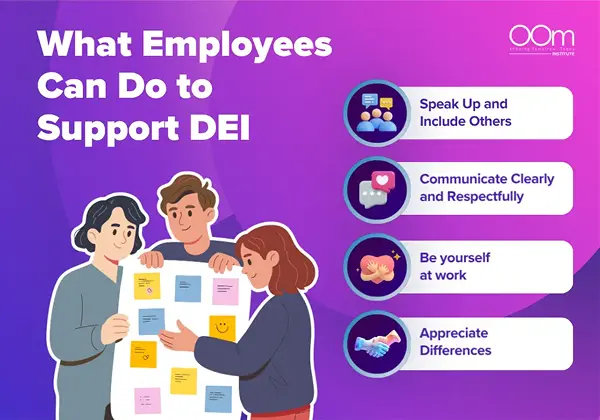
Speak up and include others
Employees play a direct role in shaping everyday workplace culture.
Small actions, such as inviting quieter colleagues to share their views or acknowledging contributions in meetings, can shift team dynamics over time.
These behaviours signal that participation is valued, rather than merely expected.
In practice, inclusion often depends on awareness.
Not everyone feels equally comfortable speaking up, especially in hierarchical or fast-paced environments.
Creating space for others, even through simple prompts, helps balance participation and encourages broader input.
Communicate clearly and respectfully
Clear and respectful communication is essential in diverse teams where working styles and expectations may differ.
Misunderstandings can arise from assumptions, tone, or unclear instructions, particularly in cross-functional or multicultural settings.
Clarity helps ensure alignment, while respect maintains trust.
Effective communication also involves active listening.
Paying attention to how others express ideas, rather than responding immediately, leads to more thoughtful discussions.
Over time, this improves collaboration and reduces friction within teams.
Appreciate differences
Appreciating differences strengthens team performance by expanding how problems are approached.
Diverse viewpoints can uncover risks, challenge assumptions, and introduce alternative solutions that might otherwise be missed.
This leads to more balanced and effective outcomes.
Openness is crucial in this regard.
It requires a willingness to consider perspectives that may not align with one’s own experience.
When differences are treated as valuable input rather than obstacles, teams become more adaptable and resilient.
Be yourself at work
Authenticity is pivotal in building an inclusive environment.
When individuals feel comfortable expressing their perspectives, ideas, and working styles, it creates a more open and collaborative culture.
This also encourages others to contribute more freely.
Over time, this contributes to a stronger sense of belonging.
Employees who feel accepted are more likely to engage, share ideas, and take initiative.
This not only benefits individuals but also strengthens overall team performance.
Conclusion
Diversity, equity, and inclusion are no longer standalone initiatives that sit outside core business operations. It influences how organisations hire, communicate, make decisions, and develop talent over time.
When embedded properly, DEI strengthens performance, culture, and long-term sustainability.
For many organisations, the challenge is not awareness but execution.
Translating DEI into consistent, everyday practices requires structure, clarity, and the right skill sets across leadership and teams. Without this, even well-intentioned efforts can remain inconsistent.
This is where OOm Institute plays a practical role.
Through structured learning and real-world application, organisations can build stronger people management skills, align leadership behaviour, and create more inclusive systems that support growth.
Many of these programmes are structured as courses for managing people, focusing on practical workplace scenarios rather than theory alone.
If you are looking to strengthen your workplace culture and operationalise DEI effectively, explore the available programmes at OOm Institute today.
Take the next step and enrol in a course that equips your team with the tools to confidently and consistently apply DEI principles.
Frequently Asked Questions
1. What is the difference between diversity and inclusion?
Diversity refers to the mix of people within an organisation, encompassing differences in backgrounds, experiences, and perspectives. Inclusion, conversely, focuses on how these individuals are involved, whether their ideas are considered, and how comfortable they feel contributing. Both are essential, as diversity without inclusion often leads to disengagement rather than meaningful impact.
2. How does DEI actually help my business's bottom line?
Diversity, equity, and inclusion enhance decision-making by incorporating a wider range of perspectives and reducing potential blind spots. It also fosters innovation, as diverse teams typically approach problems more creatively and adapt more swiftly to change. Ultimately, this results in improved hiring outcomes, stronger retention, and more consistent performance across teams.
3. We are a small team of 10. Do we really need a DEI policy?
Yes. Smaller teams frequently rely on informal processes, which can unintentionally introduce bias or inconsistency. Establishing clear and fair practices early helps to create alignment, build trust, and prevent potential issues as the organisation grows.
4. How do I start being more inclusive without a big budget?
Begin with simple, structured actions that influence daily behaviour. This encompasses conducting meetings where everyone has an opportunity to contribute, employing clear decision criteria, and openly communicating expectations. Such changes prioritise consistency over cost and can be implemented immediately.
5. Does OOm Institute provide specific DEI training?
Yes. Our training programmes are designed to help organisations build practical skills that support inclusive leadership and effective team management. The focus is on applying diversity, equity, and inclusion principles in real workplace scenarios, rather than treating them as abstract concepts.
6. What are the first steps to start a DEI initiative?
Begin by reviewing existing processes, such as hiring, decision-making, and promotions. Identify areas where decisions may rely on informal judgement rather than clear, objective criteria. Introducing structure and consistency in these areas often proves to be the most effective starting point.
7. How do I get leadership buy-in for DEI?
Link diversity, equity, and inclusion outcomes directly to measurable business results. Highlight how it enhances decision quality, mitigates hiring risks, and strengthens employee retention over time. When leaders observe the positive impact of these initiatives on performance and growth, they are more likely to support and prioritise them.