Key Takeaways
|
Introduction
Many seniors in Singapore already use Artificial Intelligence (AI) in small but familiar ways every day, sometimes without even noticing.
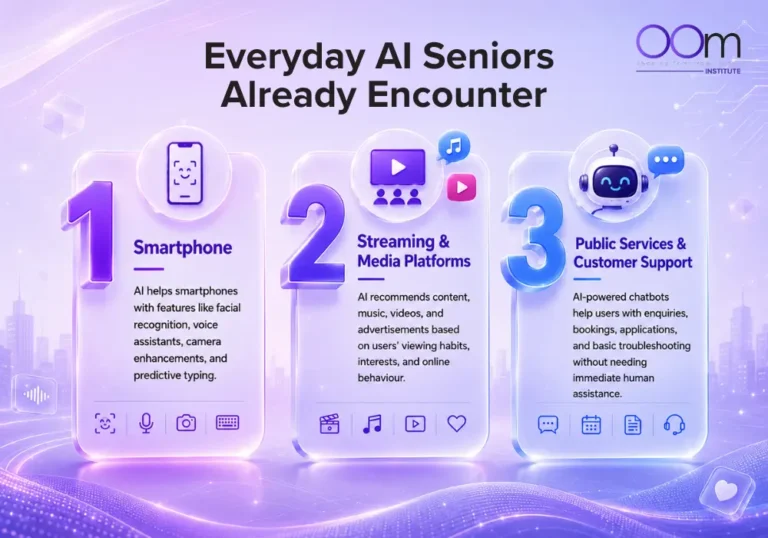
Unlocking a smartphone with facial recognition, asking a voice assistant for the weather, or receiving Netflix recommendations are all examples of AI quietly working in the background.
Customer service chatbots used by banks, airlines, and government services to help people find information more quickly and conveniently are another common example.
Learning about AI does not mean learning how to code or becoming highly technical.
It is about using everyday technology more confidently, staying connected with loved ones, and navigating an increasingly digital world with greater ease and independence.
Also read: 8 SkillsFuture Courses for Seniors
Everyday AI Seniors Already Encounter
Many seniors still associate AI with robots, complex machines, or highly technical industries. In reality, AI is already part of many everyday tools and services they regularly use.
Smartphones, streaming platforms, navigation apps, and online customer support often rely on AI working quietly in the background to make tasks faster, simpler, and more personalised.
Once these examples become easier to recognise, AI often feels less intimidating and far more relatable to daily life.
A. Smartphones
Modern smartphones use AI in many ways that people interact with daily. Facial recognition helps unlock devices securely by identifying the user’s face, while voice assistants can answer simple questions, make calls, send messages, or set reminders through spoken commands.
AI also plays a large role in smartphone cameras. When a phone automatically improves brightness, adjusts lighting, sharpens details, or enhances portrait photos, AI is often working behind the scenes to optimise the image.
Even everyday typing features rely on AI. Predictive text and autocorrect learn from usage habits over time, helping users type messages more quickly while suggesting words or correcting spelling automatically.
B. Streaming and Media Platforms
Streaming platforms such as Netflix and Spotify use AI to personalise what users see and hear. After someone watches a few dramas, listens to certain music genres, or follows specific interests, the platform gradually recommends similar content based on their viewing and listening habits.
This makes it easier for users to discover new shows, songs, podcasts, or videos without needing to search extensively on their own. Over time, the recommendations often become more tailored to individual preferences and routines.
Social media platforms also rely heavily on AI. The posts, videos, and advertisements that appear in a person’s feed are often organised based on past interactions, viewing behaviour, and engagement patterns.
C. Public Services and Customer Support
Many organisations now use AI-powered chatbots to assist with common enquiries and online support. Seniors may encounter these systems when contacting banks, airlines, insurance providers, healthcare institutions, or government services via websites and mobile applications.
Instead of waiting for a customer service representative, users can often receive immediate responses to simple questions, such as checking account information, tracking applications, or finding service details. Some systems can also guide users through forms, appointment bookings, or troubleshooting steps.
While AI chatbots may not always completely replace human support, they are becoming an increasingly familiar part of everyday digital interactions across Singapore.
How to Make Better Use of AI in Your Daily Life
Recognising where AI already appears in everyday life is a useful starting point.
The next step is learning how these tools can be used more intentionally to support daily routines, communication, organisation, and personal interests.
For many seniors, the value of AI is not found in technical knowledge or complex systems.
What often matters more is whether the technology feels practical, approachable, and genuinely helpful in everyday situations.
A. Health and Wellbeing
AI tools can support everyday routines and personal organisation in practical and accessible ways, particularly for seniors managing busy schedules, medications, or health-related information.
Voice assistants can help set medication reminders, create grocery lists, schedule appointments, or answer simple health-related questions through spoken commands.
Smartwatches and wellness applications may also track activity levels, sleep patterns, heart rates, and daily movement to provide useful insights into overall wellbeing.
Some AI-powered translation and transcription tools can make communication easier during medical appointments or when reading healthcare information online, especially for individuals who prefer information presented more clearly or in different languages.
These tools are not intended to replace professional medical advice or healthcare services. However, they can help support day-to-day awareness, organisation, and independence in small but meaningful ways.
B. Travel and Leisure
AI tools can also make travelling and planning outings feel more convenient and less overwhelming, especially when information needs to be accessed quickly while on the move.
Digital assistants can recommend restaurants, suggest travel itineraries, translate menus or signs, and provide directions through simple voice or text prompts.
AI-powered navigation apps can also adjust routes in real time based on traffic conditions, weather disruptions, or public transport delays, helping users move around more smoothly.
For seniors planning holidays independently, these tools may help reduce uncertainty while making travel information easier to understand and access.
Even simple features such as live translation, voice navigation, or personalised recommendations can make unfamiliar environments feel more manageable and enjoyable.
C. Creativity and Hobbies
AI is also becoming part of how people explore creativity, personal interests, and lifelong hobbies in more accessible ways.
Some seniors use AI image tools to experiment with art ideas, restore old family photos, or create personalised greeting cards and memory projects.
Others use AI writing assistants to organise memoirs, draft speeches, generate recipes, or put thoughts into words more easily.
Music streaming platforms, language-learning applications, and online hobby communities also rely on AI to personalise recommendations based on individual interests, learning pace, and preferences.
This can make it easier for users to discover new activities, revisit old passions, or explore unfamiliar topics with greater confidence.
Rather than replacing hobbies or creativity, these tools often help make creative exploration feel more approachable, engaging, and enjoyable for everyday life.
Singapore Initiatives to Support Seniors in AI Learning
Learning about AI does not need to feel isolating or overly technical.
Across Singapore, growing efforts are being made to help older adults become more comfortable with digital technology through practical guidance, accessible learning environments, and community-based support.
As AI becomes increasingly woven into everyday life, more initiatives are recognising the importance of helping seniors build digital confidence at a pace that feels manageable and encouraging.
A. Government Inclusion Efforts
Singapore has placed increasing emphasis on digital inclusion as technology continues to shape communication, services, healthcare, and daily living.
Many public initiatives encourage seniors to strengthen digital literacy skills, particularly in areas such as online communication, digital transactions, mobile applications, and internet safety.
As AI tools become more widely used, these conversations are gradually expanding to include broader awareness of how AI influences everyday experiences.
This growing focus reflects a wider understanding that digital confidence plays an important role in helping seniors remain connected, informed, and active participants within society.
B. Community Support
Community centres, libraries, volunteer groups, and learning organisations are also creating more opportunities for seniors to explore digital skills in supportive environments.
These workshops often focus on practical learning rather than technical terminology.
Seniors may learn how to use mobile applications more confidently, recognise suspicious online activity, or explore beginner-friendly AI tools through guided exercises and hands-on demonstrations.
The learning environment itself can make a significant difference. Studying alongside others at a similar pace often helps reduce anxiety and creates a more comfortable, encouraging experience for older learners.
C. Financial Support
Access to digital learning has also become more flexible and affordable in recent years.
Government-supported funding initiatives help make technology-related learning more accessible for seniors who wish to explore new skills without facing significant financial barriers. Some programmes may fall under broader categories, such as SkillsFuture courses for seniors, which allow learners to offset course fees while building practical digital knowledge and confidence.
For older adults who prefer a more gradual approach to learning, structured programmes can provide clearer guidance and a more manageable pathway into AI and digital literacy topics.
Stay Competitive & Relevant

Why Seniors Must Learn AI to Stay Safe
As AI technology advances, online scams and misinformation are becoming more convincing and harder to detect.
For seniors, learning about AI is no longer only about convenience or keeping up with technology. It is increasingly becoming part of staying safe and informed in digital spaces.
Understanding how AI is used online can help older adults recognise suspicious behaviour more quickly, respond more cautiously, and feel more confident navigating everyday digital interactions.
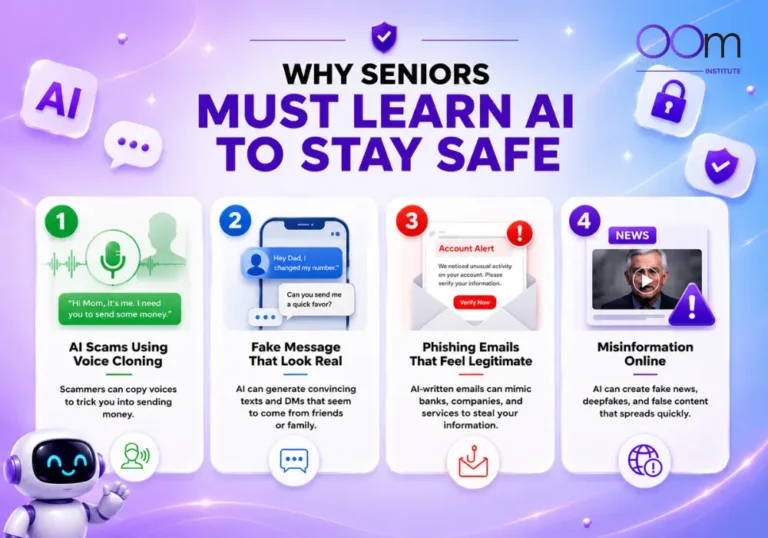
A. AI Scams Using Voice Cloning
Scammers can now use AI-generated voice technology to imitate familiar voices with surprising realism.
In some reported cases, individuals receive urgent phone calls that appear to come from family members or close contacts asking for financial assistance. The tone, speech patterns, and emotional urgency may sound convincing even though the voice itself is artificially generated.
Simply being aware that this technology exists can help seniors pause, independently verify requests, and approach unexpected situations more cautiously.
B. Fake Messages That Look Real
AI tools can now generate highly realistic messages, advertisements, websites, and social media posts within seconds.
Unlike older scam attempts that often contained obvious spelling mistakes or awkward phrasing, many AI-generated scam messages now appear polished, professional, and believable. This makes them much harder to identify based on appearance alone.
Understanding how AI-generated content works may help seniors be more mindful before clicking unfamiliar links, downloading attachments, or responding immediately to urgent online requests.
C. Phishing Emails That Feel Legitimate
AI-generated phishing emails are becoming increasingly sophisticated. Many now closely mimic the tone, formatting, and branding used by banks, delivery companies, healthcare providers, and government agencies.
Some scams even personalise messages using publicly available information, making the emails appear more trustworthy and convincing. As a result, digital safety today often depends less on spotting obvious errors and more on recognising unusual requests, urgency tactics, or suspicious behaviour patterns.
For individuals who wish to further strengthen their online awareness, a WSQ cybersecurity course can complement AI learning by building practical knowledge in phishing awareness, scam prevention, and safer digital habits.
D. Misinformation Online
AI-generated articles, images, videos, and social media content can spread misinformation quickly across online platforms.
Some manipulated content may look highly realistic despite being inaccurate, misleading, or entirely fabricated. This can make it more difficult for users to distinguish between trustworthy information and content designed to mislead or provoke emotional reactions.
For seniors who regularly read news, watch videos, or use social media, understanding how AI influences online content can support more informed decision-making.
Critical thinking, fact-checking, and source verification are becoming increasingly important digital skills for people of all ages.
How OOm Institute Makes AI Learning Senior-Friendly
Learning about AI does not need to feel overwhelming, highly technical, or difficult to follow. For many seniors, confidence develops more naturally when lessons focus on practical, everyday use rather than complex technical theory.
At OOm Institute, AI learning is designed with accessibility, clarity, and real-world application in mind, helping learners build familiarity at a comfortable and manageable pace.
A. A No-Coding, Practical Approach
Many older adults assume that learning AI requires programming knowledge or advanced technical skills. In reality, many useful AI tools can be understood and applied without any coding background at all.
OOm Institute’s programmes focus on practical applications that relate directly to daily life. Learners are guided in how AI tools can support communication, organisation, research, productivity, and digital awareness in simple, approachable ways.
By focusing on usability rather than technical complexity, lessons help learners feel more comfortable gradually and confidently experimenting with AI tools.
B. Hands-On and Supportive Learning
The learning environment itself can play a major role in helping seniors feel more at ease with technology.
Smaller class settings and guided exercises create opportunities for learners to explore tools step by step while asking questions comfortably along the way. Hands-on activities also help concepts feel more tangible and easier to apply outside the classroom.
Learning alongside peers at a similar pace can further reduce pressure and encourage discussion, shared experiences, and mutual support. Rather than rushing through lessons, the focus remains on helping learners build confidence steadily over time.
C. Structured Learning Pathways
For many people, confidence with AI develops gradually through repeated exposure and guided practice.
A structured generative AI course can help seniors move from basic awareness to more practical, independent use in a way that feels organised and approachable.
Instead of trying to understand everything at once, learners progressively become more familiar with how AI tools can support everyday situations and digital interactions.
This gradual approach helps learning feel more purposeful, relevant, and achievable without becoming overwhelming.
Conclusion
For seniors, learning about AI is not about becoming highly technical or mastering every new tool available.
More often, it is about building familiarity and confidence in a digital environment that continues evolving around us.
Even a basic understanding of AI can help older adults feel more comfortable navigating online spaces, using digital services, and more cautiously recognising potential risks.
Small steps into AI learning can still create meaningful benefits. From staying organised and connected to exploring hobbies or improving online awareness, practical digital skills can support greater independence and confidence in everyday situations.
At OOm Institute, AI learning is designed to feel approachable, practical, and relevant to real life. Through guided, hands-on programmes focused on everyday applications rather than technical complexity, learners can gradually build confidence in a supportive environment.
If you are looking to explore AI in a way that feels accessible and manageable, explore OOm Institute’s programmes and discover how practical digital skills can support everyday communication, safety, and lifelong learning.
Frequently Asked Questions
1. Is AI too difficult for seniors to learn?
Not necessarily. Many AI tools today are designed for everyday users rather than technical professionals. Seniors often learn effectively when lessons focus on practical examples, guided exercises, and gradual familiarity instead of technical jargon. Learning at a comfortable pace can also help build confidence over time.
2. Why should senior citizens learn AI?
AI increasingly influences communication, banking, healthcare, entertainment, travel, and online safety. Understanding how these tools work may help seniors stay informed, independent, and more confident when navigating digital environments. It can also support safer decision-making when interacting with online content and services.
3. What are some simple AI tools seniors can start with?
Voice assistants, translation apps, navigation tools, streaming recommendations, and AI-powered photo-editing applications are often accessible starting points for beginners. Many seniors also begin with everyday smartphone features that already use AI quietly in the background.
4. Can AI help seniors stay safe from scams?
Learning about AI can improve awareness of newer scam tactics such as voice cloning, phishing emails, fake advertisements, and manipulated online content. Greater understanding may help seniors pause before responding to suspicious requests and make safer decisions while using digital platforms.
5. Are there AI courses in Singapore suitable for seniors?
Yes. Some learning providers in Singapore now offer beginner-friendly AI programmes designed around practical usage, digital confidence, and accessible learning environments. These courses often focus on real-life applications instead of technical theory or coding.
6. Do seniors need to know coding to learn AI?
No. Many beginner AI courses focus entirely on practical usage without requiring programming knowledge or a technical background. Seniors can still learn how to use AI tools effectively for communication, organisation, creativity, and online safety without learning how to code.
7. How can I encourage my parents to start learning AI?
Starting with relatable examples often helps. Showing how AI already appears in smartphones, navigation apps, streaming platforms, or online customer support can make the technology feel more familiar and less intimidating. Gentle encouragement and hands-on exploration usually work better than introducing overly technical concepts immediately.
8. What should seniors watch out for when using AI?
Seniors should remain cautious about suspicious links, requests for personal information, urgent financial messages, and online content that appears unusually emotional or sensational. Verifying information through trusted sources and taking time before responding can help reduce the risk of scams or misinformation.