
Key Takeaways
|
Introduction
As businesses adopt more digital tools to run daily operations, workflows often become harder to manage rather than easier. Tasks pass between platforms, approvals stall in inboxes, and teams spend time coordinating work that should move forward on its own. Over time, these minor delays add up. This is where AI workflow automation begins to change how organisations approach efficiency.
In practice, AI workflow automation uses artificial intelligence to design and run business workflows that respond to real-world conditions. Instead of relying on fixed rules, AI-driven workflows can interpret data, recognise patterns, and decide what should happen next. This allows automation to support processes that involve variation, judgement, or unstructured information such as documents, emails, and support requests.
The difference from traditional automation is significant. Rule-based systems work best when tasks are predictable and rarely change. Modern business environments are less stable. Priorities shift, inputs vary, and decisions often depend on context rather than a single condition. AI-enabled workflows are better suited to this reality, allowing organisations to automate more complex processes without constant manual adjustment.
For businesses in Singapore, where teams are lean and expectations around speed and accuracy are high, AI workflow automation is no longer a nice-to-have upgrade. It has become a practical way to maintain consistency, support growing workloads, and help teams focus on work that requires human judgement and experience.
Why AI Workflow Automation Is Critical for Modern Businesses
A lack of software does not hold modern businesses back. The real challenge is getting multiple tools to work together seamlessly. As organisations add systems for marketing, finance, HR, operations, and customer support, workflows often become fragmented. Tasks are transferred manually, approvals linger, and minor inconsistencies turn into recurring problems. In this environment, AI workflow automation becomes essential rather than optional.
Speed is one of the strongest pressures driving this shift. Customers expect timely responses, leaders need up-to-date visibility, and teams are asked to deliver more with limited resources. Manual workflows struggle to keep pace. AI-driven automation reduces reliance on constant human input by handling routine decisions, routing tasks intelligently, and keeping work moving even when teams are not actively monitoring every step.
Accuracy is just as important. Many traditional workflows rely on repeated manual input, increasing the risk of missed steps, inconsistent handling, or simple human error. AI workflow automation improves reliability by applying consistent logic across each action while still responding appropriately to different scenarios. This balance is particularly valuable in areas such as finance approvals, customer support triage, and internal request management.
Scalability is another critical factor. Processes that work well at low volumes often break down as demand grows. Adding headcount is not always practical, especially in competitive markets like Singapore. AI-enabled workflows scale more effectively, allowing organisations to manage higher workloads without a proportional increase in cost or complexity.
There is also a broader strategic impact. When teams spend less time coordinating tasks, chasing updates, or correcting avoidable issues, they free up capacity for analysis, planning, and improvement. AI workflow automation helps shift effort away from administrative overhead and towards work that supports long-term organisational value.
For businesses building digital capability through structured learning, such as an AI course, understanding how automation fits into real operational workflows is increasingly important. AI workflow automation is no longer just a technical enhancement. It is a core element of how modern organisations operate efficiently, consistently, and at scale.
How AI Automation Works in Business Workflows
At a high level, AI workflow automation works by linking systems, interpreting incoming information, and moving tasks through a defined process. Rather than treating each step as a fixed instruction, AI introduces decision-making into the workflow, allowing actions to change based on context, data quality, and previous outcomes.
Most workflows begin with an input. This might be an email, a form submission, a support ticket, or a document upload. AI models analyse this input to understand intent, extract relevant details, and determine what type of task it represents. An invoice, for example, can be read, categorised, and checked against approval limits without requiring manual review at every step.
Once the input is understood, the workflow decides what should happen next. AI workflow automation moves beyond basic if-then logic by weighing multiple factors such as urgency, historical trends, or user behaviour. Tasks are then routed to the appropriate person or system, reducing unnecessary handoffs and enabling work to progress without delay.
From there, actions are carried out automatically across connected platforms. These may include updating records, sending notifications, scheduling follow-ups, or triggering additional workflows. Over time, AI-driven workflows can be refined based on results. Feedback loops allow the system to improve accuracy, timing, and routing decisions as more data becomes available.
Visibility and oversight remain essential throughout this process. Effective AI workflow automation provides clear insight into performance, highlights where delays occur, and signals when human input is needed. This keeps automation transparent and ensures it supports teams rather than operating as an unseen layer in the background.
For professionals who want to design workflows that behave reliably in real environments, understanding how instructions, context, and system behaviour interact is critical. Structured learning through a prompt engineering course helps build this capability, ensuring AI-driven workflows operate as intended and deliver consistent outcomes.
Real-World Examples of AI Workflow Automation
A. Human Resources
B. Finance
C. Customer Support
D. IT and Operations
E. Small and Medium Enterprises
Small and medium enterprises often adopt AI workflow automation through no-code tools that connect everyday systems. Zapier is commonly used for lead routing, automatically assigning enquiries from forms or emails to sales teams. Make supports inventory updates by syncing stock levels when orders are placed. Microsoft Power Automate is frequently used for employee onboarding, triggering account setup, document sharing, and task assignments when new hires join.
Taken together, these examples show that AI workflow automation is not limited to large enterprises or highly complex environments. It scales across business sizes and functions, delivering clear efficiency gains wherever coordination, routing, and decision-making slow work down.
Benefits of AI Workflow Automation
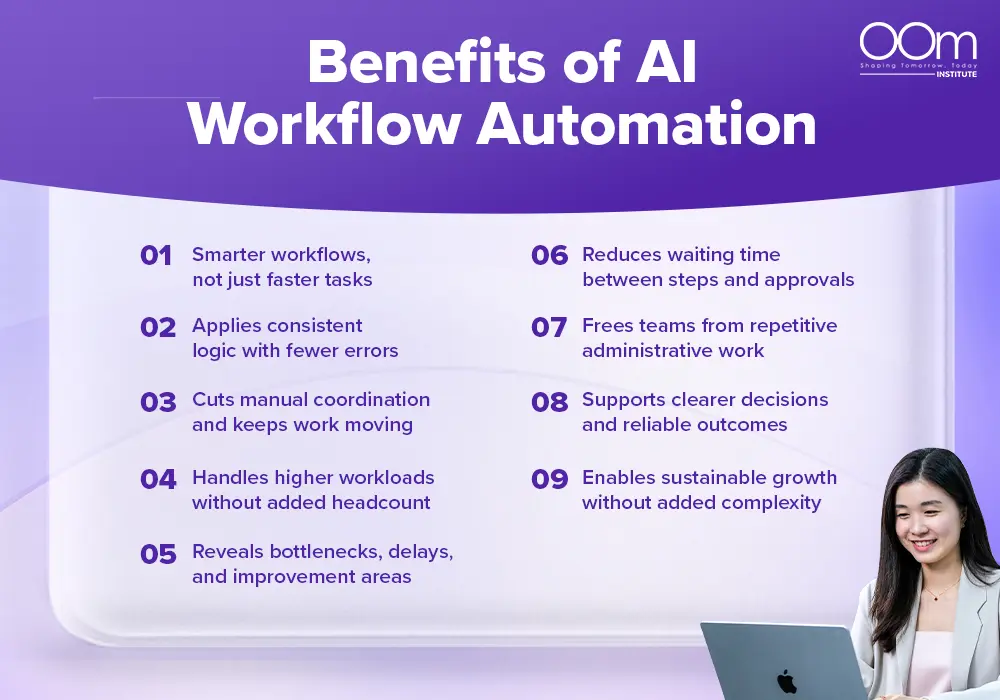
The real value of AI workflow automation is not just about saving time. It lies in improving how work moves across the organisation. When workflows are designed to respond intelligently rather than follow rigid steps, the benefits extend across teams, systems, and outcomes.
Operational efficiency is often the most immediate gain. AI-driven workflows reduce manual coordination by handling routine decisions, automatically routing tasks, and keeping processes moving without repeated follow-ups. This helps shorten turnaround times and reduces friction between teams that depend on shared systems.
Consistency is another key advantage. Manual workflows can vary depending on workload, experience, or individual judgement. AI workflow automation applies the same logic each time while still responding to context, leading to more predictable outcomes and fewer errors. This is particularly important in areas such as finance, HR, and customer support, where accuracy and compliance are critical.
Scalability also improves as workloads increase. Processes that work well at low volumes often struggle as demand grows. AI-powered workflows scale without requiring a proportional increase in staff, allowing organisations to handle higher volumes while maintaining service quality. This makes automation especially relevant for growing businesses and lean teams.
Improved visibility is another benefit. Automated workflows generate clear data on processing times, bottlenecks, and exceptions. These insights make it easier to identify inefficiencies and refine processes over time. With AI workflow automation, optimisation becomes a continuous activity rather than a one-off exercise.
There is also a positive impact on how teams experience their work. When repetitive coordination and administrative tasks are handled automatically, employees can focus on analysis, problem-solving, and decision-making. This shift supports higher-quality output and reduces fatigue caused by constant task switching.
Together, these benefits explain why AI workflow automation is increasingly seen as a core operational capability. It supports efficiency, reliability, and sustainable growth in complex digital environments.
The Best AI Workflow Automation Tools by Category
A. Best No-Code and Low-Code AI Workflow Automation Tools (SME-Friendly)
No-code and low-code platforms are often the most accessible entry point for small and medium businesses. They allow teams to automate workflows without deep technical expertise, while still delivering clear improvements in efficiency and coordination.
- Zapier focuses on connecting everyday business applications and triggering actions when specific events occur. It is commonly used for lead routing, data synchronisation, and simple process automation where speed of setup and ease of use are priorities.
- Make provides a visual workflow builder that supports more complex logic through a drag-and-drop interface. It is well-suited for businesses that need conditional routing, data transformation, or multi-step workflows without writing code.
- FlowForma combines no-code workflow design with AI-driven capabilities for structured business processes. It is often used for compliance workflows, approvals, and operational processes where governance, consistency, and documentation are important.
- Airtable AI extends database-driven workflows with AI-assisted features. Teams can organise information, trigger actions, and generate insights from structured data, making it useful for project management, content operations, and internal request tracking.
B. Best Enterprise AI Workflow Automation and Integration Tools
Larger organisations often need automation platforms that can operate securely at scale, integrate deeply with existing systems, and support workflows across multiple departments. Enterprise-focused tools are designed to handle this level of complexity while maintaining governance and reliability.
- Microsoft Power Automate integrates closely with the Microsoft ecosystem, enabling automation across applications such as Outlook, Teams, SharePoint, and Dynamics. It is a common choice for organisations that are already standardised on Microsoft tools and require consistent workflows across business and collaboration platforms.
- Workato focuses on enterprise-grade integrations and workflow orchestration. It supports complex data flows between systems and is often adopted by organisations with established automation strategies and cross-functional requirements spanning multiple business units.
- ServiceNow Automation Engine is built for IT workflows and large-scale enterprise operations. It supports automation across service management, incident response, and operational processes, making it particularly suited to regulated environments where visibility, control, and auditability are essential.
C. Best AI-Powered RPA Tools
Robotic Process Automation tools are designed to automate repetitive, rules-based tasks, particularly across legacy systems and user interfaces that are not easily integrated. When combined with AI, these tools can handle more complex scenarios involving both structured and unstructured data.
- UiPath is widely used for intelligent document processing and large-scale automation. By combining RPA with AI capabilities, it can extract, interpret, and act on information from documents, emails, and systems, making it suitable for functions such as finance, operations, and shared services.
- Automation Anywhere offers RPA supported by AI-assisted workflows that operate across multiple applications. It is commonly used to automate repetitive processes that span different systems, helping organisations reduce manual effort while maintaining consistency at scale.
D. Best Open-Source and Developer Automation Tools
For teams with in-house technical capabilities, open-source automation tools offer high flexibility and control. These platforms are often chosen when organisations need custom logic, self-hosting options, or tighter control over data and infrastructure.
- n8n is an open-source workflow automation platform that supports custom logic and integrations across a wide range of services. It is commonly used by development teams that want greater control over how workflows are built, deployed, and maintained.
- Huginn supports self-hosted event automation through custom-built agents. Developers can configure agents to monitor specific events and trigger actions when conditions are met, making it suitable for highly tailored or experimental automation use cases.
Understanding these categories helps organisations match automation tools to real operational needs, rather than adopting platforms that are either too restrictive or unnecessarily complex.
How to Choose an AI Workflow Automation Tool
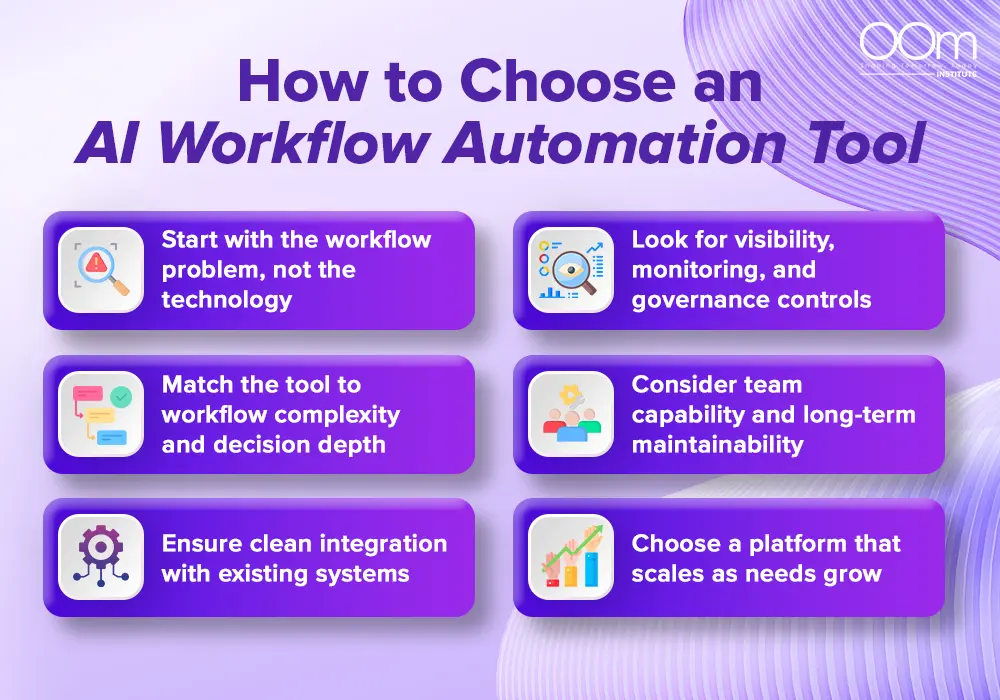
Choosing the right AI workflow automation tool begins with clarity around the problem being addressed, not the technology itself. Many organisations are drawn to platforms based on popularity or feature lists, only to discover later that the tool does not align with how their workflows actually operate.
Workflow complexity is a good place to start. Simple, linear processes can often be handled with basic no-code automation. More involved workflows that span multiple systems, include conditional logic, or rely on unstructured data tend to benefit from AI-driven decision-making. Mapping the process from start to finish helps identify which capabilities are truly necessary.
Integration should be considered early. Automation tools need to work reliably with existing systems such as CRM platforms, finance software, and collaboration tools. Poor integration can introduce new friction and manual work, undermining the purpose of automation. For organisations already committed to specific technology ecosystems, compatibility can significantly narrow the field of suitable options.
Governance and oversight are equally important. Effective AI workflow automation depends on visibility into how decisions are made, where exceptions occur, and when human review is required. Tools that offer monitoring, audit trails, and role-based access controls are better suited for workflows that involve compliance, financial impact, or operational risk.
Team capability also plays a role. While no-code platforms reduce technical barriers, designing reliable and scalable workflows still requires structured thinking and clear logic. Organisations that plan to expand their automation efforts benefit from investing in training to ensure teams can maintain and refine workflows as needs change.
Finally, long-term scalability should not be overlooked. A tool that performs well during a pilot may struggle as volumes grow or processes evolve. Selecting a platform that supports gradual expansion allows businesses to scale automation without repeated disruption.
When AI Workflow Automation Is Worth It: Cost vs Value
Cost is often the first concern when businesses consider AI workflow automation. Subscription fees, setup effort, and training requirements can feel like obstacles, particularly for small and medium organisations. However, focusing only on upfront cost often overlooks where the actual value is generated.
The strongest returns usually come from reducing hidden operational costs. Manual workflows consume time through repeated follow-ups, corrections, rework, and cross-team coordination. These inefficiencies rarely appear as a single expense, but they accumulate steadily. AI workflow automation reduces this friction by keeping processes moving in a consistent and predictable way.
Error reduction is another important factor. Mistakes in areas such as finance approvals, data entry, or customer handling create downstream impacts that extend beyond immediate fixes. AI-driven workflows apply consistent checks and decision logic, lowering the likelihood of costly exceptions. Over time, this reliability supports measurable savings and stronger compliance.
Labour efficiency also matters, especially in markets like Singapore, where talent is competitive, and resources are limited. Automation does not replace teams. Instead, it enables existing staff to handle higher volumes without proportional increases in headcount. In this sense, AI workflow automation functions as a capacity multiplier rather than a simple cost-cutting measure.
Opportunity cost should also be considered. Time spent managing administrative tasks is time not spent on analysis, planning, or customer engagement. When workflows are automated thoughtfully, teams regain the space to focus on work that supports growth and long-term value.
For most organisations, the value equation becomes favourable when workflows are repetitive, decision-heavy, or frequently delayed. In these situations, AI workflow automation delivers returns through steady, compounding efficiency gains rather than dramatic, one-off transformation.
The Next Evolution: Introducing Agentic AI
As AI workflow automation continues to mature, many businesses are beginning to move beyond task-based automation towards a more autonomous approach known as agentic AI. This shift changes not just what workflows do, but how they are designed and managed.
Traditional automation is built around executing predefined steps. Even advanced AI workflows usually operate within structured processes that rely on human direction at key points. Agentic AI goes a step further by allowing systems to work towards defined goals rather than following fixed instructions. Instead of being told what to do at every stage, agents are given an objective and the boundaries within which they can act.
This move from task execution to goal-based behaviour allows workflows to respond more flexibly to real-world conditions. An agent can assess context, select appropriate tools, adjust its approach, and respond to unexpected situations without constant human input. For example, rather than only routing tickets, an agentic system could prioritise issues, request missing information, and escalate cases as conditions change.
For businesses, this evolution brings both opportunity and responsibility. Agentic AI can unlock new levels of efficiency, but it also demands stronger governance, clearer objectives, and well-designed workflows. Teams need to understand how agents make decisions, how those decisions are monitored, and when human oversight is required. Without this foundation, greater autonomy can introduce risk rather than value.
Preparation is therefore critical. Organisations that have already invested in AI workflow automation are better positioned to adopt agentic models responsibly. Familiarity with existing processes, data flows, and decision points makes it easier to define goals that agents can effectively work towards.
For those exploring what this next phase looks like in practice, our article on the Best Agentic AI Tools for Businesses examines platforms built to support goal-driven automation across real operational use cases.
Challenges and Risks of AI Workflow Automation
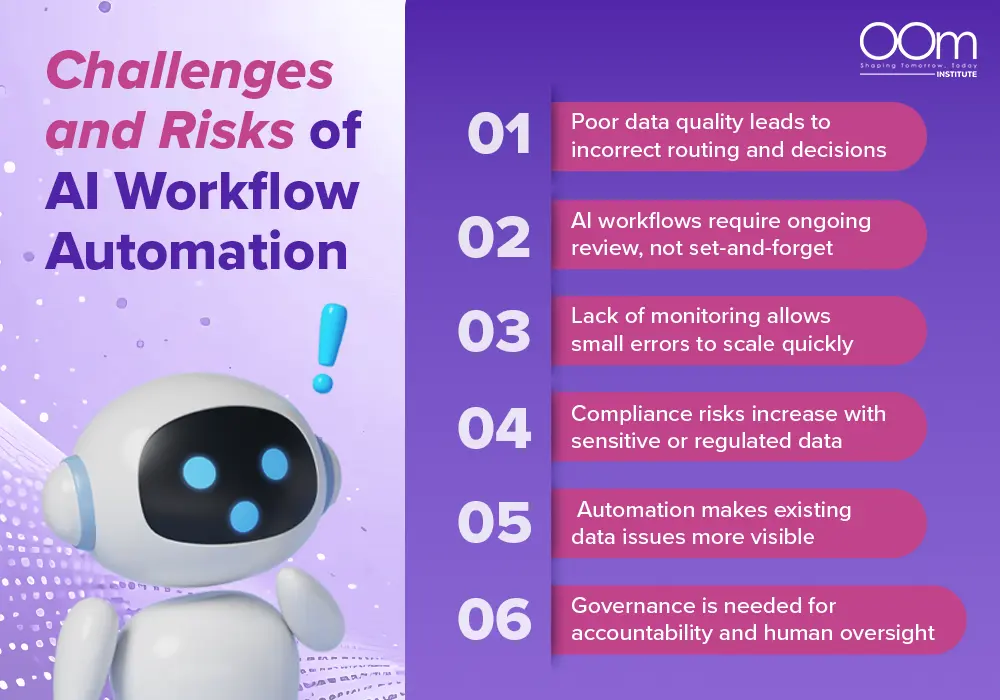
Data quality is one of the most common issues. AI-driven workflows depend on accurate and well-structured inputs to function effectively. Inconsistent data, outdated records, or missing information can lead to misclassification, incorrect routing, or delayed outcomes. Automation does not mask these problems. In many cases, it makes them more visible.
Monitoring and governance are equally crucial as workflows become more autonomous. Businesses need visibility into how decisions are made, where exceptions occur, and when human review is required. Without proper oversight, minor errors can spread quickly across systems. Effective AI workflow automation includes clear logging, performance tracking, and defined escalation points.
Ethical and compliance considerations also need attention, particularly when workflows involve personal data, financial decisions, or hiring processes. Automated systems must operate in accordance with regulatory requirements and organisational policies. This calls for thoughtful design, ongoing review, and clear accountability for outcomes, even when decisions are supported by AI.
Expectation management is another challenge. Automation is sometimes treated as a set-and-forget solution, but AI workflows require ongoing refinement. Models need to be reviewed, rules adjusted, and performance monitored as business conditions change. Viewing automation as a system that evolves over time leads to more sustainable results.
By addressing these risks early, businesses can adopt AI workflow automation that supports efficiency while maintaining trust, control, and compliance.
How to Measure Automation Success
Measuring the success of AI workflow automation means looking beyond simple activity counts. The objective is not to automate the most significant number of tasks, but to improve how work moves through the organisation and how consistently outcomes are delivered.
Cycle time is one of the most valuable indicators. Comparing how long a process takes before and after automation highlights where efficiency gains occur. Shorter turnaround times often indicate better task routing, fewer handoffs, and shorter wait times between steps.
Error rates are another important measure. Effective automation should reduce issues such as incorrect data entry, missed approvals, or inconsistent handling. Tracking exceptions and rework helps reveal whether AI workflow automation is improving accuracy or simply relocating problems within the process.
Throughput and capacity also provide insight. Successful automation enables teams to manage higher volumes without adding resources, which is particularly valuable in functions such as customer support, finance processing, or IT operations, where demand can fluctuate.
User experience should also be considered. Feedback from employees and stakeholders helps determine whether workflows feel clearer and easier to work with. Automation that introduces confusion or additional friction undermines its purpose. Well-designed workflows should support users rather than get in their way.
Long-term impact is the final test. The most effective AI workflow automation efforts show steady improvement over time, with workflows refined based on performance data and evolving needs. Treating measurement as an ongoing practice helps ensure automation continues to deliver value as the organisation grows and changes.
Frequently Asked Questions
1. How does agentic AI improve AI automation workflows?
Agentic AI shifts automation from executing fixed steps to working towards defined goals. Instead of following a set sequence, agentic systems assess context, choose appropriate actions, and adapt when conditions change. This enables AI workflow automation to handle more complex, variable scenarios with less manual oversight, particularly in environments where priorities and inputs change frequently.
2. Can small businesses adopt AI automation effectively?
Yes. Many small businesses adopt AI workflow automation using no-code and low-code platforms that integrate easily with existing tools. These solutions support tasks such as lead routing, approvals, onboarding, and data synchronisation without requiring deep technical expertise. Starting with a single high-impact workflow often delivers early results and builds confidence for broader adoption.
3. How much does AI automation typically cost for small and medium businesses?
Costs vary depending on the tools used, the number of workflows, and the complexity of the workflows. Subscription-based platforms often start with manageable monthly fees, while more advanced use cases may require additional setup or training. For most SMEs, the value of AI workflow automation comes from time savings, reduced errors, and increased capacity rather than direct cost reduction alone.
4. Do AI workflow automation tools require technical skills to use effectively?
Basic workflows can usually be built without technical skills, particularly on no-code platforms. However, creating reliable and scalable automation still requires structured thinking, clear logic, and an understanding of how systems interact. Developing these capabilities helps teams use automation more effectively and avoid unintended outcomes.
5. How can training prepare teams for AI automation?
Training helps teams understand how AI-driven workflows operate, where human oversight is needed, and how automation should be refined over time. Skills such as workflow design, data quality management, and prompt formulation play an essential role. Applied learning enables organisations to adopt AI workflow automation with greater confidence and long-term effectiveness.
Conclusion: Building Smarter Workflows for the Future
As organisations manage increasing complexity across tools, teams, and data, AI workflow automation has moved from experimentation to everyday practice. It offers a practical way to reduce friction, improve consistency, and scale operations without adding unnecessary strain to existing teams.
The real value comes from understanding how automation fits into daily work. When AI-driven workflows are designed with clear intent and appropriate oversight, they support better decisions, clearer accountability, and more efficient use of time. Routine coordination happens quietly in the background, giving teams more space to focus on work that requires human judgement and strategic thinking.
Adapting to this shift takes more than adopting new platforms. It requires skills in workflow design, critical evaluation, and responsible use of AI. As automation continues to evolve towards more autonomous, agent-driven models, these capabilities will play an even greater role in long-term success.
For professionals and teams looking to build practical, job-ready skills, OOm Institute provides structured training that connects AI concepts to real-world applications. Through applied learning and real-world scenarios, participants develop the confidence to implement AI workflow automation thoughtfully and effectively.