Key Takeaways
|
Introduction
In many workplaces today, roles rarely operate in isolation. Projects often involve multiple departments, and decisions can affect teams beyond your immediate scope. Expectations may come from senior leaders, peers, clients, or partners, sometimes all at once.
A technically strong proposal may still struggle if key stakeholders are not aligned. A well-planned initiative can slow down when assumptions remain unclear. Over time, many professionals realise that progress is shaped not only by individual capability, but also by how effectively relationships are managed around the work.
This is where stakeholder management skills become increasingly important. They support clearer communication, steadier alignment, and more thoughtful navigation of competing interests. In complex organisational settings, the ability to engage stakeholders constructively often makes a meaningful difference to outcomes.
What Are Stakeholder Management Skills?
Stakeholder management skills describe the ability to work thoughtfully and constructively with people who have an interest in your work. These individuals or groups may influence your projects, depend on your deliverables, or be affected by the decisions you make. In most roles, this network extends further than it first appears.
Managing stakeholders usually begins with understanding who is involved and how they are connected to the outcome. Different stakeholders often view the same situation through very different lenses. A senior leader may be thinking about strategic alignment and risk exposure, while a colleague may be focused on operational feasibility. A client might be concerned about responsiveness and service quality. Recognising these perspectives helps create context for more balanced conversations.
Beyond identification, stakeholder management involves making sense of what sits beneath the surface. Concerns raised in meetings may reflect competing pressures. Silence may signal uncertainty rather than agreement. A measured response often requires listening carefully, asking clarifying questions, and considering how priorities intersect rather than collide.
In practical terms, stakeholder management can involve clarifying scope, setting expectations, communicating constraints, and revisiting agreements as circumstances shift. It may also require navigating disagreement with composure and guiding discussions towards shared ground. This is rarely about persuading everyone to see things the same way. More often, it is about finding workable alignment that allows progress to continue.
At a broader level, stakeholder management calls for a blend of judgement, communication awareness, and structured thinking. It involves balancing multiple viewpoints while keeping overall objectives in sight. When approached deliberately, it can help reduce friction, build trust over time, and support steadier collaboration across complex workplace environments.
Examples of Stakeholders in the Workplace (Up, Down, Across & External)
Stakeholders can be found at every level of an organisation. One helpful way to understand them is to consider where they sit relative to your role. Looking at stakeholders through this lens often makes complex networks easier to navigate.
A. Upward Stakeholders
Upward stakeholders typically include senior leaders, directors, or executives. Their focus often centres on strategy, risk exposure, performance metrics, and broader organisational outcomes.
Engaging with upward stakeholders may involve providing concise updates, explaining the rationale for decisions, and demonstrating how your work supports broader business priorities. Clarity and relevance tend to matter more than volume of detail.
B. Downward Stakeholders
Downward stakeholders usually refer to team members or direct reports. They often rely on you for direction, context, and support in carrying out responsibilities.
Working with stakeholders below you may require setting clear expectations, providing background on decisions, and being attentive to workload and morale. Consistency in communication can help reduce uncertainty and maintain trust.
C. Across Stakeholders
Across stakeholders are peers in other departments or functions. In many organisations, collaboration across teams is common, and priorities may not always align neatly.
Engagement here may involve coordinating timelines, negotiating resource allocation, and aligning on shared deliverables. These interactions often benefit from mutual understanding of constraints on both sides.
D. External Stakeholders
External stakeholders can include clients, vendors, partners, regulators, or customers. Although they may sit outside the organisation, their expectations can significantly shape internal decisions.
Managing external stakeholders may involve clarifying service standards, responding to feedback, addressing concerns constructively, and representing organisational interests with professionalism.
Recognising these layers does not eliminate complexity, but it can make stakeholder management more intentional. When you are aware of who sits in each direction and what they are likely to prioritise, responses tend to become more measured rather than reactive.
Common Stakeholder Management Challenges at Work
Even capable and experienced professionals can encounter friction when working with stakeholders. The difficulty is not always a lack of effort. More often, it reflects gaps in specific capabilities that have not yet been deliberately developed.
1. Problem: You Keep Running into Conflict with Stakeholders
What this looks like at work
- Tension during discussions
- Defensive reactions in meetings
- Issues escalating more quickly than expected
What this usually means
Recurring conflict can suggest gaps in conflict handling, emotional awareness, or expectation management. Without a structured way to navigate disagreement, conversations may drift from the issue itself to personal reactions. Over time, this pattern can create strain across teams. Developing stronger conflict management approaches often shifts discussions from confrontation towards resolution and shared understanding.
2. Problem: Stakeholders Seem Unhappy Despite Your Efforts
What this looks like at work
- Repeated last-minute changes
- Feedback that expectations were “not met”
- Misalignment between deliverables and initial assumptions
What this usually means
When dissatisfaction persists despite genuine effort, the root cause may lie in unclear scope or unspoken expectations. In many cases, the issue is less about quality and more about ambiguity. Strengthening clarity around timelines, trade-offs, and constraints can reduce misunderstanding and improve alignment before frustration builds.
3. Problem: Decisions Keep Getting Delayed
What this looks like at work
- Meetings that end without a clear resolution
- The same concerns are revisited repeatedly
- Stakeholders are hesitant to commit to the next steps
What this usually means
Delays can point to gaps in structured facilitation and decision alignment. Without clear criteria or defined ownership, discussions may circle without progress. Stronger stakeholder management skills often involve guiding conversations towards clarity, surfacing concerns early, and helping groups evaluate options against agreed priorities.
4. Problem: You Feel Pulled in Too Many Directions
What this looks like at work
- Conflicting requests from different parties
- Difficulty prioritising competing demands
- Ongoing pressure from multiple fronts
What this usually means
Feeling stretched across expectations can suggest gaps in boundary-setting, influence, or stakeholder prioritisation. Not all stakeholders hold equal influence in every situation, yet this hierarchy is not always explicit. Developing a more strategic approach to assessing impact and urgency can help professionals allocate attention more effectively rather than attempting to satisfy all demands at once.
Why Stakeholder Management Skills Are Important in the Workplace
Many organisations today operate within interconnected structures, where reporting lines and working relationships overlap. Projects frequently rely on cross-functional collaboration, and outcomes often depend on cooperation rather than formal authority alone. In such environments, the ability to engage stakeholders thoughtfully can shape whether initiatives gain traction or stall.
Strong stakeholder management skills can contribute to smoother project execution by reducing misunderstandings early. They can support clearer and more timely decision-making by aligning expectations before issues escalate. When conversations are handled constructively, interpersonal friction may lessen, and trust across teams can develop more steadily over time.
These skills also influence professional perception. Individuals who communicate clearly, manage tension calmly, and balance competing interests are often viewed as dependable and measured. When alignment becomes complex or sensitive, colleagues may naturally turn to those who demonstrate steady judgement and a collaborative approach.
Key Steps in Stakeholder Management
Every stakeholder situation carries its own nuances. Personalities differ. Priorities shift. Timelines evolve. Even so, applying a structured approach can bring greater consistency and steadiness to how you engage others.
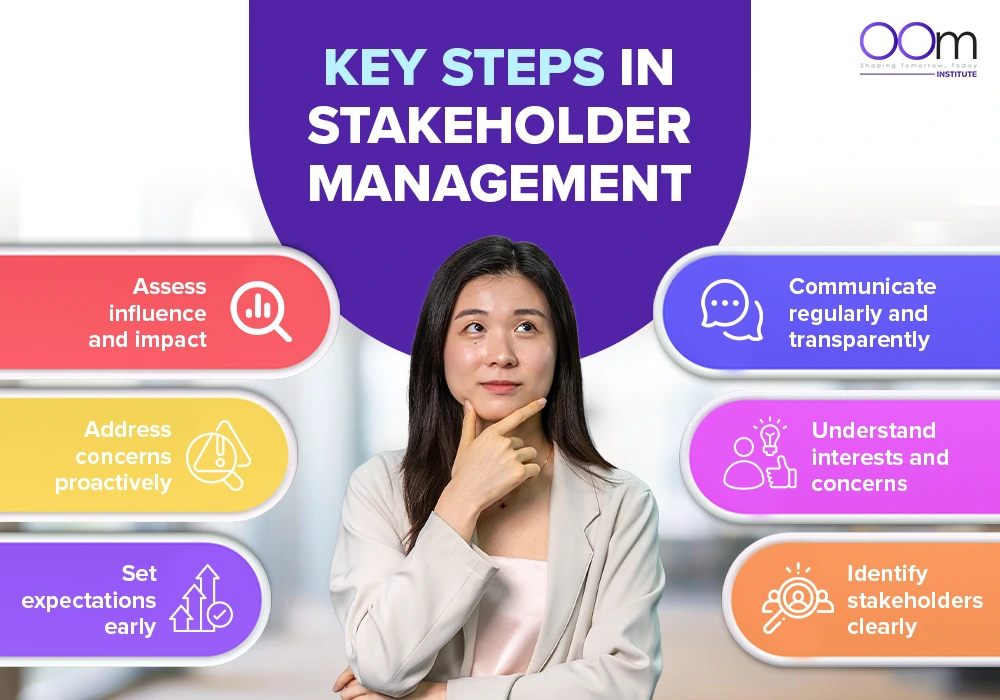
1. Identify Stakeholders Clearly
Begin by asking who is affected by the decision or project, and who has influence over its direction. Some stakeholders may be visible from the outset, while others emerge as work progresses. Taking time to map this landscape reduces blind spots.
2. Understand Interests and Concerns
Each stakeholder is likely to have distinct priorities. Some may focus on cost or risk, others on timelines, workload, or long-term impact. Exploring what matters most to each party helps prevent assumptions from driving the conversation.
3. Assess Influence and Impact
Not all stakeholders hold the same level of decision-making authority. Some shape formal outcomes, while others influence perception or momentum. Understanding this dynamic supports more thoughtful prioritisation.
4. Set Expectations Early
Clarity around scope, timelines, constraints, and trade-offs can prevent many misunderstandings. When expectations are discussed openly at the beginning, there is less room for misalignment later.
5. Communicate Regularly and Transparently
Progress updates, even when incremental, help maintain trust. Silence can create uncertainty. Consistent communication reduces the likelihood of surprise or last-minute resistance.
6. Address Concerns Proactively
When hesitation or resistance appears, acknowledging it early often prevents escalation. Open dialogue can surface underlying issues before they grow into larger conflicts.
A structured approach does not eliminate complexity, but it can reduce unnecessary emotional reactivity. It encourages conversations to remain focused on objectives rather than assumptions, supporting more balanced and objective engagement.
Key Skills Needed for Effective Stakeholder Management
A single ability rarely drives stakeholder management. It usually draws on a combination of interpersonal awareness, communication clarity, and structured thinking. The following capabilities often play a central role.
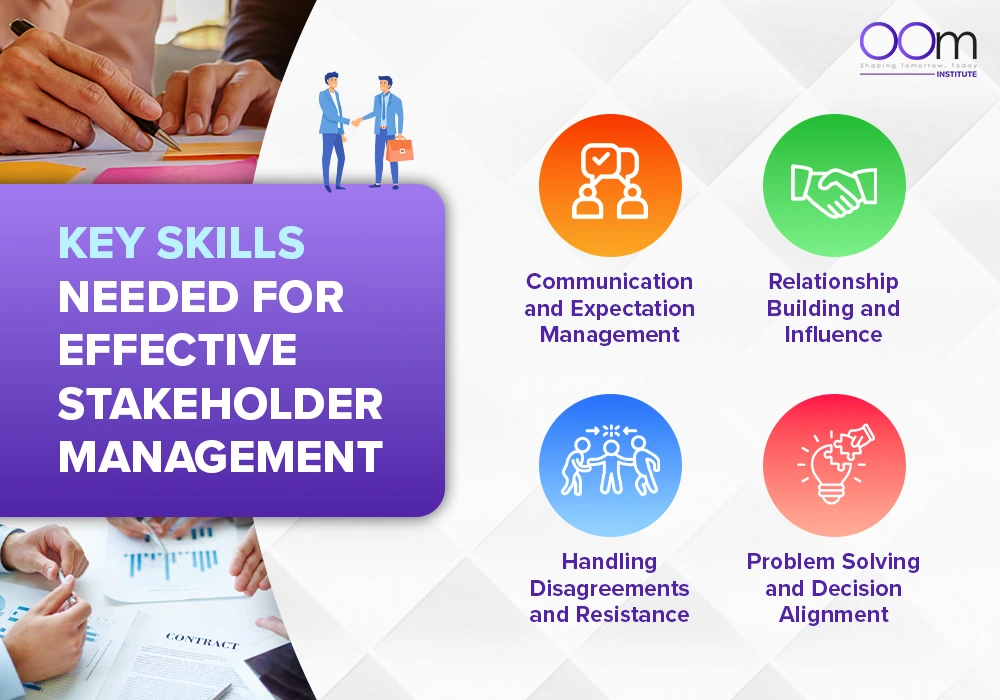
I. Communication and Expectation Management
Clear communication goes beyond delivering updates. It involves explaining goals, outlining constraints, and being transparent about trade-offs. When expectations are discussed early, the likelihood of misunderstanding tends to decrease.
Equally important is listening. Stakeholders are more likely to engage constructively when they feel heard. Asking clarifying questions, reflecting back concerns, and checking assumptions can strengthen alignment before tension develops. Structured communication, delivered consistently, helps build clarity and professional confidence on both sides.
II. Relationship Building and Influence
Trust often develops gradually through reliability and follow-through. When commitments are honoured and concerns are acknowledged, relationships tend to strengthen over time.
Influence does not always stem from formal authority. In many workplace settings, it rests on credibility, fairness, and the ability to connect priorities across different perspectives. Professionals who understand what matters to others are often better positioned to guide conversations towards workable outcomes.
III. Handling Disagreements and Resistance
Disagreement is common wherever collaboration exists. What shapes the outcome is often how it is addressed.
Separating the issue from the individual can prevent discussions from becoming personal. Exploring underlying concerns and identifying shared objectives may shift the tone from opposition to problem-solving. Calm, measured responses can reduce defensiveness and keep conversations productive.
IV. Problem Solving and Decision Alignment
Effective stakeholder management often requires structured thinking. Complex situations may involve competing interests, incomplete information, or time pressure.
Clearly framing options, outlining potential risks, and identifying decision criteria can help groups move forward with greater confidence. When decisions are linked to agreed objectives rather than individual preference, ambiguity tends to decrease and alignment becomes easier to sustain.
How to Improve Stakeholder Management Skills
Strengthening stakeholder management skills rarely happens by chance. While experience offers exposure, deliberate development often brings clearer progress. Reflection, feedback, and structured learning help translate everyday interactions into more consistent capability.
Enrol in Professional Development Courses
Targeted training provides space to examine real workplace scenarios in a structured setting. Rather than relying solely on instinct, professionals can learn frameworks that clarify how to approach difficult conversations, competing priorities, and complex decision-making.
You may consider:
- A communication skills course to strengthen clarity, listening, and expectation setting
- A people management skills course to deepen influence, empathy, and relationship-building approaches
- A conflict management skills course to navigate tension more constructively and reduce escalation
- A problem-solving skills course to guide stakeholders towards aligned, criteria-based decisions
Well-designed programmes often include case discussions, guided practice, and practical tools that can be applied directly to workplace situations. Over time, this kind of structured development can shift stakeholder management from a reactive, instinct-driven process to a more deliberate, steady professional capability.
Conclusion: Building Stakeholder Management as a Professional Advantage
Workplace environments continue to evolve. Teams often collaborate across functions, locations, and reporting lines, while expectations come from multiple directions. In this context, the ability to engage stakeholders thoughtfully can shape not only project outcomes but also professional credibility.
Developing strong stakeholder management skills supports clearer communication, steadier handling of disagreement, and more deliberate decision alignment. When expectations are surfaced early, and conversations remain constructive, collaboration tends to feel less strained and more purposeful.
If you are looking to strengthen these capabilities in a structured and practical way, explore OOm Institute’s WSQ courses in Singapore. Whether you are looking to enhance communication, people management, conflict handling, or structured problem solving, our courses are designed to translate directly into day-to-day workplace performance.
Frequently Asked Questions
1. What are stakeholder management skills, and why do they matter?
Stakeholder management skills involve identifying, engaging, and aligning individuals who influence or are affected by your work. They matter because many workplace outcomes depend on coordination and alignment across people, rather than individual effort alone. When stakeholders are engaged thoughtfully, projects progress with fewer misunderstandings and delays.
2. How do I handle difficult stakeholders?
Handling challenging stakeholders often begins with clarifying expectations and exploring underlying concerns. Rather than reacting to tone or behaviour, it can be helpful to focus on shared objectives and practical constraints. Structured listening, measured responses, and clear boundaries can reduce tension and shift discussions towards workable solutions.
3. Can stakeholder management skills be learned?
Stakeholder management is not purely instinctive. While personality influences communication style, many core techniques can be developed deliberately. Expectation setting, conflict handling, prioritisation, and decision facilitation are skills that improve through structured practice, reflection, and feedback.
4. Are stakeholder management skills important for individual contributors, not just managers?
Yes. Individual contributors frequently work with cross-functional partners, clients, and senior leaders. In many cases, they influence outcomes without formal authority. The ability to communicate clearly and align expectations is valuable at every career stage, not only in leadership roles.
5. What are the most common mistakes in stakeholder management?
Common missteps include leaving expectations ambiguous, communicating reactively rather than proactively, avoiding difficult conversations, and attempting to satisfy every stakeholder equally without assessing influence or impact. Over time, these patterns can create friction that might have been reduced with clearer structure and prioritisation.