For years, paid search has trained marketers to think in keywords.
Someone searches for “accounting software Singapore”. An advertiser identifies the intent, targets relevant keywords, serves an ad and directs the user to a landing page.
Now consider a different interaction:
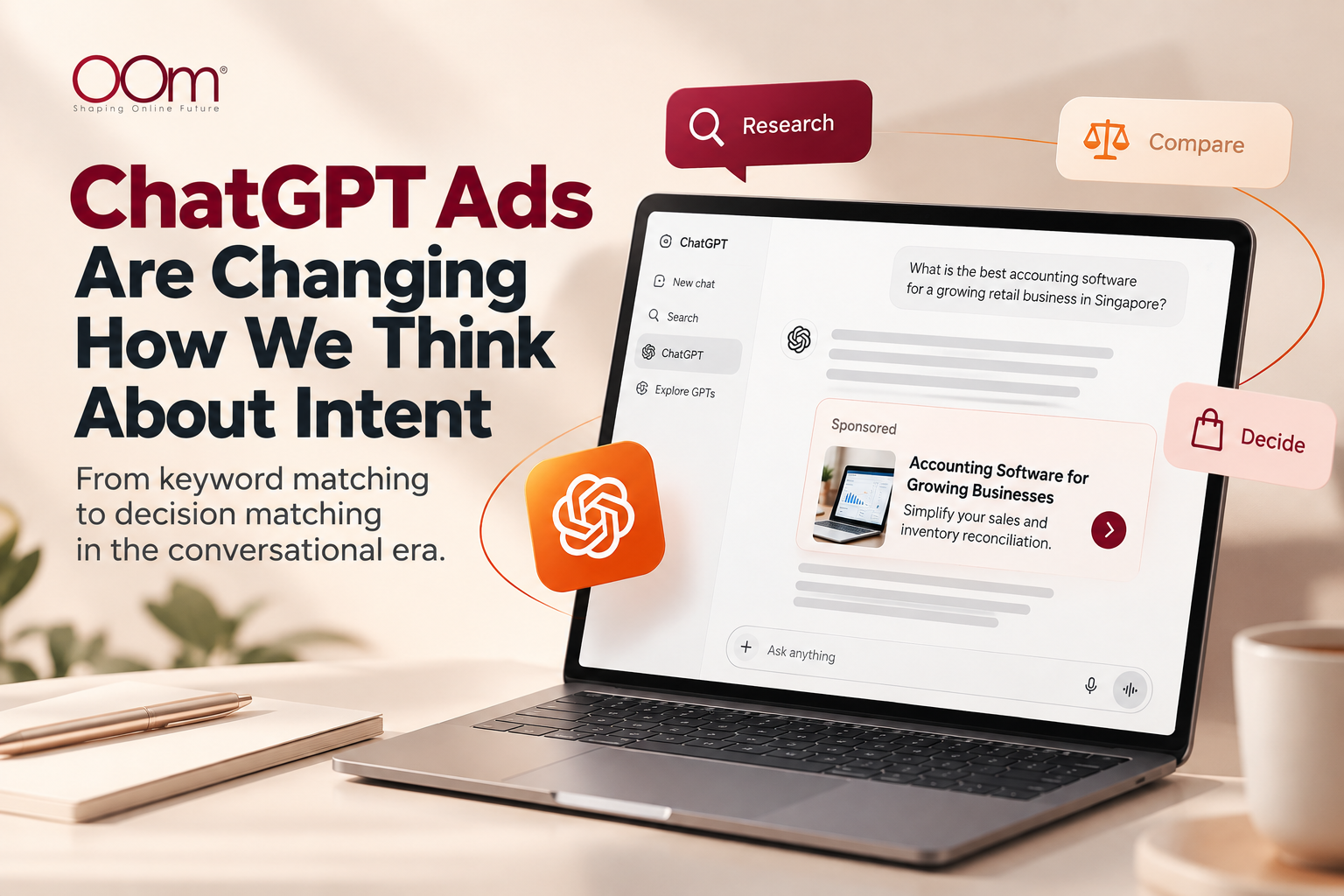
“I run a growing retail business with both online and physical sales. We are still reconciling transactions manually. What accounting software should we consider?”
The commercial need is similar, but the second interaction reveals much more.
We know something about the business, the problem it is facing and why it is looking for accounting software in the first place.
This is what makes ChatGPT Ads interesting for marketers.
What Are ChatGPT Ads?
ChatGPT Ads are sponsored placements that can appear around relevant conversations in ChatGPT. They are clearly labelled as ads and are kept separate from ChatGPT’s answers, meaning advertisers do not pay to influence what ChatGPT says. Unlike traditional search advertising, where a keyword can be a key signal of intent, ChatGPT Ads can also consider the context of the conversation when determining ad relevance.
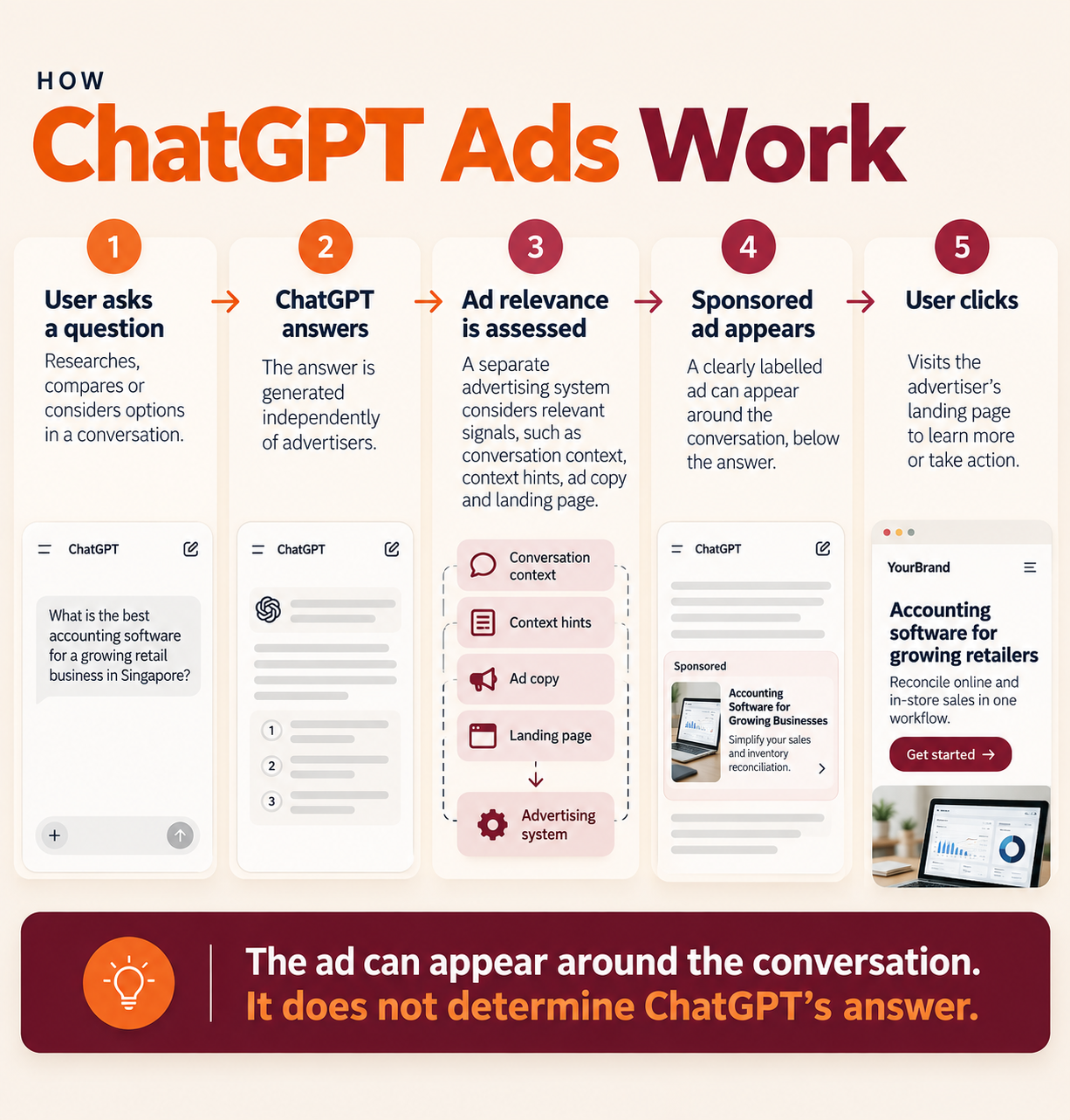
According to OpenAI’s current ChatGPT Ads documentation, ad delivery can consider the context and intent of the current conversation, together with signals such as the ad’s landing page, title, copy and advertiser-provided context hints. These context hints can describe relevant conversations, topics or keywords, but they are not exact-match targeting rules.
Approaching ChatGPT Ads as another place to deploy a keyword list therefore misses part of the opportunity.
[VISUAL: HOW CHATGPT ADS WORK]
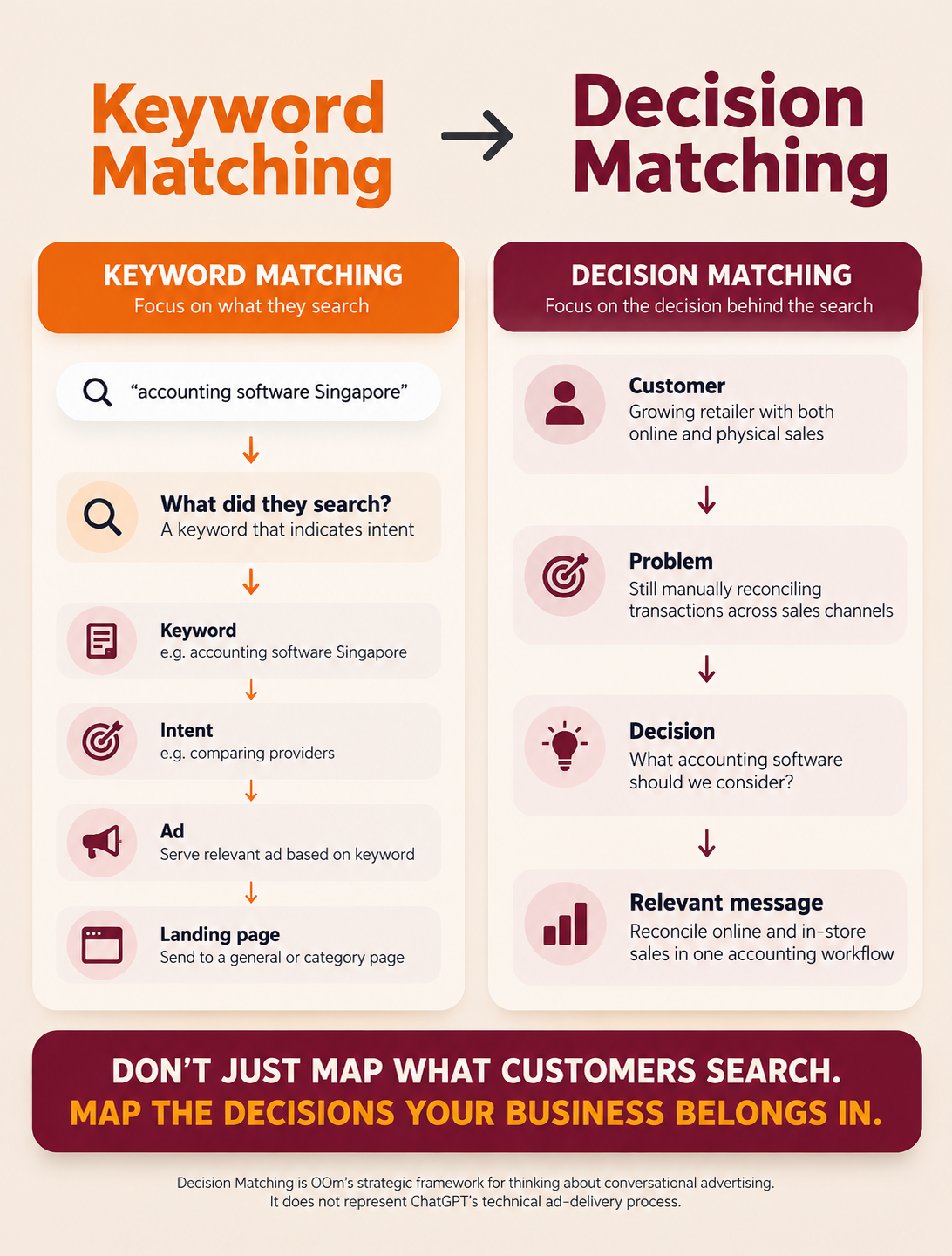
The shift is better understood as:
Keyword Matching → Decision Matching
Instead of only mapping what customers search, marketers can start mapping the decisions their businesses belong in.
A Conversation Can Reveal More Than a Search Query
Search intent has never been limited to keywords.
Someone searching for “CRM software” could be learning about the category, comparing providers or preparing to buy. Paid search marketers already account for these differences through campaign structure, audiences, creative and landing pages.
Conversational advertising adds more context.
A user can explain what they are trying to achieve, who the solution is for, what problems they face and what constraints matter, all within the same conversation.
OpenAI’s guidance on context hints reflects this. Advertisers are encouraged to think about what they offer, who it helps and when it may be useful. The guidance focuses on customer needs and circumstances rather than lists of disconnected keywords.
For marketers, that adds another layer to intent planning.
Keyword planning: What might the customer search?
Decision planning: What is the customer trying to solve, and when does our business become relevant?
The second question does not replace the first. It helps marketers understand the demand behind it.
[VISUAL: KEYWORD MATCHING → DECISION MATCHING]
The Same Keyword Can Represent Different Decisions
Take “accounting software Singapore”.
One retailer might need a better way to reconcile ecommerce and physical store transactions.
Another business might be expanding overseas and reviewing whether its existing accounting setup still meets its needs.
Both could use the same search term, but the reason behind the search is different.
OpenAI recommends grouping ads around a shared product, service, theme or customer need. It also recommends separating meaningfully different use cases when they require different messaging or landing pages.
This is where decision matching becomes useful.
Rather than building a campaign around every possible way someone could phrase a question, marketers can identify recurring situations in which their offering is relevant.
For example:
Customer: Growing retailer
Problem: Manual reconciliation across sales channels
Decision: Whether new accounting software can simplify the process
Relevant message: How the software handles online and in-store transactions
The advertising strategy starts with the problem being solved, not just the words used to describe it.
Conversational Targeting Is Not a Longer Keyword List
A tempting response would be to make keywords longer.
“Accounting software Singapore” becomes:
“Accounting software for Singapore retailers with online and offline sales that need reconciliation.”
That still treats conversational advertising like conventional keyword matching.
OpenAI states that context hints are not exact-match keywords or targeting rules and do not guarantee delivery for particular conversations or audiences.
Marketers therefore do not need to predict every prompt a potential customer might enter into ChatGPT.
A better starting point is to identify recurring customer circumstances:
Who is the customer?
What are they trying to accomplish?
What problem is shaping the decision?
When does the product or service become relevant?
Would different circumstances require different messaging or information before someone takes action?
This turns conversational targeting into a customer research exercise rather than a prompt-writing exercise.
Decision Matching Should Influence the Message Too
If the situation changes, the most relevant message may change with it.
Compare:
“Powerful accounting software for growing businesses.”
with:
“Reconcile online and in-store sales in one accounting workflow.”
The first broadly describes the product.
The second connects it to a recognisable business problem.
OpenAI’s creative guidance for ChatGPT Ads encourages advertisers to use clear, specific and benefit-focused copy that explains the practical value of an offering, who it is for and when it may be helpful.
This does not mean creating an ad and landing page for every possible conversation.
The question is whether two customer situations are different enough to require different information.
If someone encounters an ad while trying to solve a specific problem, the page after the click should continue addressing that problem.
A generic landing page may describe the right product while failing to address why the customer was interested in the first place.
Relevance should continue from the conversation to the ad, and from the ad to the landing page.
Keywords Still Have a Role
Decision matching does not make keywords obsolete.
OpenAI itself allows advertisers to describe conversations, topics or keywords through context hints.
Search queries also remain valuable signals of explicit demand, particularly across paid search advertising.
The difference is how much marketers can understand about the decision behind that demand.
A search query might show that someone is looking for accounting software. A conversation could reveal why they are looking for it, the problem they need to solve and the circumstances shaping their choice.
Rather than treating keywords and conversational context as competing approaches, marketers can use each for what it reveals about intent.
Paid ChatGPT Visibility Is Not Organic AI Visibility
There is another distinction businesses need to keep clear.
Paying for advertising in ChatGPT does not mean paying to influence ChatGPT’s answers.
Under OpenAI’s advertising principles, ads do not influence the answers ChatGPT gives. Ads are separate and clearly labelled.
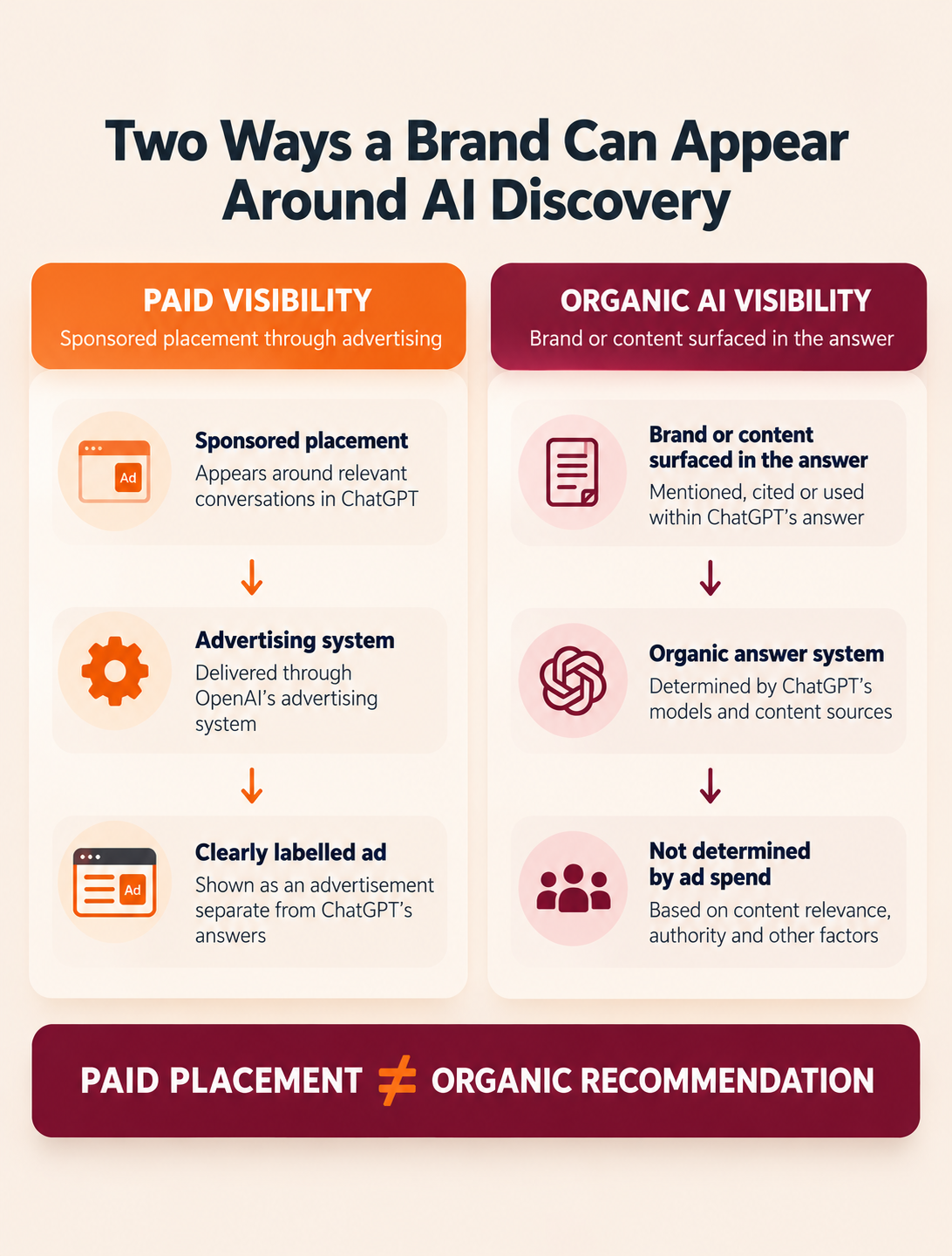
This creates two different forms of visibility.
Organic AI visibility looks at whether a brand or its content is surfaced, mentioned or used within generated answers. This is where strategies such as Generative Engine Optimisation (GEO) come into play.
Paid AI visibility looks at whether an advertisement can appear around a relevant conversation.
A paid placement should not be reported as evidence that ChatGPT organically recommends the brand. OpenAI also states that seeing an ad does not mean OpenAI endorses or recommends the advertiser or its products.
Likewise, organic AI visibility does not remove the potential role of paid advertising.
For businesses investing in both performance marketing and GEO, these should remain separate parts of the measurement framework.
[VISUAL: PAID VISIBILITY ≠ ORGANIC AI VISIBILITY]
Don’t Measure ChatGPT Ads by Novelty
Being among the first advertisers to appear in a new channel can attract attention internally.
That does not make the campaign successful.
OpenAI’s current ChatGPT Ads reporting includes impressions, clicks, spend, click-through rate, average CPC, average CPM and conversions. Advertisers can also use conversion measurement and tracking parameters to analyse activity after the click.
The same performance discipline used elsewhere still applies.
Did the campaign reach relevant potential customers?
Did they engage?
What happened after the click?
Did those interactions contribute to enquiries, leads, sales or another meaningful business outcome?
For conversational advertising, there is one more question worth asking:
Did we appear in the right decision contexts?
A large number of impressions around loosely related conversations may be less valuable than opportunities where the advertiser closely matches the customer’s situation.
As the platform develops, advertisers will need to identify which contexts translate into meaningful commercial outcomes rather than assuming contextual relevance automatically equals performance.
From Keyword Matching to Decision Matching
ChatGPT Ads do not make keywords irrelevant.
What changes is the amount of context that can exist around commercial intent.
A keyword can tell marketers what someone searched.
A conversation can reveal more about the problem they are trying to solve and the circumstances surrounding that decision.
Instead of taking an existing keyword list and turning it into longer conversational phrases, start with the customer.
Identify the situations that lead them to consider your category. Understand what makes your offering relevant in those situations. Then decide whether those differences should change the targeting, message or landing-page experience.
That is the shift from:
Keyword Matching → Decision Matching
The principle behind it is simple:
Don’t just map what customers search. Map the decisions your business belongs in.
As search, conversational discovery and paid media continue to develop, businesses need to understand not only where customers are searching, but how different channels fit into the decisions they make.
Ready to improve your digital advertising performance?
Discover how OOm can help you reach the right audiences and turn advertising spend into measurable business results.