Key Takeaways
|
Introduction
It is a question many professionals ask themselves: Will AI replace my job?
The concern does not come from nowhere. News stories frequently spotlight automation replacing clerical functions. Generative AI now drafts articles, prepares contracts, builds presentations, analyses data, and even produces code in seconds. The efficiency gains are real. At the same time, organisations are investing in reskilling, restructuring, and digital transformation at an equally rapid pace.
Framing this moment purely as a replacement, however, oversimplifies what is happening. The shift feels less like a sudden erasure and more like a gradual redesign.
Work is already changing. That much is clear. The more useful conversation may be less about whether AI will affect jobs, and more about how it is reshaping the value humans bring to the workplace and where that value is beginning to move.
What “AI Taking Jobs” Actually Means
When people type “What job AI will replace” into a search bar, it often reflects a fear that entire professions might disappear overnight. The reality tends to be more layered. Most large-scale studies suggest that AI is more likely to automate specific tasks within a role rather than eliminate the occupation altogether.
Recent Forbes reporting notes that positions built around repetitive, rule-based processes are typically affected first. Administrative paperwork, routine accounting entries, templated content creation, and highly scripted customer service interactions are often cited as examples. These functions are structured to make them easier to replicate with automation.
Even so, AI rarely runs entirely on its own. Outputs need reviewing. Parameters require refinement. Exceptions must be handled thoughtfully. Results still need interpretation within a broader business context. What changes is the distribution of effort. Less time is spent on manual execution, and more attention shifts towards supervision, judgement, and decision-making.
Across industries, a similar pattern is emerging. Execution becomes increasingly automated, while oversight, accountability, and contextual understanding remain human-led. That distinction is subtle, yet significant.
How AI Is Reshaping Work Rather Than Erasing It
AI is no longer something separate from daily work. It is embedded within it. Drafts are generated in seconds. Reports are summarised automatically. Irregularities in data are flagged before they become problems. Suggested headlines appear with a click. Compliance risks are surfaced early. Through AI workflow automation, organisations are steadily reducing the time spent on repetitive, mechanical steps.
That shift creates two outcomes at once.
Productivity improves, often quite noticeably. Teams complete tasks faster and with fewer manual processes. Yet at the same time, expectations evolve. When a first draft takes minutes instead of hours, the true differentiator becomes judgement. The ability to refine, interpret, and contextualise matters more than the ability to produce quickly.
Take AI in digital marketing, for example. AI tools can analyse audience patterns instantly and generate multiple campaign variations at scale. What they do not determine is positioning strategy, brand nuance, cultural sensitivity, or ethical boundaries. Those decisions still sit firmly with people. AI enhances execution. Humans provide direction and accountability.
A similar pattern is unfolding across finance, operations, logistics, education, and healthcare administration. Tasks shift. Responsibilities adjust. The centre of gravity moves from doing to deciding.
So, when asking, “Will AI replace my job?” it may be more accurate to ask how the nature of your contribution is changing and whether you are prepared for that shift.
Roles Most Vulnerable to Replacement
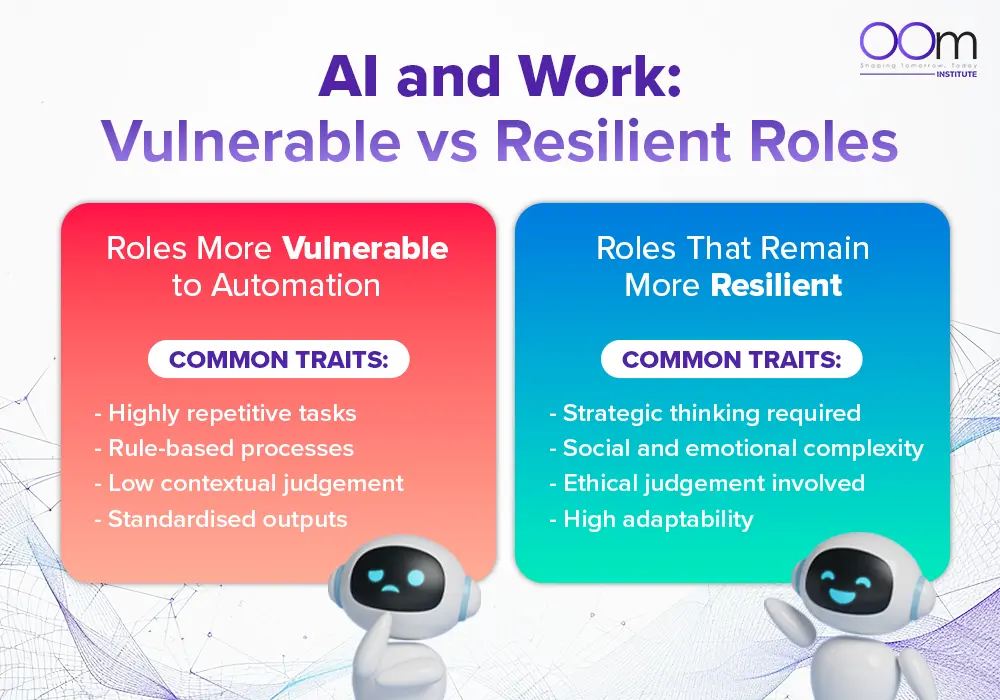
When people ask whether AI will replace their job, the honest answer depends largely on the nature of the work itself. Roles that are highly predictable, tightly structured, and limited in their ability to make contextual judgement tend to be exposed to greater risk.
These typically include functions such as:
- High-volume data processing
- Routine bookkeeping tasks
- Script-based telemarketing
- Entry-level administrative documentation
- Basic report compilation
The common thread is procedural repetition. When a task follows clear rules, fixed inputs, and consistent outputs, it becomes easier to automate. AI systems excel in environments where variation is low and decision pathways are predefined.
Even in these areas, however, complete elimination is not always immediate or absolute. More often, the pressure appears in subtler ways. Headcount may tighten. Productivity benchmarks may increase. Individuals are expected to oversee systems, interpret outputs, and manage exceptions rather than carry out each manual step themselves.
The vulnerability, therefore, is less about job titles and more about task design.
Roles That Remain Resilient
When asking whether AI will replace my job, it is equally important to recognise where automation struggles. Work that depends on social complexity, ethical judgement, negotiation, and long-term strategic thinking is significantly harder to replicate with algorithms.
Roles that tend to remain more resilient include:
- Leadership and executive decision making
- Advisory and consultative positions
- Team supervision and people development
- Conflict mediation and stakeholder alignment
- Creative strategy and innovation design
These functions rely on nuance. They require reading unspoken signals, balancing competing interests, weighing moral considerations, and adapting communication in real time. While AI can provide analysis or recommendations, it does not carry accountability in the human sense. It does not manage trust.
Professionals who intentionally deepen their capabilities through structured development, such as conflict management or people management courses, strengthen their long-term relevance. The advantage does not sit in a title alone. It sits in the depths of judgement, adaptability, and relational intelligence that a person brings to complex situations.
The Skills That Define Future Relevance
The more useful question is no longer simply “Will AI replace my job?” A better question might be: “What makes my contribution difficult to substitute?”
Future relevance increasingly sits at the intersection of technical fluency and human intelligence. It is not about choosing one over the other. It is about integrating both.
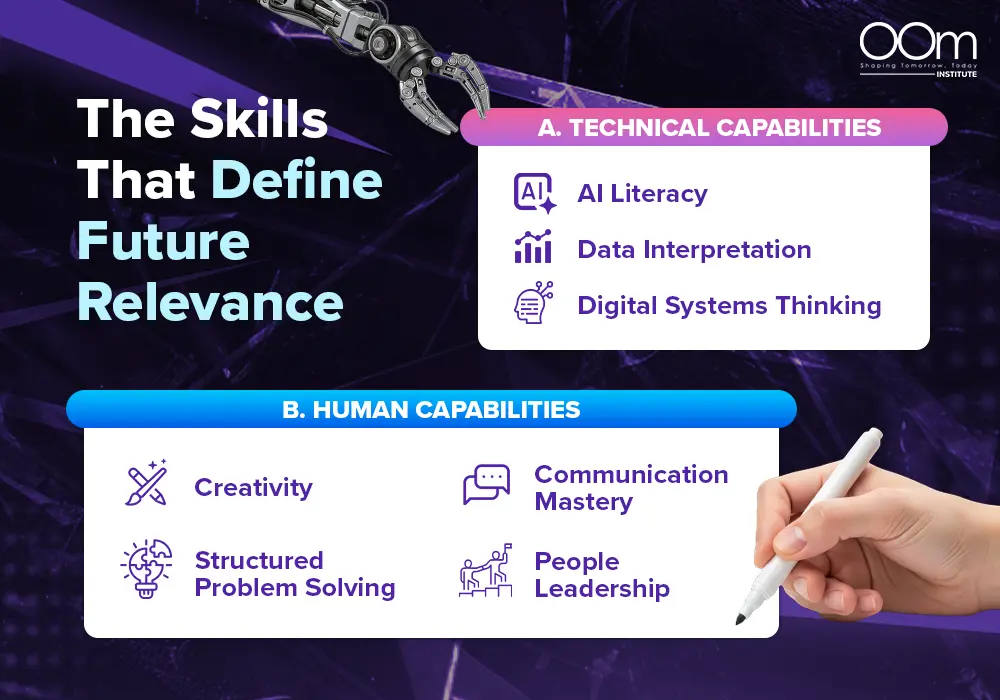
A. Technical Capabilities
I. AI Literacy
A working understanding of how AI systems generate outputs, where their blind spots lie, and how to assess reliability is fast becoming baseline competence. AI literacy does not mean learning to code complex models. It means developing the operational judgement to question outputs, refine prompts, and recognise when human oversight is required.
II. Data Interpretation
AI can surface patterns in seconds. The value lies in what happens next. Professionals who can translate those patterns into meaningful business decisions, identify implications, and weigh trade-offs bring strategic depth that raw automation cannot.
III. Digital Systems Thinking
Modern workplaces run on interconnected tools and automated workflows. Comfort with platforms, integrations, and optimisation processes is increasingly expected. Developing structured AI skills allows professionals to supervise and improve intelligent systems rather than compete with them on speed alone.
B. Human Capabilities
I. Creativity
AI recombines existing information at scale. Humans frame problems, define intent, and shape original direction. Conceptual thinking and narrative coherence remain distinctly human strengths.
II. Structured Problem Solving
Real-world challenges rarely arrive in tidy datasets. Ambiguity, incomplete information, and competing priorities are common. Strengthening reasoning through a rigorous problem-solving course sharpens the ability to navigate uncertainty with logic and clarity.
III. Communication Mastery
As automation increases, collaboration often becomes more complex. Insights generated by systems must still be explained, debated, and aligned across teams. A focused workplace communication course helps professionals translate technical analysis into shared understanding and informed decisions.
IV. People Leadership
Technological change can create resistance, anxiety, and confusion. Leaders who invest in deliberate soft skills training are better positioned to guide teams through transition, manage expectations, and maintain cohesion during periods of adjustment.
Ultimately, defensibility in the age of AI is less about completing tasks faster. It is about elevating the quality of thinking, interpretation, and leadership that surrounds those tasks.
Government Support and Structural Incentives
Workplace transformation is not unfolding in isolation. In Singapore, policymakers have recognised that AI-driven change is structural rather than temporary, and support mechanisms have been put in place to ease the transition.
A. Financial Support for Individuals
Initiatives such as SkillsFuture credits and subsidised professional programmes lower the financial barrier for working adults seeking to upgrade their competencies. This makes mid-career upskilling more accessible, particularly for those balancing employment and family commitments.
B. Targeted Upskilling Pathways
Training options have also evolved. Many programmes are designed for professionals who want to integrate AI into business, operations, and marketing functions without necessarily becoming full-time technologists. The emphasis is on practical application rather than purely technical specialisation.
C. Employer Incentives
Grants and workforce transformation schemes encourage organisations to retrain and redeploy employees instead of defaulting to replacement. Companies are supported in redesigning roles, investing in capability development, and building internal resilience.
These structural supports signal a broader policy intent. Adaptation is encouraged at both the individual and organisational levels. The responsibility for evolution does not rest solely with employees.
A Realistic Perspective on Job Replacement
When asking whether AI will replace my job, it helps to step back from extreme narratives. AI-driven disruption is not uniform. Some roles will shrink as automation absorbs routine functions. Others will expand as new demands emerge. Entirely new positions are already appearing, many of which did not exist even five years ago.
History offers a useful perspective. Previous waves of automation in manufacturing did not eliminate work altogether. They altered the mix of skills required. Technical maintenance, systems supervision, and higher-order coordination became more valuable as manual tasks declined. A similar shift is now unfolding across knowledge-based industries.
The greater risk may not be universal replacement, but inertia. Work is evolving whether individuals choose to respond or not. Professionals who remain passive may find their roles narrowing. Those who actively integrate AI tools into their workflows while strengthening distinctly human capabilities often discover new forms of leverage and influence.
Conclusion: Redesign Over Replacement
So, will AI replace my job?
For many professionals, parts of the role will change. Repetitive tasks may be streamlined. Predictable processes may be automated. Workflows may accelerate. What is far less likely to disappear is the need for judgement, accountability, creativity, leadership, and trust.
AI is not removing value from the workplace. It is redistributing it. As execution becomes increasingly automated, interpretation, direction, and human coordination grow in importance.
Those who thrive in this environment are not trying to outpace machines on speed alone. They focus on using AI systems intelligently while deepening strategic thinking, strengthening communication, and refining decision-making.
If you are ready to build practical AI skills, understand AI workflow automation, and sharpen your AI capabilities in digital marketing, structured problem-solving, and leadership, OOm Institute offers professional programmes designed for working adults navigating real workplace change. From targeted technical application to soft skills training, our courses are built to help you adapt with clarity and confidence.
Work is evolving rapidly, and standing still is no longer an option. Explore our programmes today and take the next step towards building a resilient, adaptable career with OOm Institute.
Frequently Asked Questions
1. Will AI really take over my job?
In most cases, AI reshapes roles rather than eliminating them outright. Tasks that are repetitive and rule-based are more likely to be automated, while responsibilities involving judgement, communication, and complex decision making tend to remain human-led.
2. Which industries are being affected by AI?
AI adoption is already visible in marketing, finance, operations, customer service, and technology. That said, the impact is not confined to these sectors. Most industries are integrating AI in different ways, depending on how structured and data-driven their processes are.
3. What skills should I learn to stay relevant in the age of AI?
Building AI literacy, data interpretation skills, and familiarity with digital workflows provides a strong foundation. Pairing these with creativity, structured thinking, and leadership capabilities creates a balanced, future-ready skill set.
4. Do I need to learn programming to survive AI disruption?
Programming knowledge can be helpful, particularly in technical roles. However, for many professionals, the greater advantage lies in knowing how to apply AI tools effectively within their field rather than developing complex systems from scratch.
5. How can working professionals upskill without quitting their jobs?
Many institutions now offer part-time certifications, modular executive programmes, and employer-supported training. These formats are designed to accommodate working schedules while allowing professionals to build relevant competencies progressively.
6. Are there courses provided for AI digital marketing?
Yes. A growing number of structured programmes integrate AI in digital marketing, automation platforms, analytics frameworks, and practical strategy application to help marketers adapt to AI-enhanced environments.