Key Takeaways:
- One page we published, our guide to the best SEO agencies in Singapore, ranked on Google the next day and has held that position for four months.
- It’s now independently cited as a source by Google’s AI Overview, Google’s AI Mode, ChatGPT, Perplexity, and Gemini when people ask the same question.
- We didn’t write it to an “AI search” playbook. We wrote it first-hand, from our own read of the market. Google’s official guidance, published in May 2026, later confirmed that’s exactly the factor that matters most.
- Google’s guidance also warns against publishing separate pages to target every AI “query fan-out” variation. We’d already made the opposite call: one thorough page instead of ten thin ones.
- This is one page, one query cluster, one market. It’s a working example you can verify yourself, not proof the same approach guarantees the same result for every site or industry.
What actually happened
One page. Five AI tools citing it. Here’s what we did and why it worked.
In March 2026, we published our guide to the best SEO agencies in Singapore. It started ranking on Google the next day and has held that position for four months since. It now also shows up as a cited source when people ask AI tools the same question. Google’s AI Overview, Google’s AI Mode, ChatGPT, Perplexity and Gemini all surface it independently.
We didn’t build this page as an “AI search” experiment. We built it based on our own read of the market and work we’ve actually done. What’s interesting is what happened next. Months later, Google published official guidance on optimising for generative AI features in Search, and it validated almost every editorial call we’d already made, point for point. The rest of this post walks through what we actually did, then shows the specific guidance that later confirmed it, along with the caveats worth knowing before you assume the same playbook works everywhere.
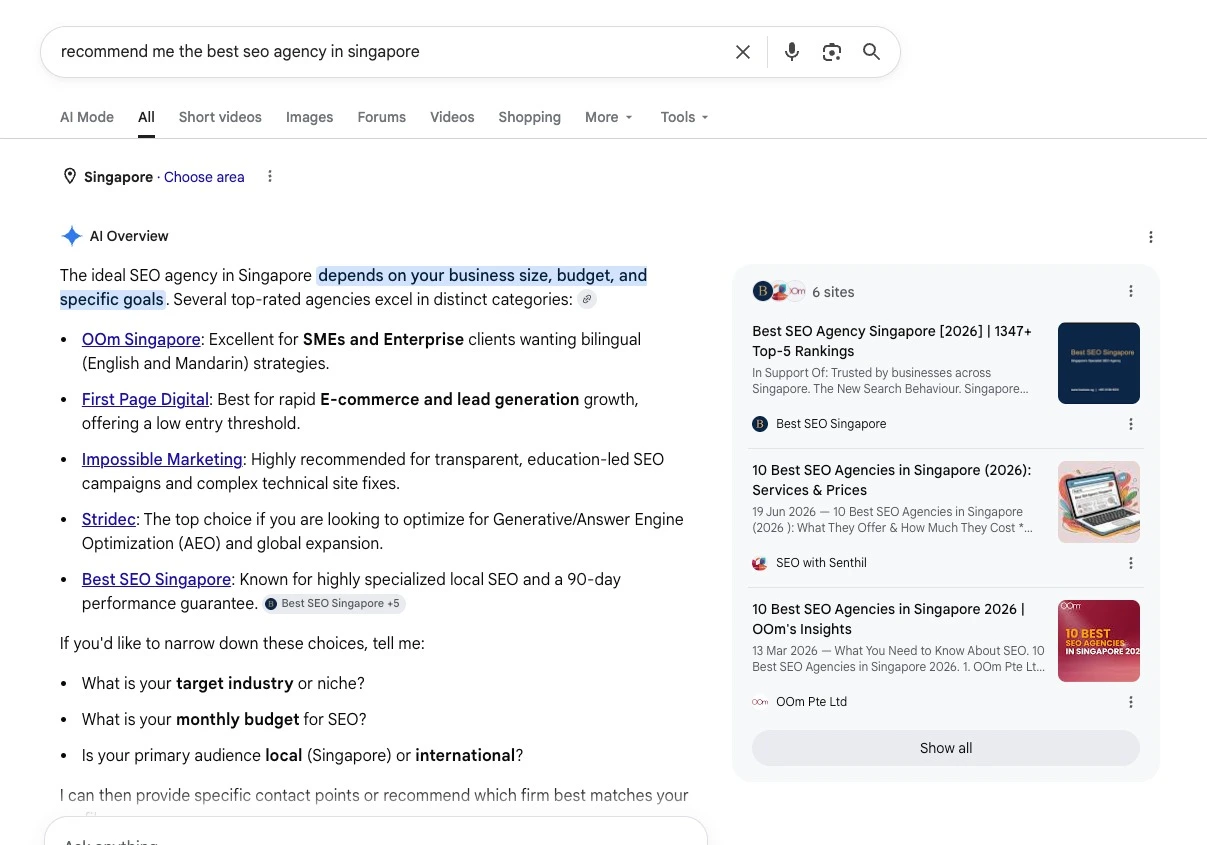
[SCREENSHOT: Google AI Overview citing OOm’s “Best SEO Agencies in Singapore” page, captured [9 July 2026]]
![SCREENSHOT Google AI Mode response citing OOm among top-ranked agencies, captured [9 July 2026]](https://www.oom.com.sg/wp-content/uploads/2026/07/SCREENSHOT-Google-AI-Mode-response-citing-OOm-among-top-ranked-agencies-captured-9-July-2026.webp)
[SCREENSHOT: Google AI Mode response citing OOm among top-ranked agencies, captured [9 July 2026]]
![SCREENSHOT ChatGPT response recommending OOm as a top Singapore SEO agency, captured [9 July 2026]](https://www.oom.com.sg/wp-content/uploads/2026/07/SCREENSHOT-ChatGPT-response-recommending-OOm-as-a-top-Singapore-SEO-agency-captured-9-July-2026.webp)
[SCREENSHOT: ChatGPT response recommending OOm as a top Singapore SEO agency, captured [9 July 2026]]
![SCREENSHOT Perplexity response citing OOm, captured [9 July 2026]](https://www.oom.com.sg/wp-content/uploads/2026/07/SCREENSHOT-Perplexity-response-citing-OOm-captured-9-July-2026.webp)
[SCREENSHOT: Perplexity response citing OOm, captured [9 July 2026]]
![SCREENSHOT Gemini response citing OOm, captured [9 July 2026]](https://www.oom.com.sg/wp-content/uploads/2026/07/SCREENSHOT-Gemini-response-citing-OOm-captured-9-July-2026.webp)
[SCREENSHOT: Gemini response citing OOm, captured [9 July 2026]]
What we did, and what Google later confirmed
None of this started as an experiment in “AI search.” When we sat down to write our guide to the best SEO agencies in Singapore, we made a handful of ordinary editorial calls based on years of running SEO campaigns, not on any AI-specific playbook. It ranked the next day and has since been cited by five separate AI tools. Months later, Google published Optimizing your website for generative AI features on Google Search, its official guidance on generative AI search. Search Engine Land’s Barry Schwartz, who covered the release the day it went live, described it as pulling together “previous communication from Google” into “a neat new help document.” Reading through it, almost every call we’d already made was in there, restated as official guidance. Here’s what we actually did, and the specific guidance that later confirmed it.
1. We treated “AI search” as just search
We never built a separate strategy for AI visibility. We optimised the page the way we optimise any page, on the assumption that there’s no special trick for showing up in AI Overviews that doesn’t start with solid SEO.
“From Google Search’s perspective, optimizing for generative AI search is optimizing for the search experience, and thus still SEO.” — Google Search Central, Optimizing your website for generative AI features on Google Search, May 2026
If an agency is pitching you a distinct “AI search optimisation” package, ask what it actually contains that isn’t just SEO fundamentals under a new name.
2. We grounded it in work we’ve actually done
We drew on real client work and our own read of the Singapore SEO agency market when we wrote it. That was an editorial choice we made before any of this had a name.
“Creating content that people find unique, compelling, and useful will likely influence your website’s presence in generative AI search in the long run more than any of the other suggestions in this guide.” — Google Search Central, Optimizing your website for generative AI features on Google Search, May 2026
Looking back, this is probably the single biggest reason the page performed the way it did. Google’s own test is concrete: a first-hand review reflects a genuine, personal perspective, while a summary of existing content just restates what’s already out there. What you should take from this: ask any agency you’re considering how much of their content is original analysis versus aggregated summary. It’s usually easy to tell once you know to look.
3. Commodity format doesn’t have to mean commodity content
A “best SEO agencies in Singapore” list isn’t a format only we use; several other agencies in the market publish some version of the same list. So the honest differentiator isn’t the format, it’s what Google’s guidance actually draws the line on: something like “7 Tips for First-Time Homebuyers” is commodity content, generic, could be written by anyone, low unique value, while something like “Why We Waived the Inspection & Saved Money: A Look Inside the Sewer Line” is non-commodity, an actual experienced take. That’s a higher bar than publishing a list, and it’s on the substance inside the format, not the format itself, whether ours or anyone else’s clears it.
4. We wrote for a tired business owner, not an algorithm
We structured the page the way we’d want to read it ourselves if we were a business owner comparing agencies late at night, trying to make a decision, clear sections, headings that let you skip to the part you need. Google’s guidance later confirmed that’s the actual reason to use headings: readability, not an AI parsing trick.
5. We thought about what people would actually ask next
Before we wrote the page, we thought through the different angles someone comparing SEO agencies would actually want answered, not just the headline query, but the follow-up questions. We covered those inside one page rather than guessing at separate search terms.
“A set of concurrent, related queries generated by the model to request more information and fetch additional relevant search results to address the user’s query.” — Google Search Central, definition of query fan-out, May 2026
Google’s guidance later gave this behaviour a name: query fan-out, the related sub-queries an AI model chases behind the scenes to build a fuller answer. What we’d done by instinct turned out to be exactly what that guidance recommends.
6. We refused to publish ten thin pages instead of one
This is probably the call that mattered most. It would have been easy to spin up separate pages for every variation, “best SEO agency for SMEs,” “best SEO agency for e-commerce,” “best SEO agency for lead generation,” each thin, each targeting a slightly different search. We didn’t. We wrote one page that covered the real question thoroughly.
Google’s guidance later confirmed why that was the right call: creating separate pages to chase every possible query variation, in order to manipulate rankings or AI responses, violates its scaled content abuse policy. A high volume of thin pages doesn’t make a site more relevant. Query fan-out is useful for understanding what sub-questions a strong page needs to cover in one place, not as a template for spinning up thin pages instead of one thorough one.
If an agency’s pitch to you involves publishing dozens of near-duplicate pages targeting keyword variations, that’s the practice Google is now telling site owners to avoid.
7. We made sure the page could actually be found first
None of the editorial choices above would have mattered if the page wasn’t indexed and eligible to appear in Search with a snippet in the first place. Technical SEO, crawlability, indexing, page experience, came first, before any content quality work could count for anything. Google’s guidance later confirmed this is the hard gate everything else sits on top of.
8. We treated images as part of the answer, not decoration
We used visuals on the page purposefully rather than as filler. Google’s guidance later noted that its generative AI search features can pull in relevant images and video alongside text, giving a site more ways to appear beyond a plain link, which is the same reasoning we’d applied without knowing Google would eventually say it outright.
9. We’re already thinking about what comes after citations
Getting cited by AI Overviews and chatbots is one layer of AI visibility. Google’s guidance points to a second one that’s only just starting to matter: AI agents, autonomous tools that visit a site to complete a task on someone’s behalf, comparing prices, filling out a form, booking something, rather than just answering a question.
“AI agents are autonomous systems that can perform tasks on behalf of people, such as booking a reservation or comparing product specifications… browser agents may access your website to gather the data they need to complete these tasks, such as analyzing visual renderings (like screenshots), inspecting the DOM structure, and interpreting the accessibility tree.” — Google Search Central, Optimizing your website for generative AI features on Google Search, May 2026
This is a separate discipline from citation visibility, and Google is upfront that it’s optional for now, worth pursuing “if this is something that’s relevant to your business and you have extra time.” We’ve already been tracking this territory, including Google’s separate Agentic Browsing tooling in Lighthouse and PageSpeed Insights, in our own breakdown of what’s actually worth implementing for AI agent readiness. It’s not part of why this particular page performs the way it does today, but it’s the next layer we’re watching.
What outside voices are saying
We’re not the only ones reading it this way, and it’s worth hearing from people outside OOm and outside Google on this.
When Google’s guide went live, Search Engine Land’s Barry Schwartz flagged the “mythbusting” section as the part worth paying attention to: Google directly naming tactics site owners can stop worrying about, including special AI markup, “chunking” content, and chasing inauthentic mentions. Search Engine Journal covered the same release under the headline “Google’s New AI Search Guide Calls AEO and GEO ‘Still SEO,'” noting that Google names popular optimisation tactics it says aren’t necessary and folds the AEO/GEO conversation back into standard SEO practice. Neither of those are agency marketing lines. They’re trade press confirming this is Google’s actual documented position.
On the content side, Search Engine Land contributor Carrie-Ann Sudlow put it plainly in a June 2026 piece: “Right now, one of the biggest things separating good content from bad content is real experience. AI can write content. But it can’t replace lived experience.” She goes on: “It can’t tell people what happened when a strategy failed. It can’t explain the lessons learned from working with real clients. It can’t share the small details that come from years of doing the work.” That’s the same gap Google’s own guidance is pointing at, independently confirmed by someone with no reason to make OOm’s case for us.
Where this doesn’t prove everything
One page holding a position for a few months, even with five AI tools citing it, is a working example, not a controlled study. A few honest limits worth naming: we’re going off periodic screenshots and manual checks rather than a formal rank-tracking log, so treat the timeline here as directionally true rather than precise to the day. This is also one page targeting one query cluster in one market. We haven’t tested whether the same approach produces the same result for a different content type, a more competitive vertical, or a market where Google’s AI features behave differently. Ranking position and AI citation aren’t the same thing as traffic or leads, and we haven’t published conversion data here. AI tools also update their retrieval behaviour over time; a page cited today isn’t guaranteed to stay cited indefinitely, and we’d need to keep checking rather than treat this as settled. None of that changes what Google’s guidance says. It just means one page is evidence, not proof.
What this means for you
Google’s guidance rewards the kind of work that’s genuinely hard to fake: real experience, a real point of view, and editorial judgment about what belongs on one page versus what doesn’t. It penalises scaled, templated content production, including some of the tactics still being sold today as “AI search optimisation.”
If you’re comparing SEO agencies in Singapore, here’s a quick way to test any of them before you sign a contract:
- Ask to see one page they’ve published that shows first-hand experience, not a summary of what’s already online.
- Ask whether their content plan involves many thin pages targeting keyword variations, or fewer, thorough pages.
- Check whether their own case studies are still ranking today, not just a screenshot from when the campaign launched.
We’re sharing this page as a live, checkable example rather than a case study slide, because it’s still ranking and still being cited right now. You can verify that yourself before you take our word for it.
FAQs
Does citing you in ChatGPT or AI Overviews actually drive traffic?
AI citations and click-through traffic are related but not identical. A citation increases the chance someone sees your brand name even in a zero-click answer, which matters for awareness, but you should still track clicks and impressions separately in Search Console rather than assume a citation equals a visit.
How long does it take a new page to get cited by AI Overviews?
There’s no fixed timeline Google publishes. In our case this page ranked in Google Search the next day and picked up AI citations over the following weeks, but that speed reflects the topic, the domain’s existing authority, and how quickly the page got indexed. A brand-new domain with no track record should expect longer.
Do we need to publish separate pages for every way people might search this topic?
No. Google explicitly warns against this. Query fan-out variations are useful for understanding what a single page needs to cover, not as a list of pages to create. Publishing many thin, near-duplicate pages to chase keyword variations risks running into Google’s scaled content abuse policy.
Does adding an llms.txt file or special AI markup help get cited?
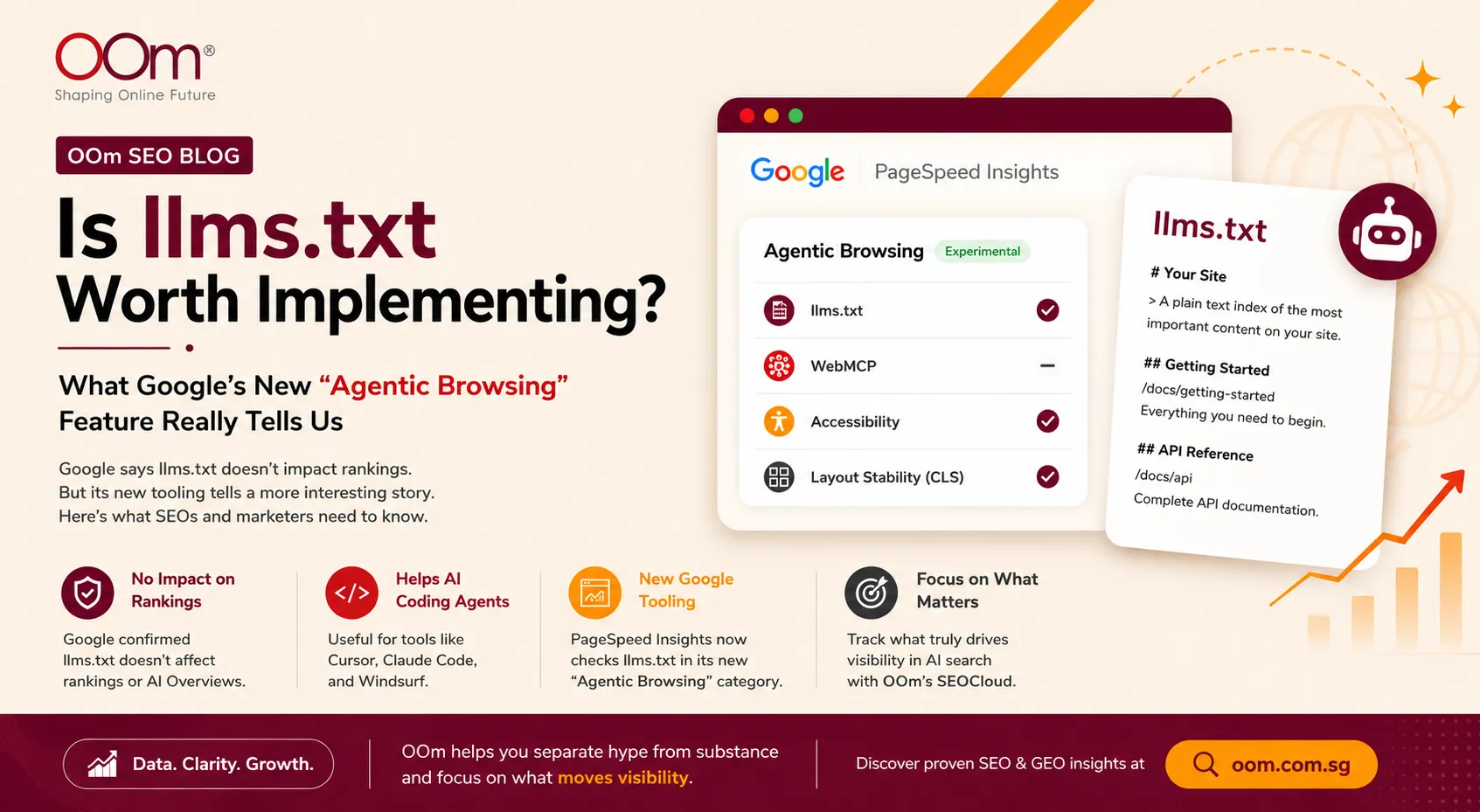
No. Google has stated directly that Search doesn’t use llms.txt or special machine-readable files for ranking or for AI Overviews and AI Mode. It’s a separate question from whether such a file helps AI coding tools read documentation, which is a different use case entirely.
Is ranking #1 on Google enough to guarantee AI citations?
No. Indexing and ranking are the eligibility gate, not a guarantee. Being eligible to appear with a snippet is necessary before an AI feature can cite a page at all, but citation also depends on how directly the content answers the underlying query and how the model’s retrieval behaves at that moment.
Sources and further reading
- Google Search Central, Optimizing your website for generative AI features on Google Search (May 2026)
- Google Search Central, AI Features and Your Website
- Barry Schwartz, “Google publishes guide on optimizing for generative AI features,” Search Engine Land, May 15, 2026
- Search Engine Journal, “Google’s New AI Search Guide Calls AEO And GEO ‘Still SEO'”
- Carrie-Ann Sudlow, “AI can write SEO content, but it can’t replace real experience,” Search Engine Land, June 11, 2026
About OOm
OOm has been a leading digital marketing agency in Singapore since 2006, with expertise in Search Engine Optimisation (SEO), Generative Engine Optimisation (GEO), Search Engine Marketing (SEM), social media marketing, and website design and development. As AI search evolves toward autonomous agents that browse and act on a user’s behalf, not just answer questions, we’re tracking that shift too, alongside GEO and SEO. Our clientele ranges from small and medium businesses to enterprises.
OOm has won over 30 marketing awards over the years, including Agency of the Year, Lead Generation Agency of the Year, Independent Agency of the Year, E-Commerce Marketing Agency of the Year, and Excellence in Search Marketing. OOm is also a Google Premier Partner, reserved for the top 3% of agency partners in Singapore, and an official Meta Business Partner.
If you’d like to walk through what this looks like for your own site, we’re happy to use this page as the working example rather than a hypothetical.