Getting someone to discover your website through Google is one achievement. Getting them to actively choose your website as a source they want to hear from again is another.
Google Preferred Sources brings that distinction into focus.
The feature allows users to select websites they would like to see more frequently in supported Google Search experiences. Its expansion into AI-powered search also raises an important consideration for publishers: readers can explicitly express which sources they value.
At OOm, we have already implemented a Preferred Sources button on our blog, inviting readers to add OOm as one of their preferred sources on Google.
But the button raises a more important question for marketers: what makes someone value your content enough to choose your website as a preferred source?
Adding the button creates the opportunity. It does not create the preference.
What Is Google Preferred Sources, and Why Does It Matter for SEO?
Google Preferred Sources allows users to choose websites they would like to see more often in relevant search experiences.
According to Google Search Central’s Preferred Sources documentation, selecting a website makes its content more likely to appear in the user’s Top Stories results when relevant articles are available. Selection does not guarantee that a publication will appear for every search.
Google has also expanded Preferred Sources into supported AI Overviews and AI Mode experiences, where selected publications can be identified with a preferred label.
For SEO professionals, this introduces a distinction worth understanding.
Traditional SEO efforts focus on making content discoverable. Marketers improve technical accessibility, content relevance, website structure and other factors that help search engines understand and surface their pages.
Preferred Sources introduces an additional consideration: whether someone who discovers a publication would actively choose to see more from it.
A website can rank for a relevant search without becoming a publication that readers want to follow. Equally, being selected as a Preferred Source does not remove the need for relevant content.
The feature therefore adds a personalised dimension to supported search experiences rather than replacing established SEO practices.
OOm Has Added the Preferred Sources Button. But What Does That Actually Achieve?
OOm has implemented Google’s Preferred Sources button on its blog, giving readers a way to select OOm as a source they would like to see more frequently in Google Search.
The button appears beneath the article heading, making the option available near the beginning of the reading experience.

OOm’s blog includes a Google Preferred Sources button, allowing readers to select OOm as one of their preferred sources.
The implementation makes the selection option accessible. However, its presence does not tell us how many readers will use it or whether it will influence future search visibility.
Consider two visitors reading OOm’s article on ChatGPT advertising.
One visitor may be researching a specific question. They find the information useful, get their answer and leave.
Another may regularly follow developments in SEO, GEO and digital advertising. They have encountered OOm’s insights before and want to keep up with future developments.
Both visitors can benefit from the article. But the second has a clearer reason to consider selecting OOm as a Preferred Source.
This illustrates why implementing the button should not be treated as the entire strategy.
A publisher controls whether the option is available. The reader decides whether to use it.
The button makes preference actionable. The content must make preference worthwhile.
The Real Difference Is Between Being Found and Being Worth Following
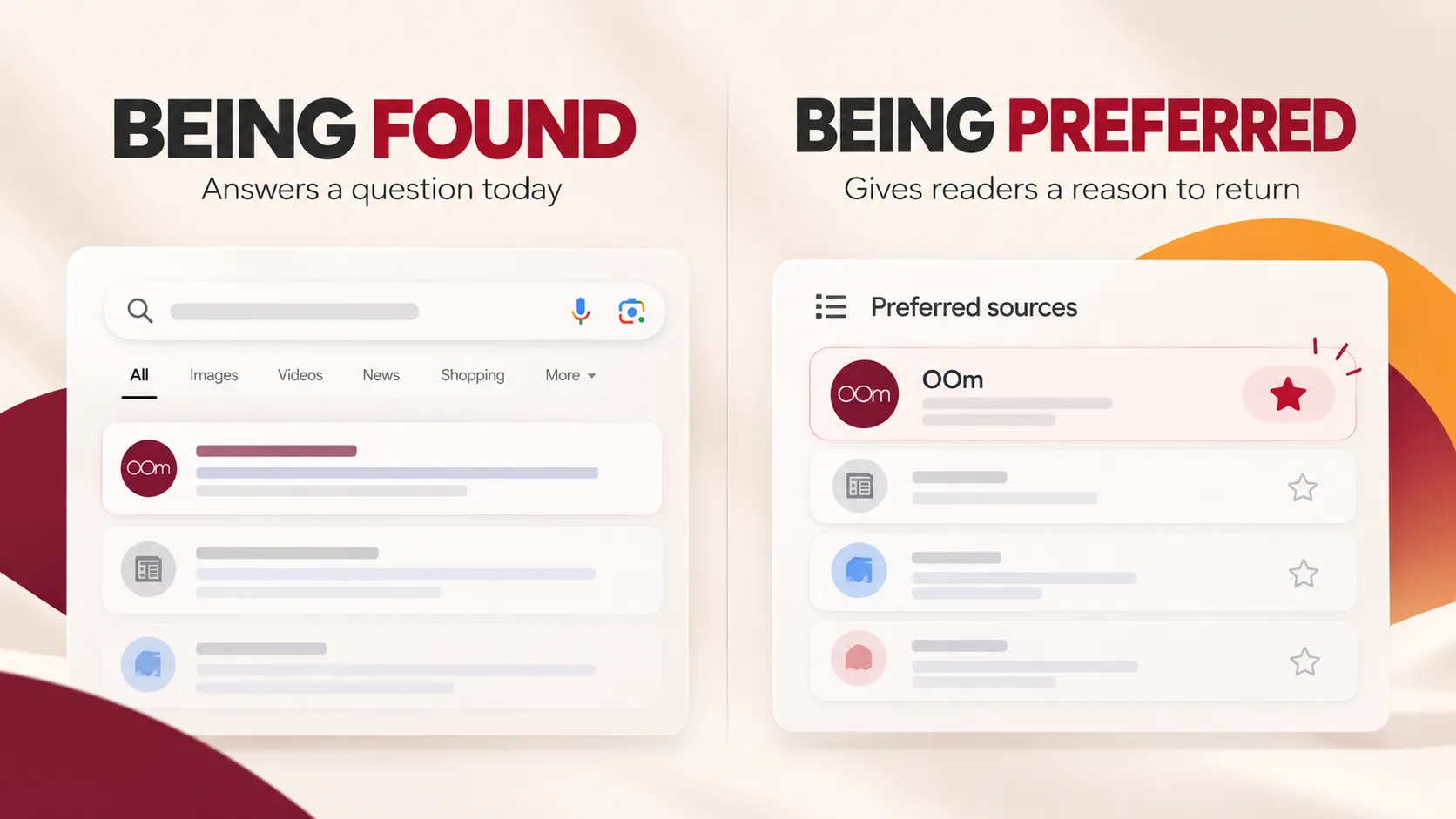
Search discovery answers an immediate need. Reader preference requires a reason to return.
A page can perform well in search because it answers a specific question at the right moment.
That is valuable. But it does not necessarily mean the reader has developed an ongoing interest in the publication behind the answer.
Consider two websites covering Google’s latest search developments.
The first reports what Google announced, summarises the feature and explains how it works.
The second provides the same factual information but goes further. It examines what the development changes for marketers, which assumptions may need reconsidering and where businesses should be cautious.
Both approaches can satisfy immediate search intent.
However, the second offers readers an additional reason to return: it consistently helps them interpret developments and make decisions.
That does not guarantee Preferred Sources selections. It demonstrates the editorial challenge the feature brings into focus.
For publishers, search discovery often begins with a question the reader already has. Earning an ongoing preference depends on whether the publication provides value beyond that individual answer.
For OOm, this reinforces the importance of publishing content that interprets developments rather than simply repeating announcements.
The Preferred Sources button can support that relationship, but it cannot substitute for it.
Does Google Preferred Sources Improve SEO Rankings?
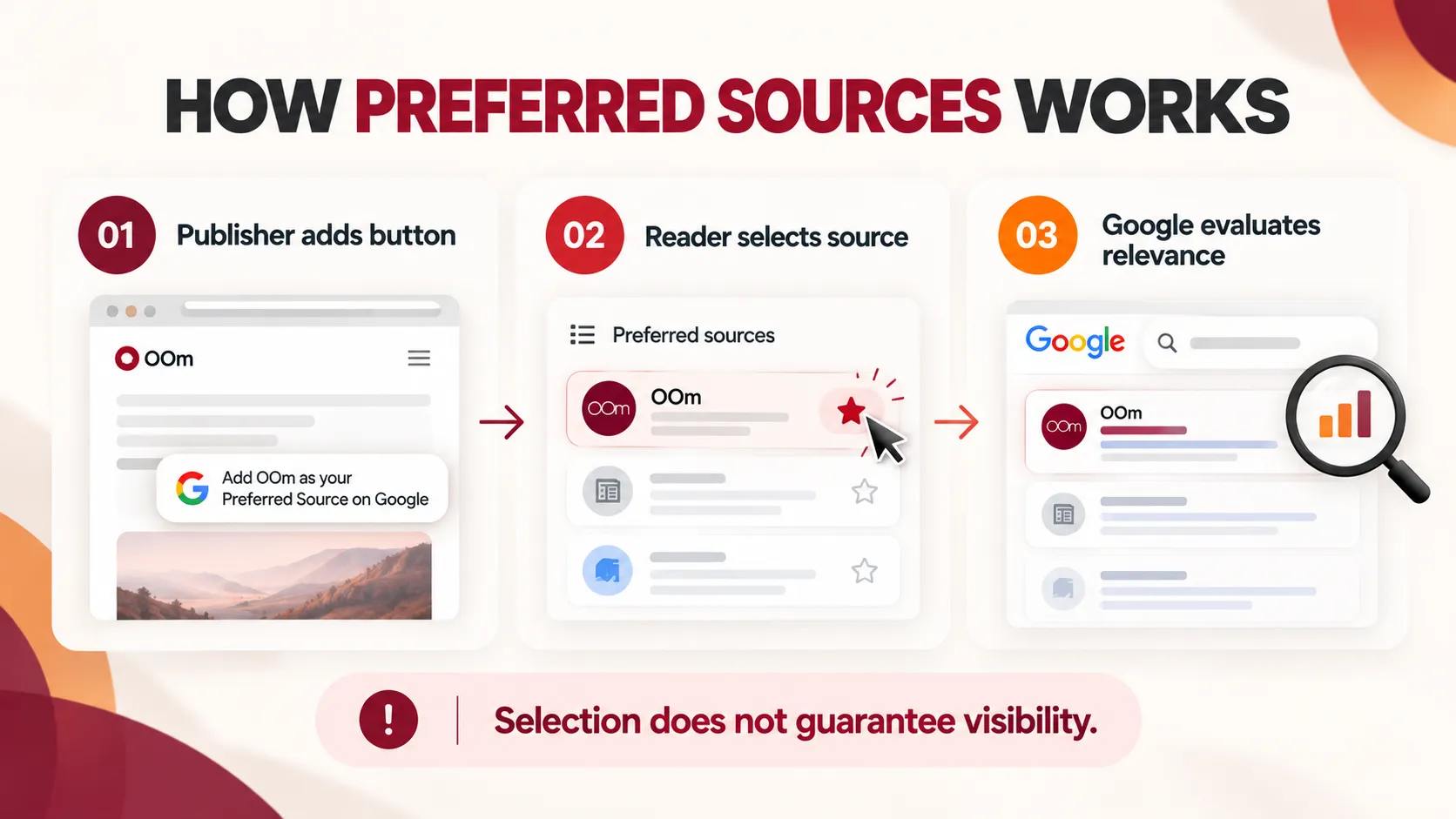
Preferred Sources involves three distinct stages. Adding the button does not guarantee that a publication will appear in search results.
Preferred Sources can influence what selected users see in supported search experiences, but it should not be confused with a general organic ranking boost.
As explained in Google’s official Preferred Sources guidance, content from selected websites is more likely to appear in relevant Top Stories results for users who have chosen those sources.
In its May 2026 announcement about original content and Search, Google reported that people were twice as likely to click through to a Preferred Source. This is a Google-reported observation about user behaviour, not a prediction that individual publishers will double their traffic.
The distinction becomes clearer when the process is separated into three stages.
| Stage | What happens | Who controls it |
|---|---|---|
| Button implementation | The website provides a way to select it as a Preferred Source | Publisher |
| Reader selection | A user chooses the publication as a preferred source | Reader |
| Search visibility | Relevant content may appear more frequently in supported experiences | Google’s systems |
Each stage is distinct. Completing one does not guarantee the next.
A website may successfully implement the button without gaining many selections. A reader may select a publication without seeing it for every search. Additional visibility may not translate into greater traffic or business results.
For SEO teams, Preferred Sources is best understood as a potential additional visibility opportunity rather than a replacement for technical SEO, content relevance or other established optimisation practices.
The feature changes how selected publications may be surfaced to individual users. It should not be presented as a universal ranking factor.
What Does Google Preferred Sources Mean for GEO and AI Search?
Preferred Sources is also relevant to discussions about Generative Engine Optimisation (GEO), particularly as Google develops more personalised AI-powered search experiences.
Google has discussed its support for original content and preferred publications in its official Search announcement.
However, there is an important difference between being identified as a preferred source and being cited in an AI-generated answer.
A preferred label reflects a user’s selection. An AI citation reflects information referenced within a generated response.
Google has not established that adding the Preferred Sources button automatically increases a website’s likelihood of being cited by AI systems.
For marketers, this distinction matters because SEO and GEO address related but different visibility challenges.
As explored in OOm’s comparison of SEO and GEO, businesses increasingly need to understand both traditional search discovery and how information may be surfaced in AI-powered experiences.
A publication may be discovered through a traditional organic result, appear in Top Stories or be highlighted as a preferred source within a supported AI search experience.
These interactions may offer different opportunities for discovery and recognition, but they should not be assumed to produce identical outcomes.
Preferred Sources is therefore relevant to GEO without being a guaranteed AI citation tactic.
The practical priority remains producing useful, relevant content while understanding the different ways readers may encounter and recognise it.
Should Every Business Add a Google Preferred Sources Button?
Not every business will have the same reason to prioritise Preferred Sources.
The feature is particularly relevant to websites that regularly publish timely information for audiences interested in following a subject.
News publishers, specialist industry publications and editorial websites may have a clearer reason to invite readers to select them.
For businesses that publish occasional articles primarily to answer customer questions, the opportunity may be less immediate.
Consider a Singapore homeowner searching for information about an air-conditioning problem.
They may read an article from a service provider to understand the issue and evaluate whether they need professional assistance. The article can be valuable without creating a reason for the homeowner to follow that provider’s future content through Google.
Now consider a Singapore-based industry publication covering business regulations, market developments and emerging technologies.
A reader who regularly depends on that coverage may have a stronger reason to select the publication as a Preferred Source.
The difference is not simply how often the website publishes. It is whether the audience has an ongoing reason to seek out its content.
Check Whether Your Website Is Eligible
Google’s Preferred Sources documentation explains the eligibility and implementation considerations for publishers.
Eligible domains and subdomains can appear in Google’s source preferences tool, while individual subdirectories cannot be selected independently.
For example, example.com/blog cannot be selected separately from example.com simply because its editorial content is hosted in that folder.
Businesses should check whether their website appears in Google’s source preferences tool before encouraging readers to select it.
For marketers, eligibility is the first practical check. Audience relevance is the second.
If a website does not regularly publish information that readers would want to follow, improving existing content, search visibility or customer journeys may be a more immediate priority.
How Should Marketers Measure the Value of Preferred Sources?
A functioning Preferred Sources button confirms that the implementation is available. It does not establish whether the feature has delivered meaningful results.
Marketers should separate implementation, reader interest and search performance rather than reporting them as one outcome.
| Measurement | What it tells you | What it cannot confirm |
|---|---|---|
| Button clicks | Readers interacted with the CTA | That they completed their selection in Google |
| Returning visitors | Readers are revisiting the website | That Preferred Sources caused their return |
| Organic search performance | Search visibility and traffic trends | That Preferred Sources caused a change |
This distinction matters for attribution.
For example, OOm could implement event tracking to measure how often visitors click the Preferred Sources button.
However, a button click should not automatically be counted as a confirmed selection. The reader may still need to complete the process within Google’s interface.
Similarly, an increase in organic traffic after implementation would not prove that Preferred Sources caused the improvement.
Content performance, ranking changes, search demand and other Google Search developments may also influence traffic.
Google Search Console and analytics platforms can provide useful supporting information, but marketers should not assume they offer a dedicated report of completed Preferred Sources selections.
The most defensible approach is to report what can actually be observed, acknowledge measurement limitations and avoid attributing results without evidence.
For OOm, the immediate objective is to make the option available to readers who value our content. Any future assessment of its search impact should be supported by appropriate data.
The Bigger Opportunity Is to Give Readers a Reason to Choose You
Google Preferred Sources gives publishers another way to connect with audiences who value their content.
Its expansion and growing relevance to AI-powered search make it worth understanding, particularly for publications that regularly cover topics readers want to follow.
But it does not remove the underlying challenge of earning attention.
A website can be technically optimised, rank for relevant searches and attract visitors without becoming a publication that readers actively choose.
Preferred Sources makes that distinction more relevant to search strategy.
For OOm, implementing the button allows readers to express their interest in our content through Google’s supported search experiences.
The longer-term priority is to continue publishing insights that make that choice worthwhile.
Being found creates the opportunity to reach a reader. Being worth following gives that reader a reason to choose your publication again.
Want More SEO, GEO and Digital Marketing Insights from OOm?
At OOm, we go beyond reporting search and digital marketing developments. We explore what they mean for businesses, marketers and the decisions they need to make.
If you find our insights useful, explore more of OOm’s SEO, GEO and digital marketing insights and add OOm as your Preferred Source on Google to make it easier to discover more of our content in supported search experiences.