From producing conversational answers and synthesising content to delivering instant, context-rich insights, generative AI is reshaping how people search, engage, and consume information online.
For marketers, this shift brings new challenges and new priorities. To remain visible and relevant, it’s no longer enough to rely on traditional search engine optimisation (SEO) alone. Instead, this is where new strategies, like generative engine optimisation (GEO), is gaining traction, helping brands stay discoverable in this AI-first era.
Join us as we explore how GEO compares with SEO as we know it—and what you need to know to stay ahead in 2025.
2. What Is Traditional SEO?
At its core, search engine optimisation (SEO) is the practice of optimising your website to rank higher in search engine results pages (SERPs), such as Google or Bing. It primarily focuses on:
- Keyword research and placement.
- On-page optimisation (e.g. meta tags, headers, structured content).
- Technical SEO (e.g. site speed, mobile responsiveness).
- Backlink building and domain authority.
The goal is simple: increase organic traffic by appearing at the top of relevant search queries.
Achieving success with traditional SEO requires marketers to:
- Focus on high-quality, user-focused content.
- Craft technically sound websites.
- Build authority through trusted backlinks.
- Monitor and adapt to search engine algorithm updates for maintaining strong, long-term visibility.
3. What Is Generative Engine Optimisation (GEO)?
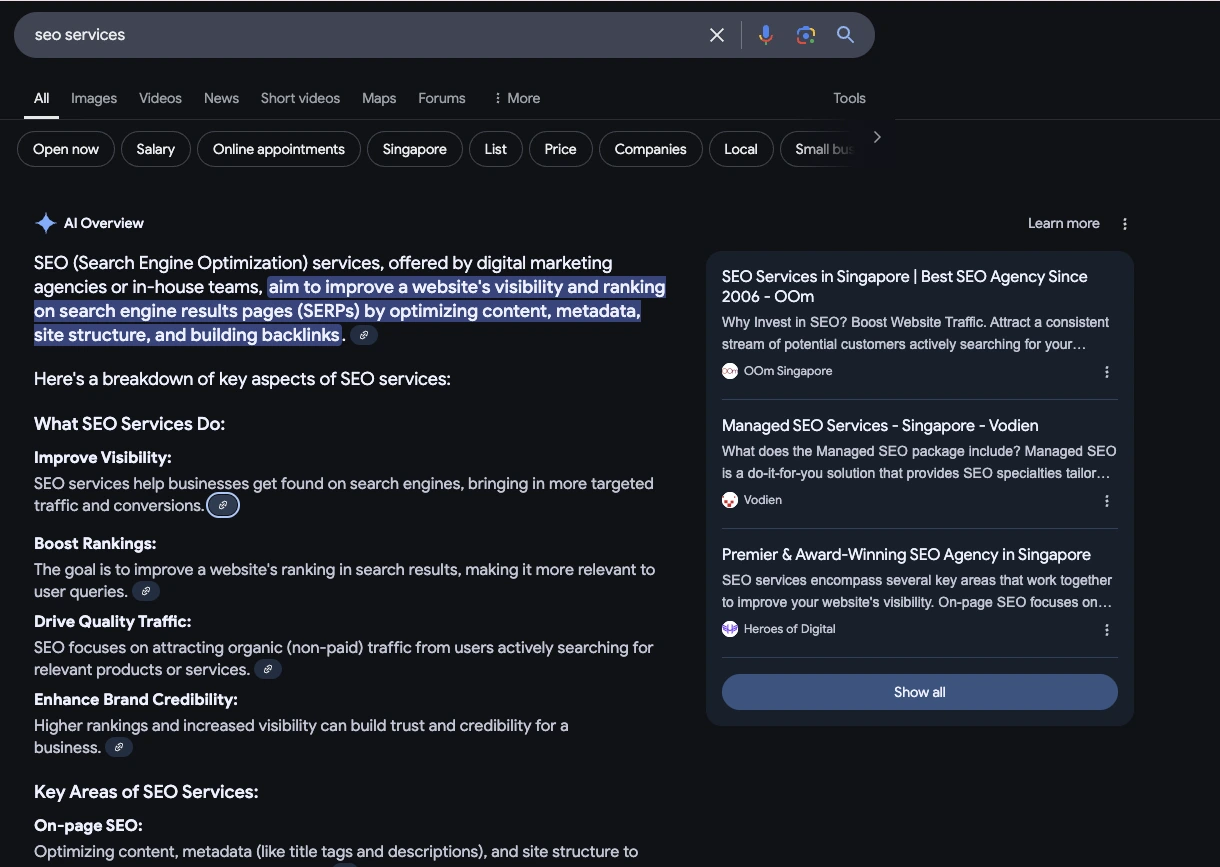
GEO is an evolution of traditional SEO. While classic SEO aims to secure a spot in the top search results on Google, GEO focuses primarily on AI search engine optimisation. This involves making sure that your content is:
- Cited or referenced in AI-generated search results like Google AI Overview or ChatGPT answers.
- Easily understood and summarised by AI systems.
- Structurally sound and semantically rich to improve retrieval by Large Language Models (LLMs).
For example, if someone searches for “best SEO agency in Singapore”, a system like Google’s AI Overview might not show the traditional list of blue links. Instead, it will generate a summary—and GEO is what will help your brand get cited in that summary.
To succeed with generative engine optimisation, it’s important to:
- Write clearly and concisely, directly addressing user questions.
- Demonstrate expertise and trustworthiness through reputable citations and original insights.
- Incorporate semantic keywords naturally and use structured data, like headings, bullet points, and schema markup, to make content easier for AI to interpret
4. Key Differences Between SEO and GEO
| SEO | GEO | |
| Purpose | Rank in search engine results pages (SERPs) | Be cited and summarised in AI-generated answers |
| Application | Applied to web content for search engine crawlers and human readers | Applied to content for better parsing, summarisation, and citation by LLMs |
| Audience | Users who browse and click through search listings | Users who consume AI-generated content on AI Overview or within tools like ChatGPT |
| Tools & Techniques | Meta tags, sitemap, H1–H6 structure, link building | Clear and structured content, scheme markup, reputable citations |
While SEO and GEO serve different purposes, they are not mutually exclusive. Traditional SEO builds the foundation for visibility in search engines, while GEO ensures your content remains discoverable in AI-driven interfaces. Together, they help your brand attract clicks from classic SERPs and citations from AI-generated summaries.
5. What About AEO and GIO?
In addition to generative engine optimisation (GEO), you may also have come across two related concepts: Answer engine optimisation (AEO) and generative AI optimisation.
What Is Answer Engine Optimisation (AEO)?
AEO focuses on structuring your content to deliver clear, concise answers to specific user questions, particularly in formats like:
- Featured snippets on Google.
- “People Also Ask” sections.
- Voice assistant responses (e.g. Siri, Google Assistant).
Unlike traditional SEO, which aims to drive traffic via rankings, AEO prioritises answering intent directly within the search environment. This ensures that users get what they need, even without clicking through.
What Is Generative AI Optimisation?
On the other hand, generative AI optimisation involves improving the quality, accuracy, and brand relevance of content generated by AI systems such as ChatGPT, Claude, and Gemini. These systems are now commonly used by marketers to produce social media posts, ad copy, blog content, product descriptions, and more.
Key techniques include:
- Prompt Engineering: Crafting precise instructions to guide AI tools toward desired outputs.
- Fine-Tuning: Training an existing model on brand-specific data for alignment in tone and messaging.
- Hyperparameter Tuning & Loss Function Adjustment: Refining technical processes to improve learning outcomes.
- Data Augmentation & Regularisation: Strengthening training data to generate more generalisable and reliable content.
For example, a content team in Singapore might use prompt engineering to tailor AI-generated social media captions to fit the brand’s voice. They might also fine-tune a generative AI model to create blog posts that reflect the company’s unique positioning.
6. Conclusion: Why These Concepts Matter for Digital Marketing in 2025
Search behaviour is evolving rapidly. Today, AI search engines are no longer confined to the classic “ten blue links”. Instead, they now synthesise answers from multiple trusted sources, providing users with direct responses that bypass the need for clicks.
For marketers, this means visibility is no longer confined to SERPs. To stay competitive, brands must optimise not just for ranking (via SEO), but also for AI interpretation (via GEO), direct answers (via AEO), and content generation quality (via generative AI optimisation). These strategies ensure your brand is discoverable, authoritative, and aligned with how users actually engage with digital content today.
Adapting to this new reality is key to staying ahead in a landscape that’s increasingly automated, more intelligent, and heavily reliant on how machines interpret and generate information.
Need help navigating this shift? At OOm, we offer comprehensive generative engine optimisation and SEO services to help brands in Singapore stay visible across both traditional search engines and AI-driven platforms. With tools like our proprietary SEOCloud Platform, we provide the insights and control needed to track visibility, manage campaigns, and stay ahead in today’s AI-driven digital ecosystem.
About OOm
OOm has been a leading digital marketing agency in Singapore since 2006, with expertise in Search Engine Optimisation (SEO), Search Engine Marketing (SEM), social media marketing to website design and development. Our clientele comprises small and medium businesses (SMEs) to enterprises.
OOm has won over 30+ marketing awards for the results we have delivered to clients over the years, including ‘Agency of the Year’, ‘Lead Generation Agency of the Year’, ‘Independent Agency of the Year’, ‘E-Commerce Marketing Agency of the Year’, ‘Excellence in Search Marketing, ‘Excellence in Performance Marketing’ to ‘Excellence in Data-driven Marketing’ among others. OOm is also a Google Premier Partner (reserved for the top 3% agency partners in Singapore), as well as an official Meta Business Partner.
Ready to boost your brand’s online presence and revenue? Book a free digital marketing strategy consultation with us today. Our experts will dissect your business, uncover hidden growth opportunities, and share tailored marketing recommendations to propel your business.