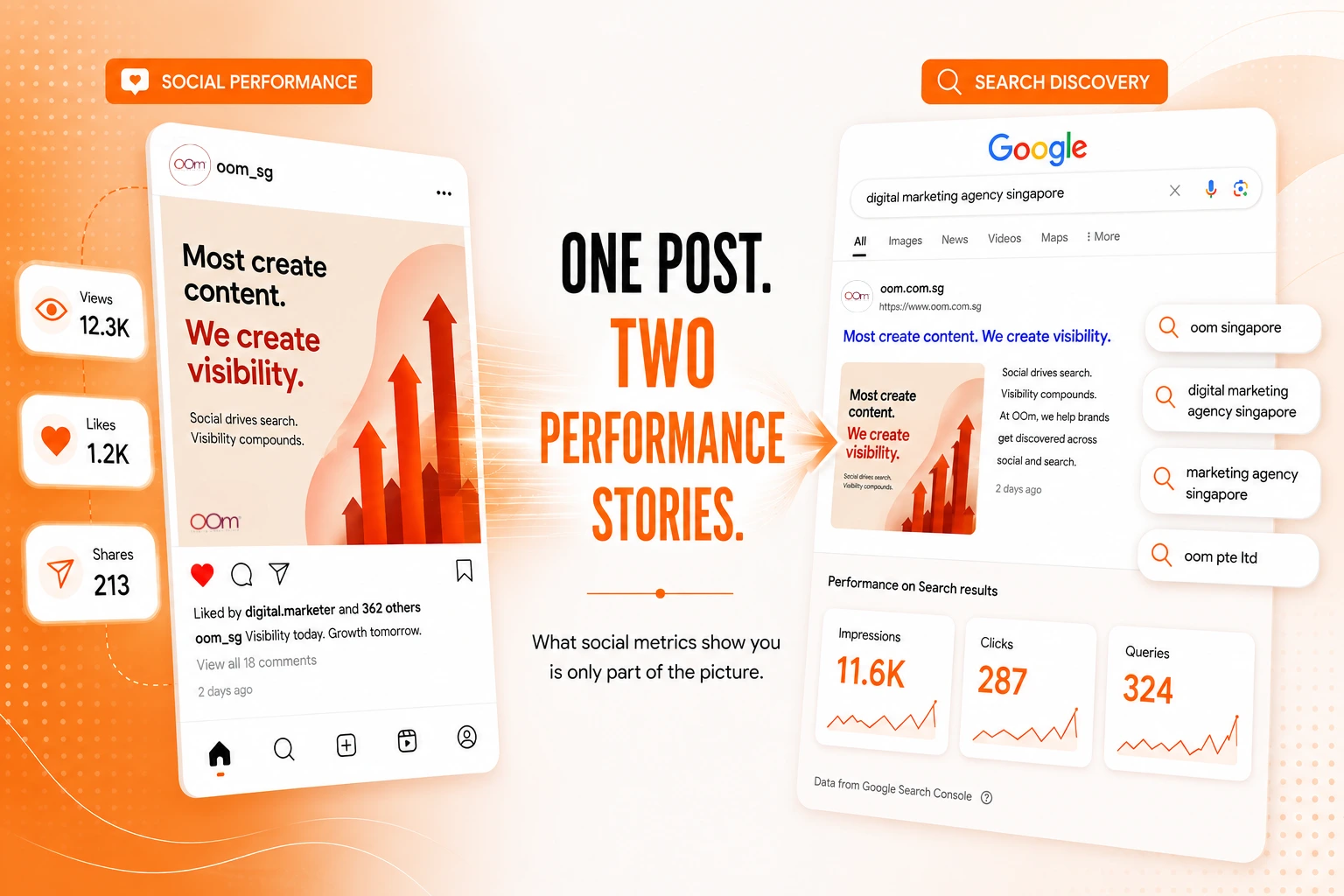
A buyer asks an AI search tool which payroll platform suits a growing Singapore business, which clinic offers a particular treatment near an MRT station, or how to compare cybersecurity providers for a regional rollout. The response may mention several brands, summarize their claims, and send the buyer to only one or two pages. A geo content framework should therefore be built for inclusion in that decision process, not merely for publishing more articles.
That distinction matters. Conventional content planning often begins with a keyword, assigns a search volume, and produces a page intended to rank. That model remains useful, but it is incomplete when discovery happens across traditional search results, AI-generated answers, maps, social platforms, review environments, and direct referrals. The commercial question is no longer simply, “Can we rank for this term?” It is, “Can a machine and a buyer quickly establish what we are credible for, who we are right for, and what should happen next?”
The real gap in most GEO content frameworks
Many GEO plans concentrate on phrasing: answer questions clearly, use structured headings, add entities, and make facts easy to extract. These are sensible production habits. They do not solve the harder problem: a business can be easy to summarize yet still be difficult to choose.
AI search experiences commonly compress a complex buying process into a short answer. If a brand’s content offers generic descriptions but no decision criteria, evidence, constraints, or next-step clarity, it may be cited as background and bypassed when the user is ready to act. Visibility without decision value is a weak commercial outcome.
A stronger framework connects three layers that are too often planned separately: what the market needs to understand, what evidence supports the brand’s position, and where a prospect can move from research to action. This is especially relevant for considered purchases, where a generic explainer may draw awareness but does little to reduce procurement, implementation, compatibility, or risk concerns.
OOm’s Evidence-Decision-Action framework
At OOm, a useful way to structure GEO content is through an Evidence-Decision-Action framework. It is deliberately simple because the purpose is not to create a new label for ordinary content work. It is to prevent a familiar failure: treating AI visibility as a publishing task rather than a customer acquisition system.
Evidence: establish claims that can withstand compression
AI systems and human buyers both need dependable source material. Content should state what a business does, where it operates, what it supports, and what constraints apply in language that is specific enough to verify. Broad claims such as “tailored solutions” or “industry-leading expertise” provide little usable substance.
Evidence can include documented capabilities, product specifications, process explanations, named service areas, authoritative first-party research, current policies, and clearly attributed customer proof where permission exists. The key is precision. A page about enterprise web development, for example, is more useful when it explains the systems involved, governance requirements, migration risks, and ownership model than when it repeats that the team builds high-performing websites.
This is also where governance matters. Content teams should identify the source owner for material claims and review dates for time-sensitive information. A GEO strategy built on outdated service descriptions or unmaintained location pages creates a credibility problem, whether the reader encounters it in search results or an AI response.
Decision: answer the question behind the query
Search queries do not always reveal the decision a buyer is trying to make. “Best CRM for small business” may signal a need to compare setup effort, reporting, data migration, local support, or integration with existing systems. Content that repeats the query but avoids these trade-offs is unlikely to be memorable or useful.
Decision content makes the selection logic visible. It explains when one approach is appropriate, when it is not, and what information the buyer needs before proceeding. This is not the same as producing comparison pages for every category. It means adding judgment where it reduces uncertainty.
For marketing services, that may mean explaining why a business with poor conversion tracking should not interpret paid media performance from platform-reported conversions alone. For a B2B technology provider, it may mean showing how security review, data residency, and implementation ownership affect the choice. The best answer is sometimes conditional. That is a strength, not a weakness.
Action: preserve the route from answer to outcome
A cited page is not automatically a conversion page. Every major content asset should have a clear role in the buyer journey and a proportionate next step. An early-stage guide may lead to a diagnostic resource or related decision page. A service-specific page may invite an assessment, consultation, or technical discussion. The appropriate action depends on purchase complexity.
The practical test is straightforward: if an AI answer quotes the most useful paragraph from the page, does the page still give the reader a logical reason and route to continue? If not, the brand may be contributing knowledge while leaving acquisition to another company.
Singapore changes the content design, not just the location tag
Singapore businesses should avoid assuming that a global GEO template becomes local by inserting “Singapore” into titles. The market creates several genuine content design considerations.
First, English is widely used in business and search, but Singapore has four official languages and a multilingual population. This does not mean every business needs full content coverage in every language. It does mean teams should validate the language customers use for high-value questions, especially in consumer categories and public-facing services. Translation without local terminology, cultural context, or service capability can add noise rather than reach.
Second, local intent can be highly granular despite Singapore’s compact geography. Buyers may frame needs around neighborhoods, MRT stations, estates, business districts, hospitals, schools, or shopping areas. Location pages only earn their place when they include genuinely local operational information, such as coverage, appointment expectations, access considerations, or the types of customers served. Near-duplicate pages for every district are unlikely to create trust or useful source material.
Third, many Singapore B2B firms sell into Southeast Asia while operating from a Singapore base. Their content must separate what is locally true from what applies across markets. A statement about implementation, support, delivery, or compliance should not imply regional coverage unless the business can substantiate it. Clear market scope is often more persuasive than broad regional language because it reduces uncertainty for procurement teams.
Measure contribution, not only citations
A common mistake is to treat mentions in AI-generated answers as the primary GEO metric. Mentions can be useful signals, but they are not sufficient evidence of business impact. Responses vary by user context, model, prompt wording, and product interface. A single screenshot is not a strategy report.
Instead, use a measurement model that follows the framework. Under Evidence, track whether priority pages are current, attributable, technically accessible, and supported by original information. Under Decision, examine engagement with comparison, implementation, and qualification content, including assisted paths where analytics consent and setup allow. Under Action, track qualified inquiries, lead quality, and the progression from content entry to meaningful commercial interaction.
Search Console data, web analytics, CRM information, sales feedback, and periodic prompt testing can each contribute a piece of the picture. None should be treated as a complete answer alone. The defensible expert view is that GEO should be managed as an extension of content quality and demand capture, not as a separate channel with a single visibility score.
Build fewer source pages with more commercial weight
The temptation is to respond to AI search by producing a large volume of question-and-answer content. That can create internal duplication, dilute editorial attention, and leave core commercial pages underdeveloped. In many cases, the better investment is a smaller set of maintained source pages that explain real customer decisions well.
Start with the decisions closest to revenue: choosing between approaches, evaluating fit, understanding implementation, resolving risk, and clarifying local or regional scope. Then identify the evidence each decision requires and the action that should follow. Supporting articles should deepen those pages, not compete with them.
A verified OOm client example should be added at this point before publication if an approved case study, source data, and permission to disclose the relevant context are available. Without that evidence, it would be inappropriate to invent a performance narrative or imply a client result.
The durable advantage will not come from trying to predict every AI response. It will come from making the business unusually easy to understand, evaluate, and engage at the moments when customers are forming a preference.